Book TOC · Previous · Chapter 3 of 7 · Next
Chapter 3: Innovating with Google Cloud AI: ML, Generative AI, Gemini & Agentic Solutions
Chapter Focus: AI/ML/Gen AI/Agentic AI hierarchy, Responsible AI, Pre-trained APIs (Document AI, Vision, Speech), BigQuery ML, Vertex AI / Gemini Enterprise Agent Platform, and TPUs.
Subsection 3.1: Describe fundamental AI and ML concepts and how they create business value
The Big Picture
When organizations first attempt to adopt Artificial Intelligence, they routinely stumble into three strategic pitfalls:
- Conflating BI, Classical ML, Generative AI, and Agentic AI (
3.1a,3.1b,3.1d): Many teams try to maintain tens of thousands of hard-codedif/elserules to detect fraud or classify support tickets—a brittle approach that breaks the moment customer behavior shifts. Conversely, others try to use a generative LLM for simple historical sales reporting where Business Intelligence (Looker) is required, or confuse a passive Generative AI chatbot (which only answers prompts) with an Agentic AI system (which reasons across multiple steps, calls external tools/APIs, and autonomously executes business workflows). - Starving Sophisticated Models with Low-Quality Data (3.1e): "Garbage In, Garbage Out" is an unforgiving law in machine learning. Training a model on incomplete, duplicate, stale, or inconsistent records guarantees skewed predictions in production—no matter how advanced the algorithm is.
- Deploying "Black-Box" Models Without Explainability or Responsible AI Guardrails (3.1f): In regulated sectors like banking, healthcare, and hiring, a model that rejects a loan application without being able to explain which feature drove the decision violates regulatory compliance and erodes human trust.
Consideration 3.1a: Recognize the definition of artificial intelligence (AI), machine learning (ML), generative AI (gen AI), data analytics, and business intelligence
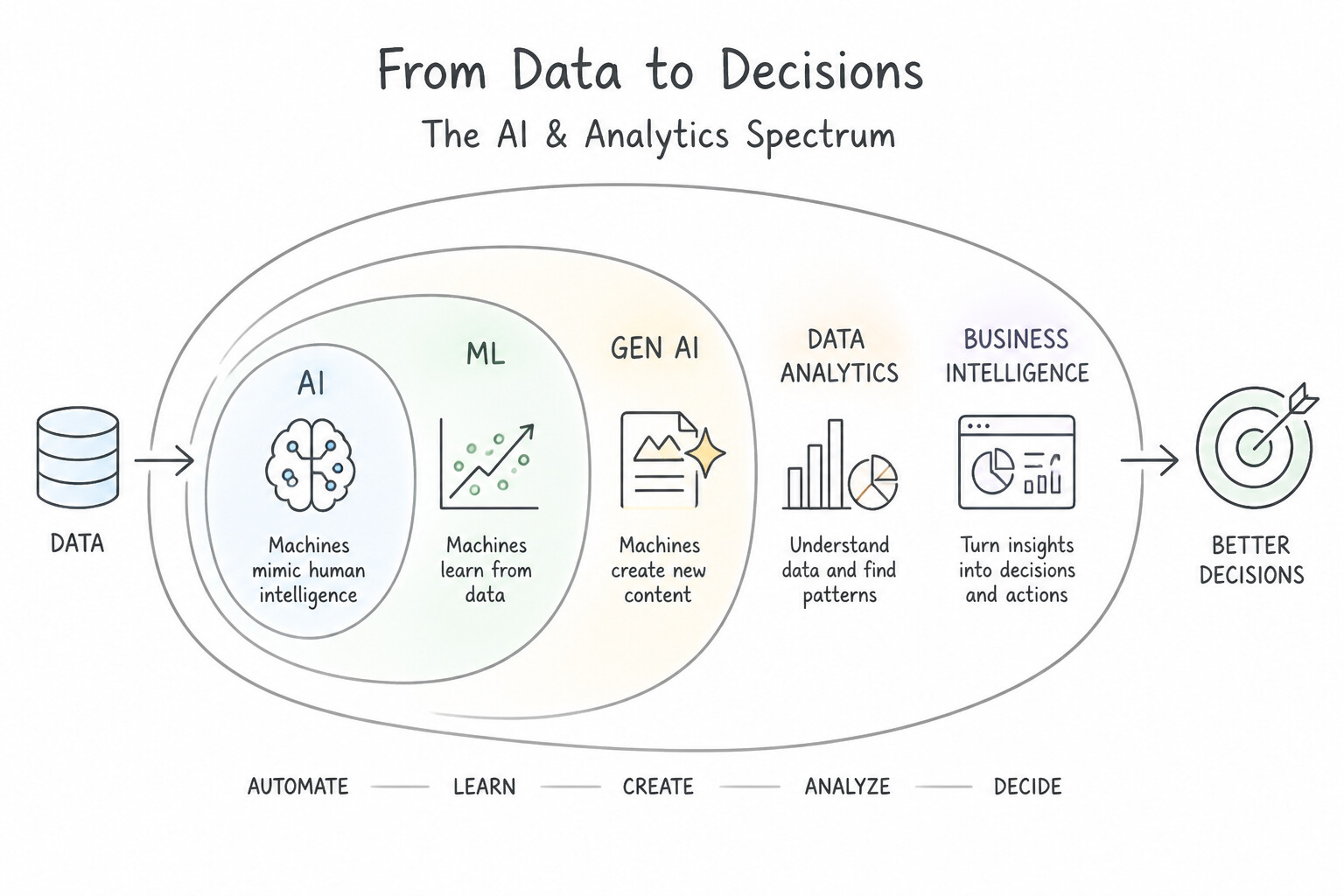
- Data Analytics & Business Intelligence (BI): Examines historical and live datasets to answer "What happened?" and "What is happening right now?" through aggregated metrics, reports, and visual dashboards (BigQuery + Looker).
- Artificial Intelligence (AI) vs. Machine Learning (ML): AI is the overarching umbrella of computer systems capable of performing tasks that typically require human intelligence. ML is a subset of AI where algorithms learn statistical patterns directly from training data to make predictions or classifications on new data—without a programmer writing explicit
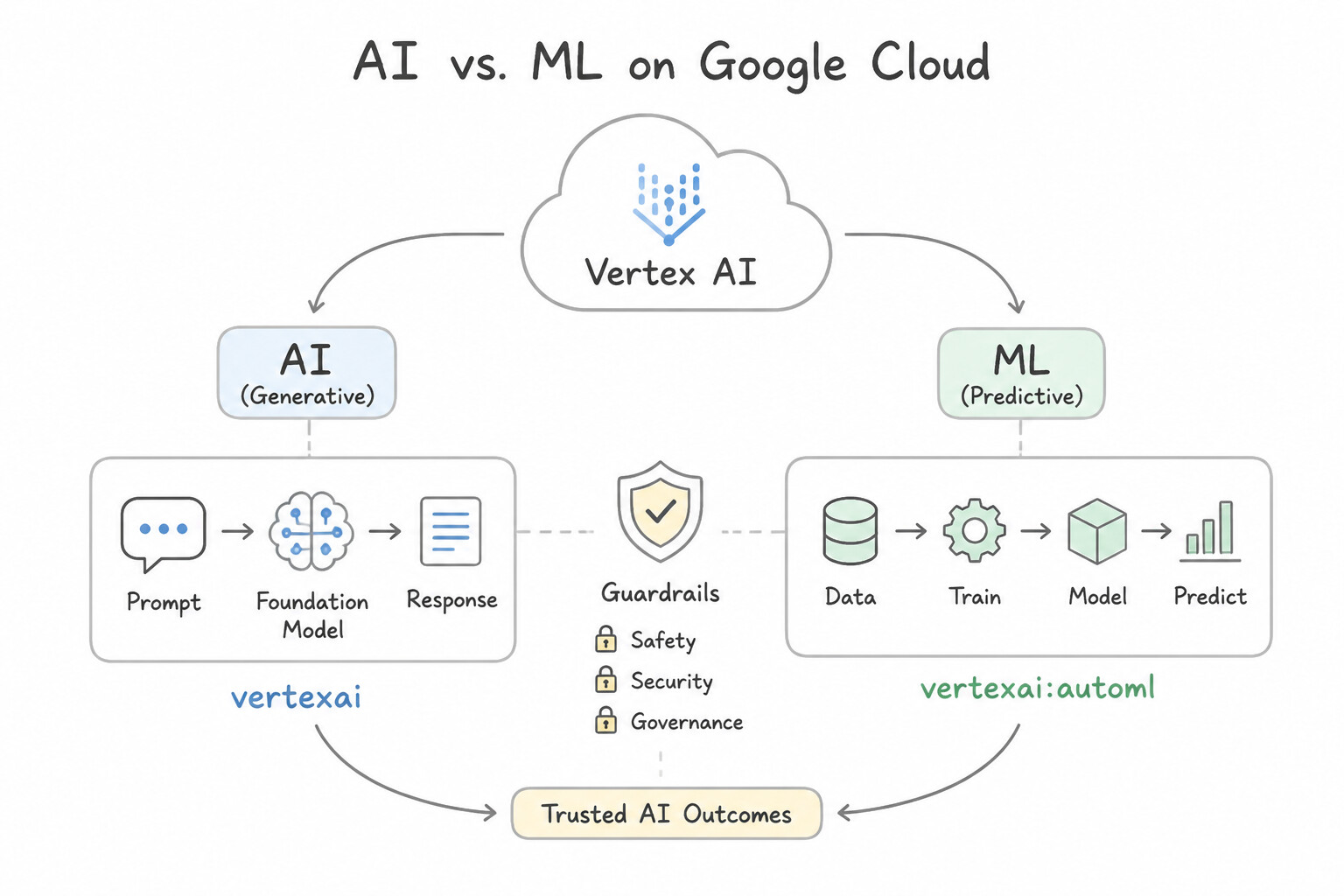
if/thenrules. - Generative AI (Gen AI): A specialized subset of deep learning (powered by large foundation models like Gemini) that learns the underlying structure of vast multimodal datasets to generate brand-new content—such as text summaries, software code, realistic images, audio, and video.
Key Implementation Patterns
- High-Performance AI Infrastructure: Use Select a regression model to predict the continuous numerical value. Regression is specifically designed to predict continuous numerical values like prices. (Avoid alternative: Classification predicts discrete categories, not continuous numbers.)
- Democratizing ML with Existing Data Infrastructure: Use Define the problem as binary classification. Binary classification is used when the model must predict one of two possible outcomes, such as Approved or Denied. (Avoid alternative: Clustering is unsupervised learning used to group data without predefined labels.)
- Automating Customer Support Operations: Use Multi-class classification model. Multi-class classification is designed to categorize data into one of more than two predefined labels. (Avoid alternative: Binary classification handles only two categories, but this scenario requires sorting into four categories.)
Key Takeaways (3.1a)
- Regression models predict continuous numerical values (e.g., prices, temperature).
- Classification models predict discrete categories or labels (e.g., Yes/No, Red/Blue/Green).
- Clustering is unsupervised and groups data without predicting labels.
- Identifying the data type of the target output (numerical vs. categorical) is the first step in choosing an ML model.
Consideration 3.1b: Recognize some of the ways agentic AI is fundamentally reshaping different industries and the way people work (e.g., workforce productivity, customer support, sales experiences, product innovation, operations, research)
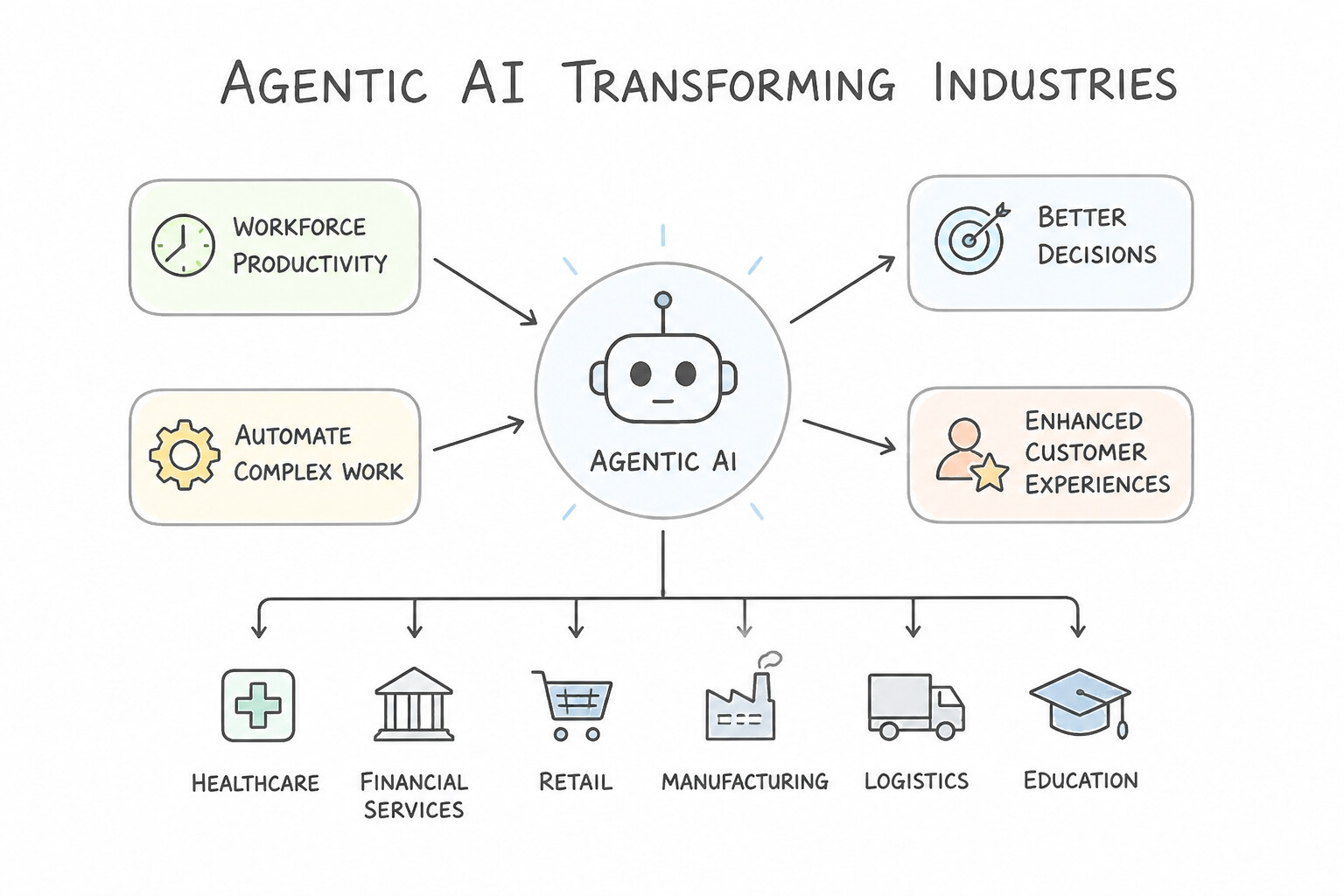
- From Passive Chatbots to Autonomous Goal-Oriented Agents: While traditional Gen AI responds to a single prompt with text, Agentic AI combines foundation model reasoning with planning, memory, grounding, and tool use (API execution) to complete complex, multi-step workflows autonomously.
- High-Impact Industry Transformations:
- Customer Support & Sales Experiences: Resolving end-to-end order returns, verifying warranty policy eligibility, and updating CRM records automatically rather than just deflecting FAQs.
- Workforce Productivity & Research: Synthesizing thousands of internal documents, emails, and spreadsheets to draft project proposals or accelerate R&D literature discovery.
- Operations & Product Innovation: Autonomously triaging IT/SecOps alerts, optimizing supply chain re-orders, and accelerating software prototyping.
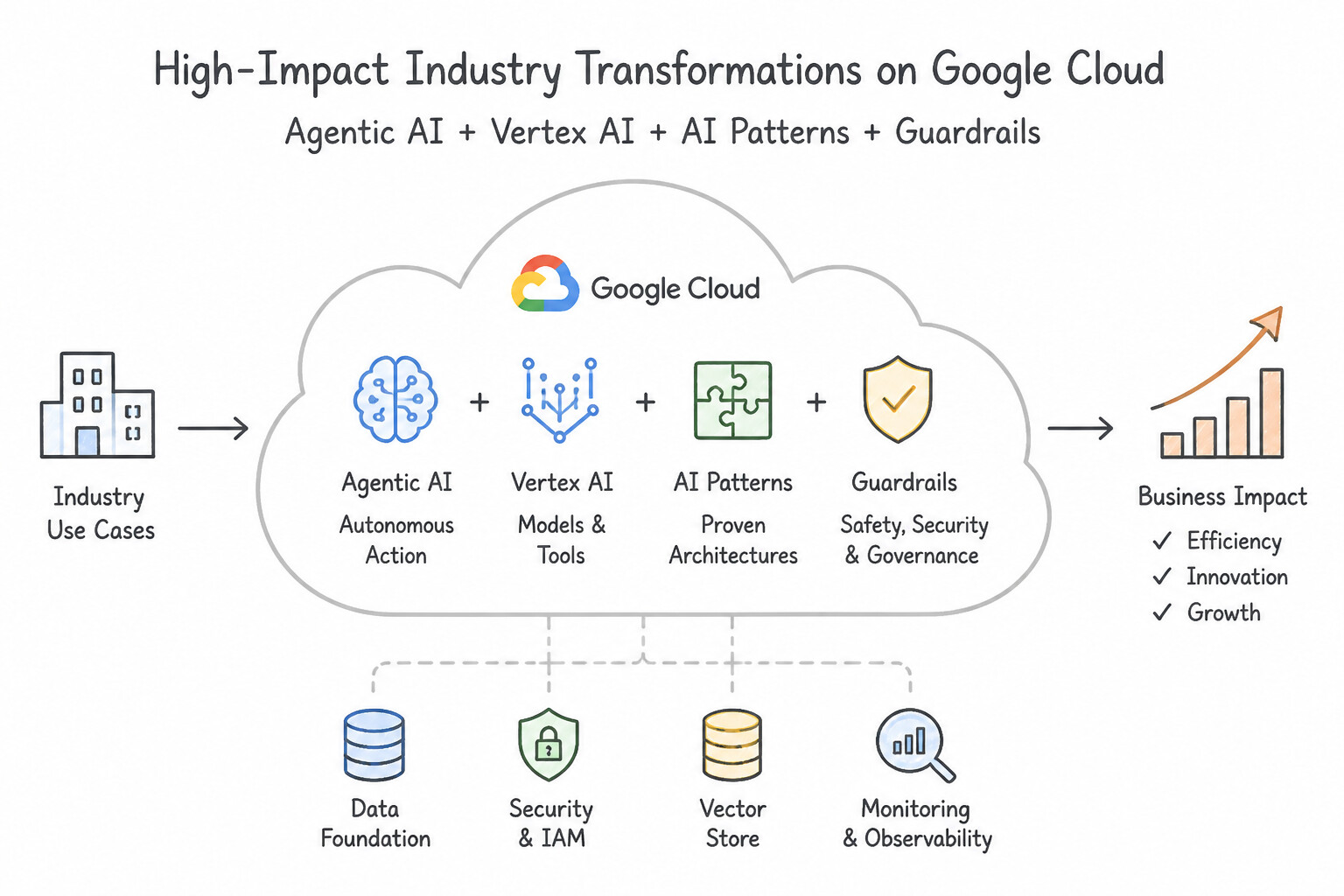
Key Implementation Patterns
- Agentic AI Reshaping Customer Support Workflows: Use It can reason about the customer's request, plan a series of tasks, and execute those tasks using backend business systems. Agentic AI can independently reason, plan, and execute tasks across different business systems.
- Agentic AI Driving Developer Workforce Productivity: Use An agentic AI system, because it acts autonomously to complete complex, multi-step task loops to achieve a specific goal. Agentic AI can autonomously execute complex, multi-step workflows without requiring continuous human prompting.
- Agentic AI Hyper-Personalizing Sales Experiences: Use The system shifts the sales team's focus away from manual research and content creation toward strategic relationship building. Agentic AI automates research, allowing humans to focus on high-value strategic tasks. (Avoid alternative: Agentic AI augments human workers rather than completely replacing them.)
Key Takeaways (3.1b)
- Legacy chatbots rely on fixed rules, keywords, and predefined answers.
- Generative AI creates new content and conversational responses but typically does not take independent action across systems.
- Agentic AI (AI Agents) can reason, plan, and interact with external tools and APIs to autonomously complete complex workflows.
- Generative AI creates content based on prompts, while Agentic AI takes autonomous actions to achieve broader goals.
Consideration 3.1c: Recognize the key benefits of Google Cloud's AI offerings (e.g., best infrastructure for AI, AI-ready data cloud, sophisticated 1P models, all-in-one AI developer platform, pre-built AI agents and applications)
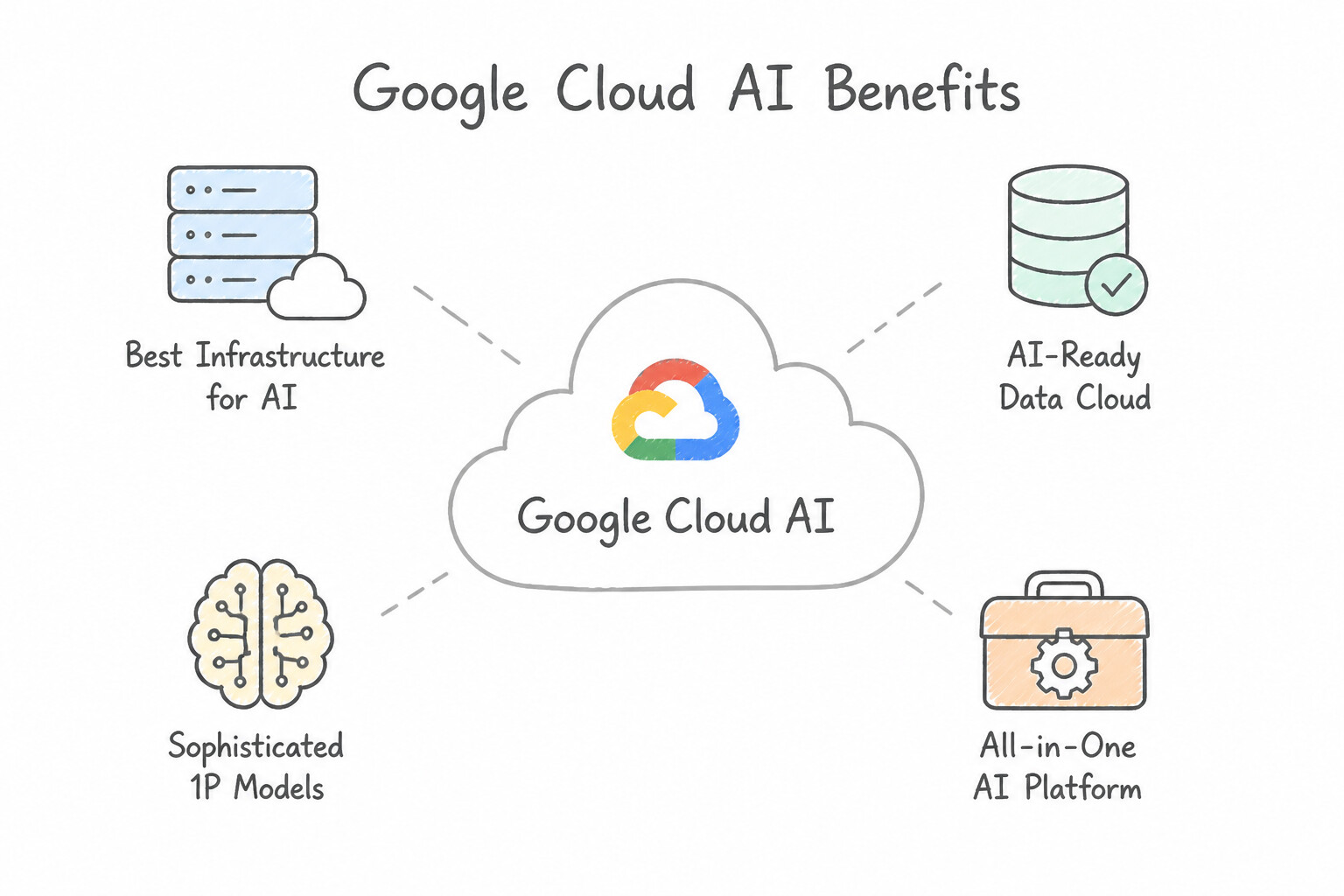
- Five Integrated Pillars of Google Cloud AI:
- Purpose-Built AI Infrastructure (AI Hypercomputer): Custom Cloud TPUs, NVIDIA GPUs, high-speed networking, and flexible consumption models.
- AI-Ready Data Cloud: Native integration between BigQuery, Cloud Storage, and Vertex AI so models train and ground directly on governed enterprise data without complex data movement.
- Sophisticated First-Party (1P) Foundation Models + Open Ecosystem: Google's multimodal Gemini, Imagen, Veo, and Chirrups/Chirp models alongside 150+ third-party and open-source models (Claude, Llama, Mistral) in Model Garden.
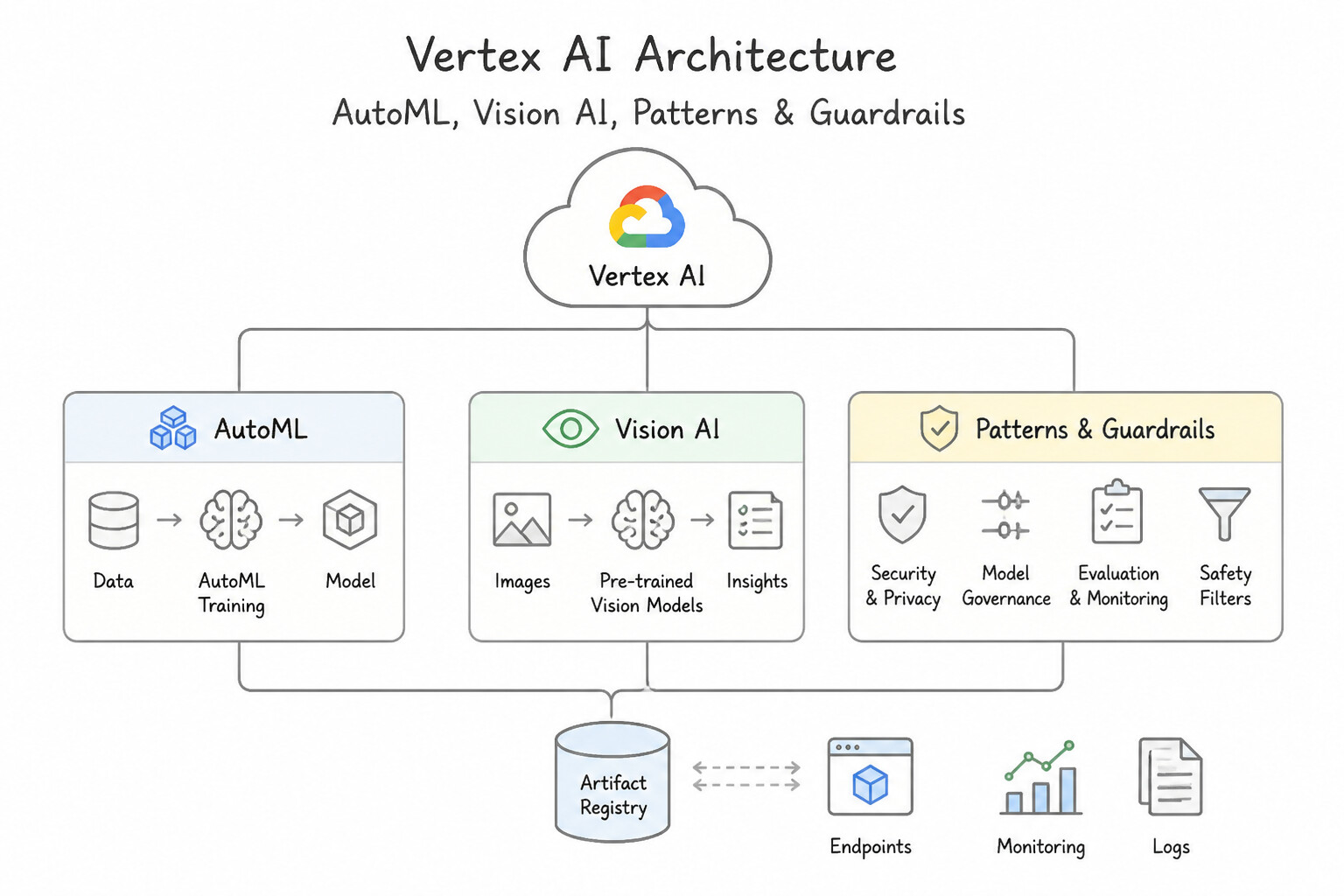
- All-in-One AI Developer Platform (Vertex AI / Agent Platform): End-to-end MLOps, tuning, grounding, evaluation, and agent orchestration.
- Pre-Built AI Agents & Applications: Turnkey productivity and customer engagement solutions (Gemini for Google Workspace, Gemini in Google Cloud, Customer Engagement Suite, Gemini Enterprise).
Key Implementation Patterns
- Custom Model with Low Code: Use Use Vertex AI AutoML to train a model with the product images. Vertex AI AutoML allows training custom models with user data without requiring coding expertise. (Avoid alternative: The pre-trained Cloud Vision API detects generic objects, not specific proprietary products.)
- Unified MLOps Platform: Use Vertex AI. Vertex AI is the unified platform for the entire machine learning lifecycle, integrating data prep, training, and deployment. (Avoid alternative: BigQuery ML allows ML models using SQL but is not a unified environment for the entire ML lifecycle.)
- Explainability and Trust: Use Vertex Explainable AI. Vertex Explainable AI provides feature attribution to explain how much each input contributed to a model's prediction. (Avoid alternative: Vertex AI Feature Store manages and shares features for training and serving, but does not explain model predictions.)
Key Takeaways (3.1c)
- Use Pre-trained APIs for generic, common tasks (e.g., OCR, face detection, generic labeling).
- Use Vertex AI AutoML when you need a custom model for your specific data but lack data science or coding expertise.
- Use Custom Training only when you need full control over the model architecture and have the engineering resources to support it.
- Vertex AI is the unified platform for building, deploying, and scaling ML models.
Consideration 3.1d: Identify the business problems that ML can solve, and describe key use cases and the business value that ML provides (e.g., replacing or simplifying rule-based systems, deriving business insights from large datasets [structured and unstructured], scaling business decisions)
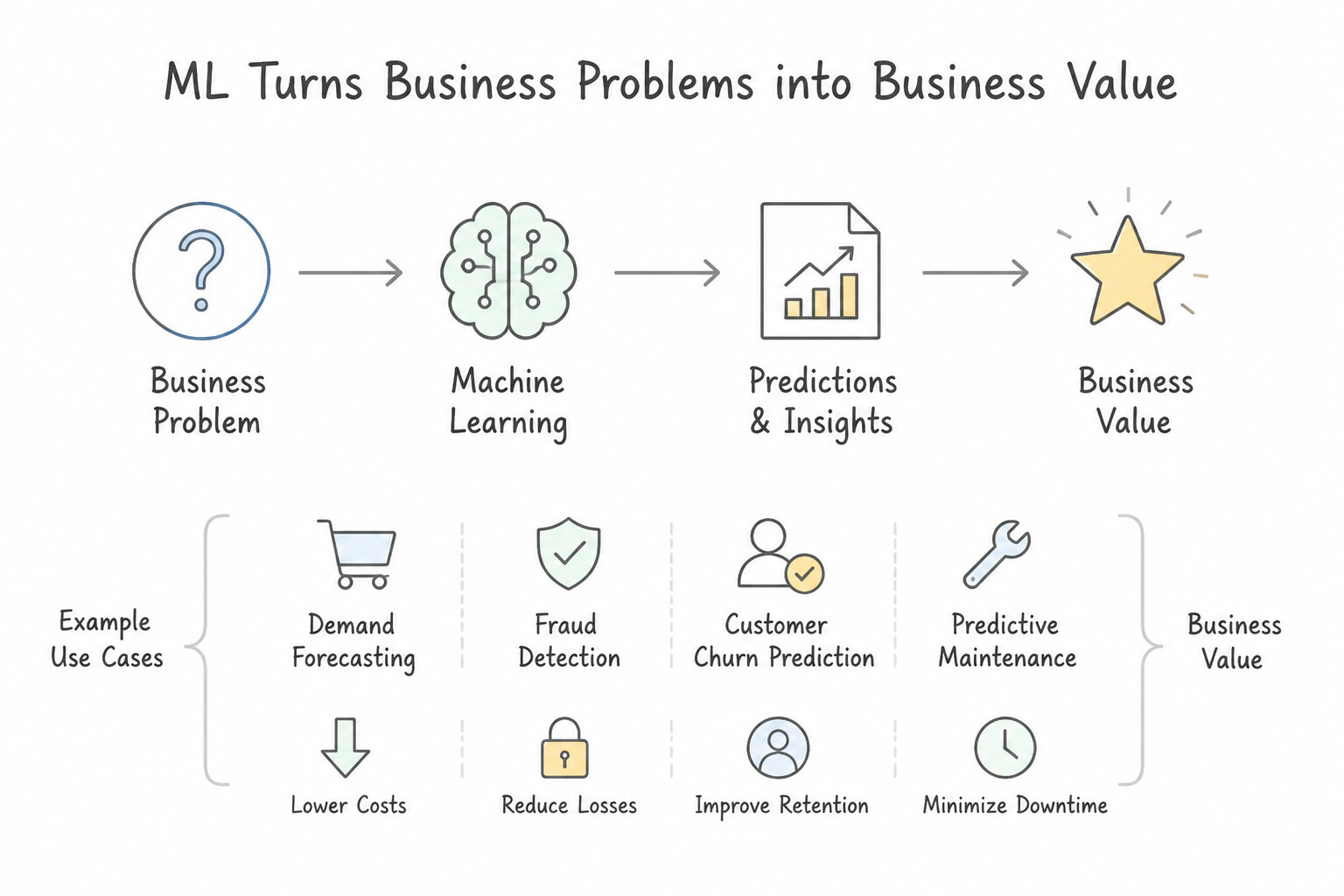
- Replacing Fragile Rule-Based Systems: Manual
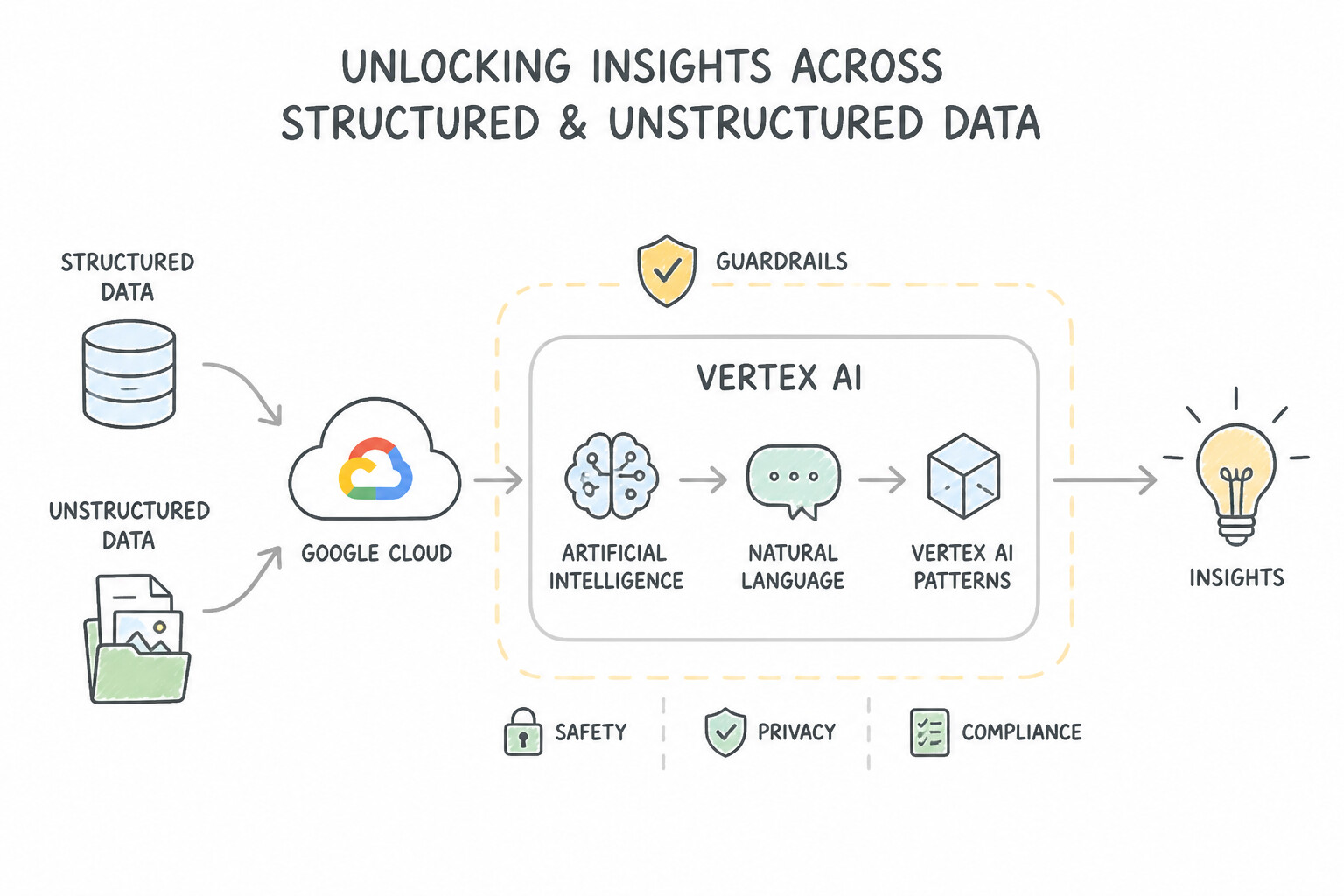
if/elseheuristics fail when variables interact non-linearly or when adversaries adapt (e.g., spam filters, payment fraud, dynamic pricing). ML models continuously adapt by retraining on fresh outcomes. - Unlocking Insights Across Structured & Unstructured Data: ML extracts high-value signals from both tabular rows (predicting customer churn or demand) and unstructured media (analyzing millions of call-center audio recordings, medical X-rays, or legal PDFs).
- Scaling Personalized Decisions in Milliseconds: Enables hyper-personalized product recommendations and real-time credit risk scoring for millions of concurrent users where human review is impossible.
Key Implementation Patterns
- Modernizing Rule-Based Fraud Detection: Use Deploy a machine learning model that analyzes the unstructured email text to identify the customer's intent. Machine learning excels at processing unstructured data like text to classify intent and automate workflows at scale.
- Scaling Real-Time Personalization: Use Use a machine learning model to analyze viewing patterns and generate personalized recommendations. Machine learning automates pattern recognition in large datasets to scale personalized recommendations. (Avoid alternative: Manual curation is impossible to scale for millions of users.)
- Unlocking Value from Unstructured Customer Feedback: Use Use the historical data to train a machine learning model to predict maintenance needs. Machine learning uses large historical datasets to identify patterns and predict future failures effectively. (Avoid alternative: Spreadsheets cannot scale to handle terabytes of data or complex predictive analysis.)
Key Takeaways (3.1d)
- Unstructured Data Challenge: Traditional databases and rule-based systems struggle with text, images, and audio.
- AI Solution: Machine Learning, specifically Natural Language Processing (NLP), is used to interpret and categorize unstructured text.
- Business Value: AI enables automation at scale, allowing businesses to handle thousands of interactions faster than humanly possible.
- Machine Learning allows businesses to scale complex decision-making to millions of users.
Consideration 3.1e: Explain why high-quality, accurate data is essential for successful AI models and identify the main dimensions of data quality (e.g., completeness, uniqueness, timeliness, validity, accuracy, consistency)
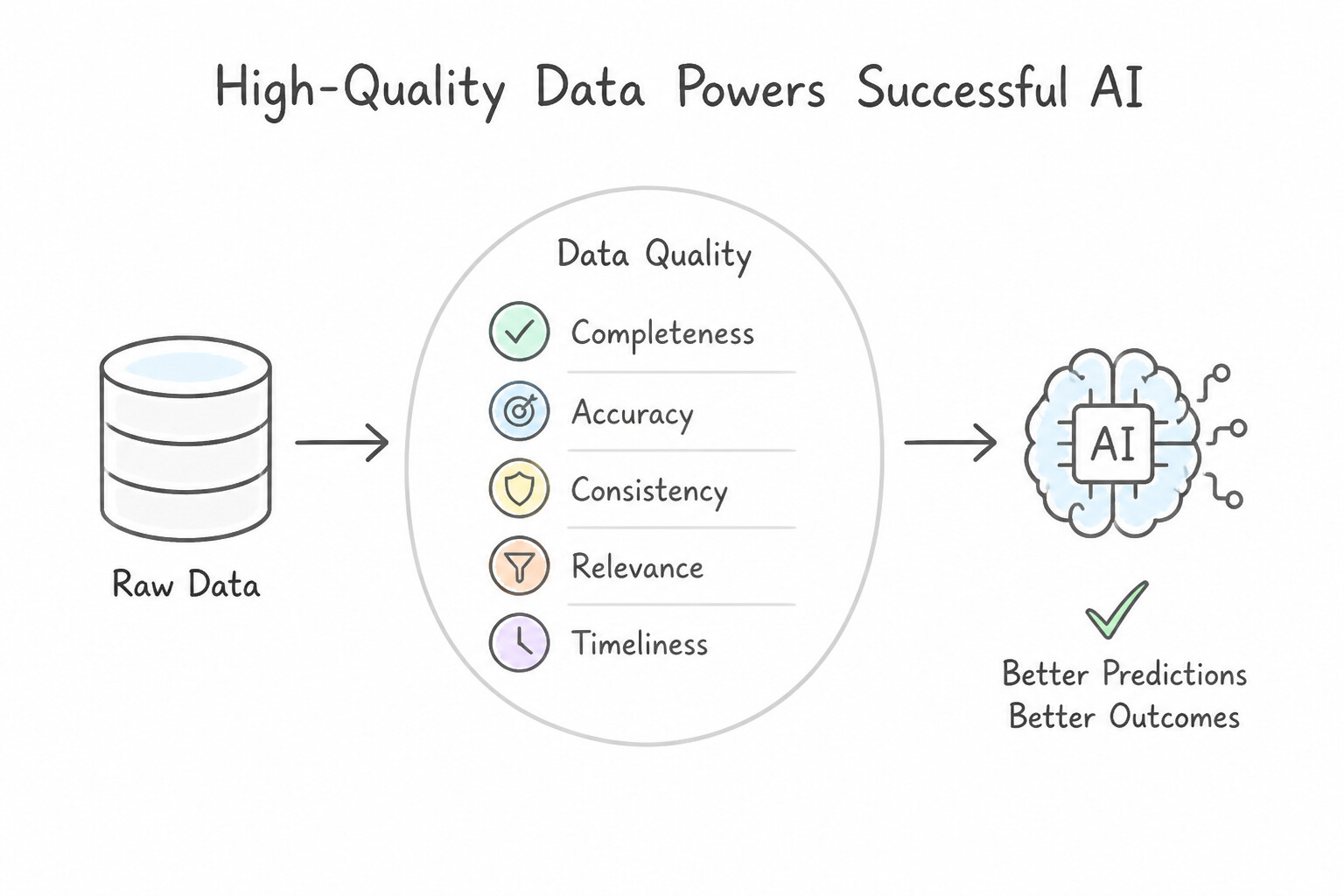
- Why Data Quality Make-or-Breaks AI: An ML model is a mathematical reflection of its training data. Low-quality data causes data drift, biased predictions, and hallucinated outputs.
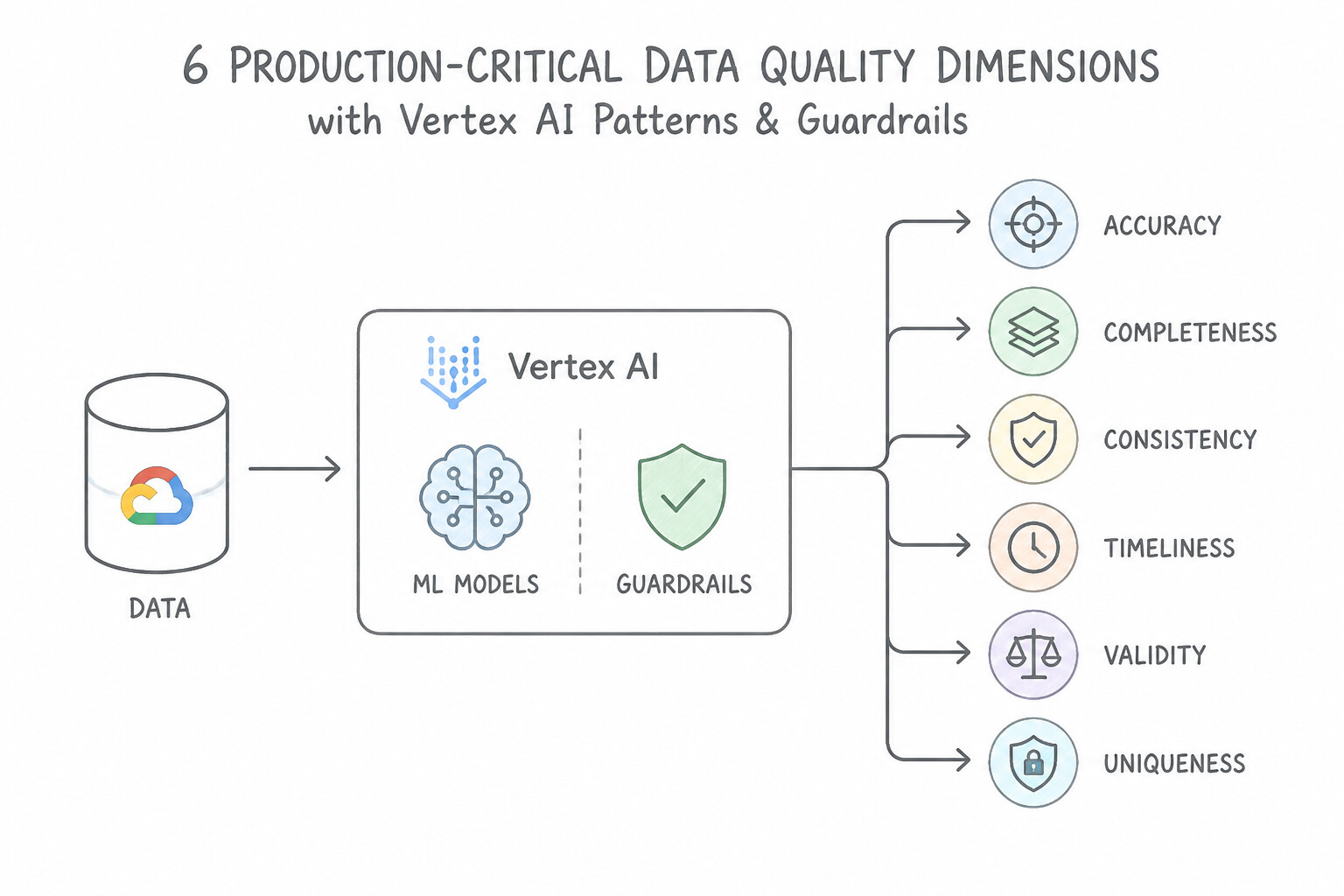
- The 6 Production-Critical Data Quality Dimensions:
- Completeness: All required fields and records are present (e.g., no missing customer age or zip code values).
- Uniqueness: Each real-world entity is recorded only once (no duplicate customer profiles skewing training weights).
- Timeliness: Data is fresh and updated rapidly enough to reflect current reality (avoiding training on 5-year-old market behavior).
- Validity: Data conforms to defined syntax, data types, and domain ranges (e.g., a month field only contains
1–12). - Accuracy: Data correctly represents the real-world event or object it describes (e.g., the recorded shipping address actually exists).
- Consistency: The same data attribute matches across different databases and departmental systems without contradiction.
Key Implementation Patterns
- Timeliness in Real-time Fraud Detection: Use Inspect the training data to identify and mitigate historical bias. Historical data often contains human biases that the model learns; you must identify and clean this data to ensure fairness. (Avoid alternative: Training longer on biased data only reinforces the bias and does not correct the underlying data quality issue.)
- Completeness in Customer Churn Prediction: Use Clean the data by removing duplicates and correcting errors before retraining the model. High-quality, clean data is required for accurate machine learning models; you must remove errors and duplicates first. (Avoid alternative: Training longer on bad data does not fix the data quality; it may actually cause the model to memorize the errors.)
- Uniqueness in E-commerce Inventory Forecasting: Use Collect recent booking data and retrain the model to reflect current travel trends. Data freshness is essential; retraining with current data allows the model to learn new patterns and trends. (Avoid alternative: Training longer on outdated data does not teach the model about new trends or restrictions.)
Key Takeaways (3.1e)
- Machine learning models learn patterns from training data, including any inherent biases.
- Historical data often contains human prejudices that can lead to unfair algorithmic decisions.
- High-quality data is essential for accurate and fair ML models; quantity does not replace quality.
- Detecting and mitigating bias is a crucial step in the ML development lifecycle.
Consideration 3.1f: Describe the business implications of explainable and responsible AI in AI systems
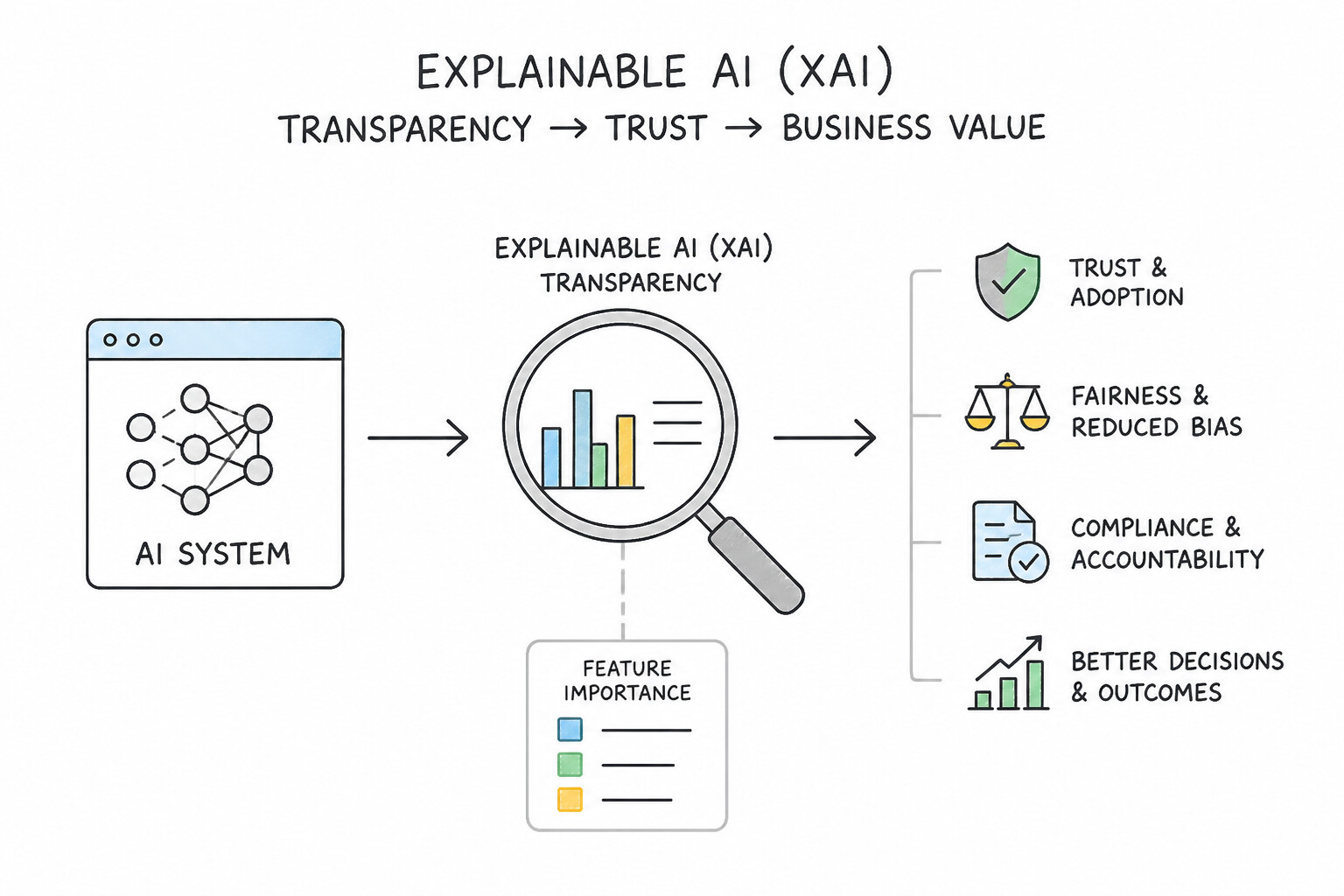
- Explainable AI (XAI — Transparency & Feature Attribution): Provides human-understandable reasons for why a model produced a specific prediction or credit score. Explainability is essential for regulatory compliance (auditing lending/healthcare decisions), debugging model errors (discovering if a model is relying on a spurious correlation), and building stakeholder trust.
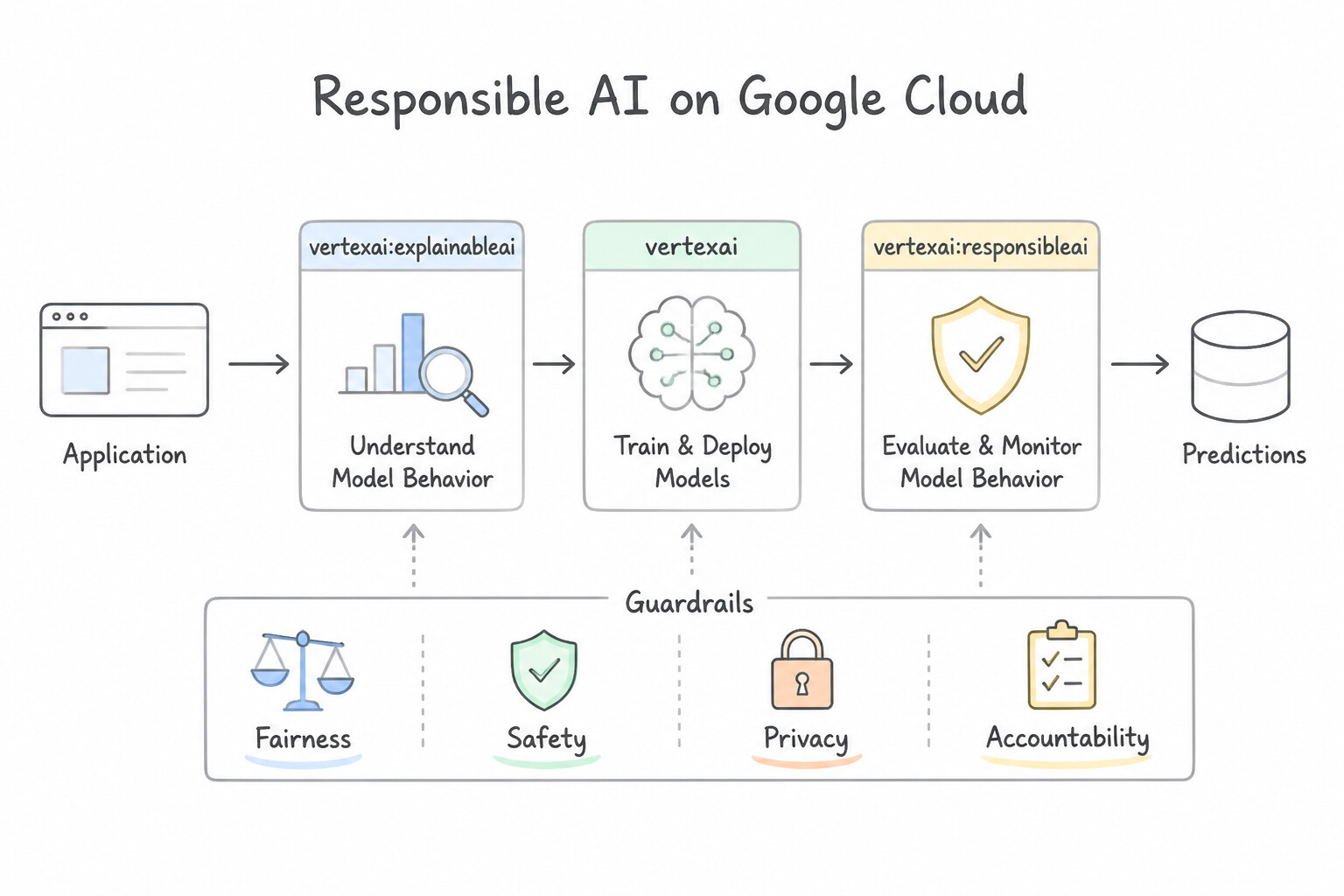
- Responsible AI (Fairness, Safety, Privacy, Accountability): Untested AI can amplify historical societal biases, leak sensitive PII, or generate toxic content. Implementing Responsible AI governance protects brand reputation, prevents legal liability, and ensures AI systems remain fair, safe, and aligned with human oversight.
Key Implementation Patterns
- Regulatory Compliance in Credit Scoring: Use Use Explainable AI to analyze which input features contributed most to the model's prediction. Explainable AI identifies how much each data input contributed to the final prediction, providing the required transparency. (Avoid alternative: More data improves accuracy but does not provide transparency into specific decisions.)
- Mitigating Demographic Bias in Recruitment: Use Evaluate the dataset for unfair bias and apply mitigation strategies before training the model. You must identify and fix unfair bias in historical data to prevent the model from learning discriminatory patterns. (Avoid alternative: Training on biased data without changes will create a biased model that replicates past unfair hiring practices.)
- Building Clinical Trust in Healthcare AI: Use Use the AI model to generate a preliminary analysis that a radiologist must review and confirm before finalizing the diagnosis. Keeping a human expert to review AI suggestions ensures safety and accountability in critical scenarios.
Key Takeaways (3.1f)
- Explainable AI is essential for trust, transparency, and regulatory compliance in ML projects.
- Feature Attribution helps identify which data inputs influenced a model's prediction the most.
- Accuracy measures how often a model is right, while explainability measures how well we understand why it is right (or wrong).
- Machine Learning models learn patterns from historical data.
Quick Decision Cheat Sheet (Subsection 3.1)
If the Scenario Requires... | Choose This Concept / Dimension | Avoid This Common Mistake |
|---|---|---|
"Historical dashboards, KPIs, and 'What happened last quarter?'" | Data Analytics & Business Intelligence (BI) | Generative AI or Deep Learning |
"Systems that learn patterns from historical data to predict outcomes without explicit programming" | Machine Learning (ML) | Rule-based if/else automation |
"Creating original text, images, code, audio, or video from foundation models" | Generative AI (Gen AI) | Classical regression/classification ML |
"Autonomous AI systems that plan, reason, remember context, and invoke tools/APIs to complete workflows" | Agentic AI | Static FAQ chatbots or passive text completion |
"Missing fields / blank values in training tables" | Completeness (Data Quality Dimension) | Validity or Timeliness |
"Duplicate records of the same customer in a dataset" | Uniqueness (Data Quality Dimension) | Consistency or Accuracy |
"Outdated data that no longer reflects current market conditions" | Timeliness (Data Quality Dimension) | Validity or Completeness |
"Values don't match expected format/range (e.g., negative age or text in a date column)" | Validity (Data Quality Dimension) | Uniqueness or Timeliness |
"Conflicting values for the same record across CRM vs. ERP systems" | Consistency (Data Quality Dimension) | Completeness or Uniqueness |
"Understanding why an AI model made a specific prediction to satisfy regulators and build trust" | Explainable AI (XAI) & Responsible AI | Increasing model parameter count |
Further Reading (Subsection 3.1)
- Machine Learning Problem Types — Review the section on framing ML problems to understand the difference between regression and classification.
- Google Cloud AI & ML Products — Provides an overview of AI concepts and how Vertex AI handles different types of ML problems like classification and regression.
- What is Generative AI? — Provides a high-level overview of Generative AI, how it works, and how it differs from other types of artificial intelligence.
- Machine Learning vs. Artificial Intelligence — Explains the foundational concepts of AI and ML, highlighting predictive capabilities and core differences.
- Understanding AI, ML, and generative AI — Explains the differences between artificial intelligence, machine learning, and generative AI.
- What is an AI agent? — AI agents are autonomous systems that can perceive their environment, make decisions, and take actions to achieve specific goals. They use large language models (LLMs) to reason, plan, and use tools to execute tasks.
Subsection 3.2: Explain how Google Cloud's AI offerings can create business value
The Big Picture
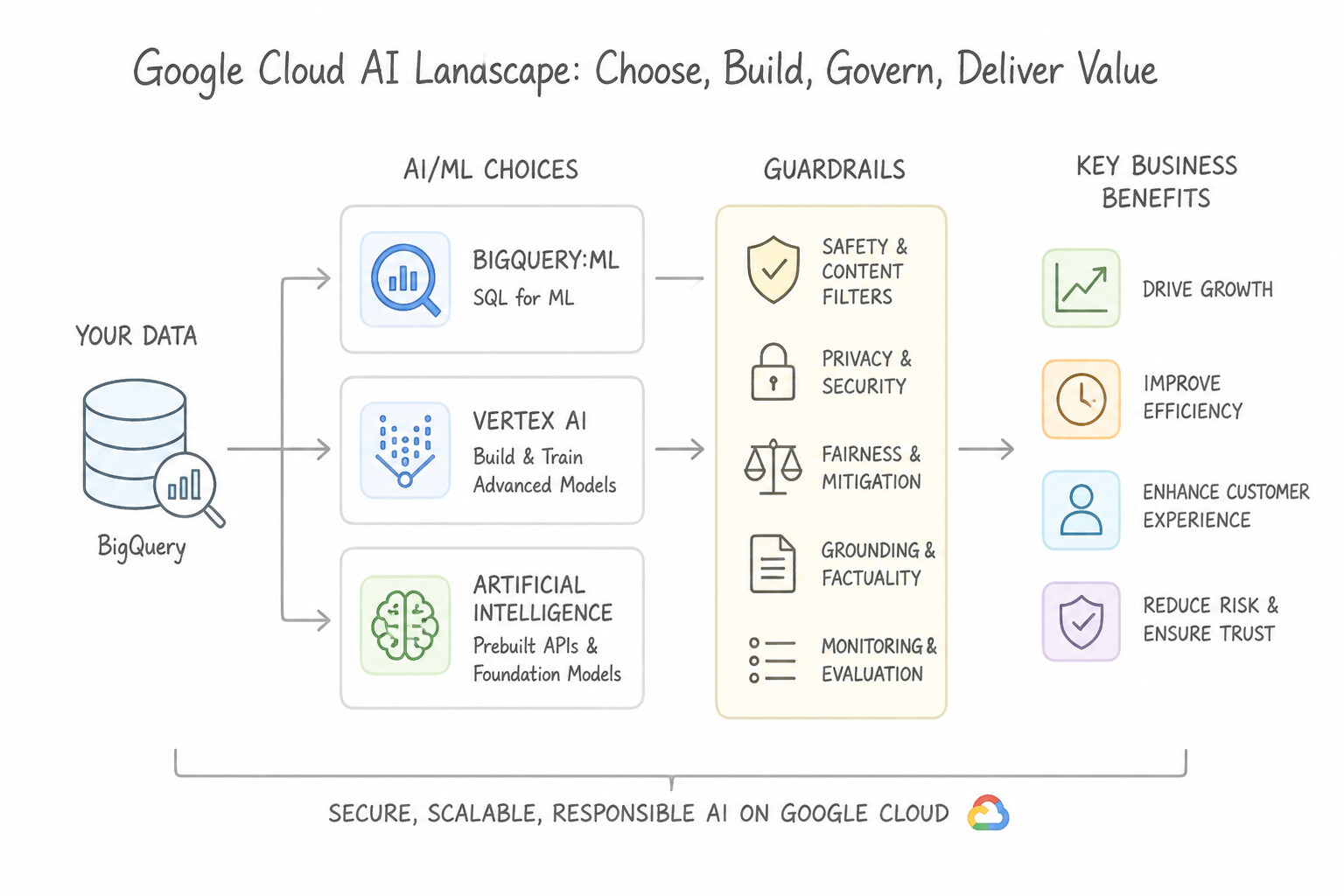
The single most critical architectural decision in Section 3 of Google Cloud architecture is choosing the right tier of Google Cloud's AI stack based on the customer's time-to-market, in-house ML expertise, data type, and need for competitive differentiation:
- Tier 1 — Turnkey SaaS AI & Enterprise Agents (
Gemini Enterprise/Customer Engagement Suite— Zero ML Coding): When business teams want an immediate enterprise search & agent hub across company documents (Gemini Enterprise) or turnkey conversational contact-center agents (Customer Engagement Suite), they buy ready-to-use applications. - Tier 2 — Pre-Trained APIs (
Vision API,Cloud Translation API,Speech-to-Text API,Text-to-Speech API,Natural Language API— Zero Training Data Needed): When developers need to extract text from receipts, translate 100+ languages, or transcribe customer calls, training a model from scratch is a massive waste of time and money. Google's Pre-Trained APIs work out of the box via a simple REST API call. - Tier 3 — SQL-Based Machine Learning (
BigQuery ML— For Data Analysts): When data analysts already have structured tabular data in BigQuery (e.g., customer churn, revenue forecasting) and know SQL (not Python/TensorFlow), BigQuery ML (BQML) lets them train and execute ML models directly inside BigQuery using standard SQL queries—without exporting data! - Tier 4 — Custom Models & Agents on
Vertex AI/Agent Platform(AutoML,Agent Studio, & Custom Training onAI Hypercomputer): - AutoML: Trains a custom model on the company's proprietary dataset (e.g., classifying custom manufacturing defects) with a no-code/low-code point-and-click interface.
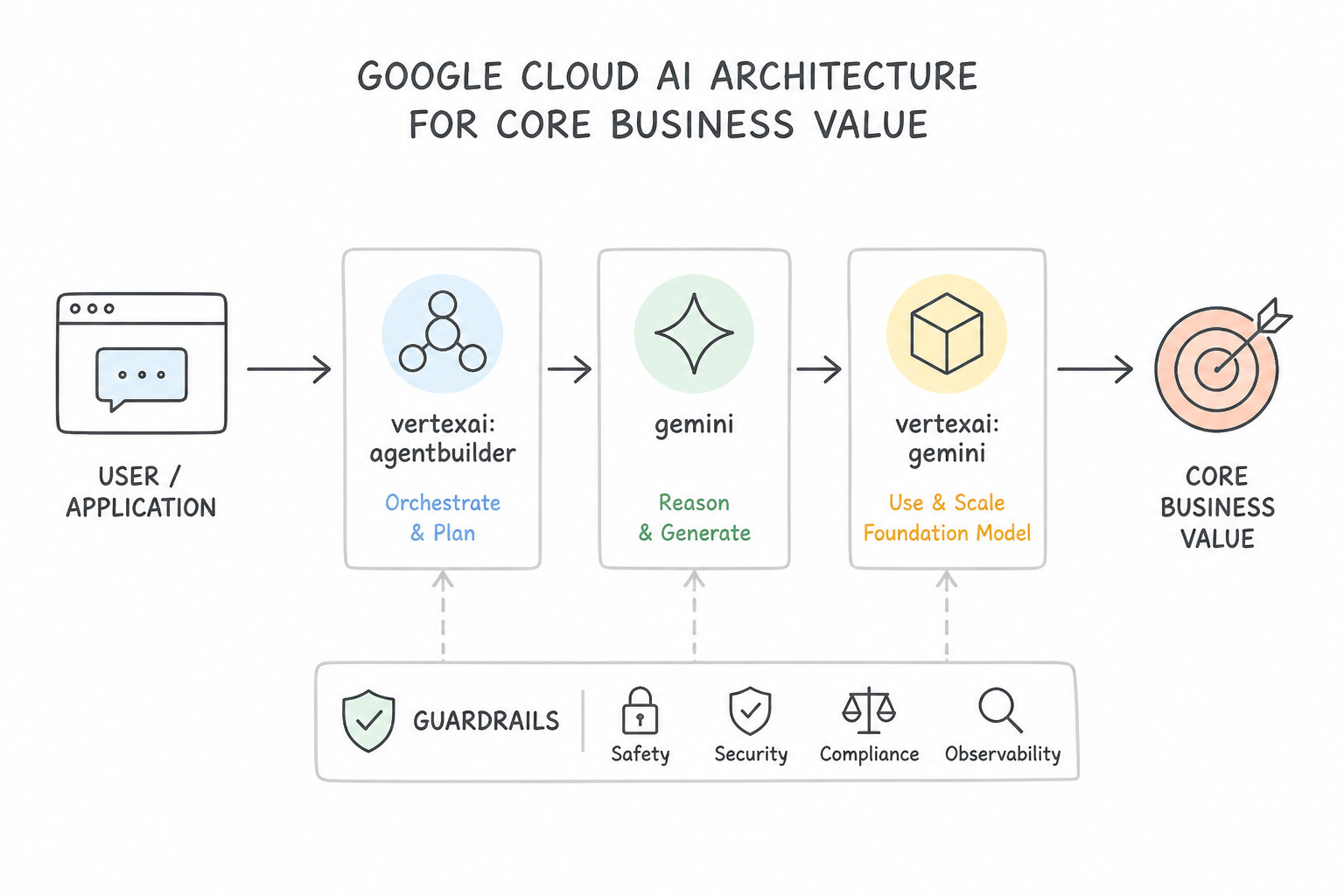
- Agent Studio / Vertex AI Agent Builder: Builds, grounds, and orchestrates custom generative AI agents connected to enterprise data and APIs.
- Custom Training on AI Hypercomputer (TPUs/GPUs): Reserved for specialized ML engineering/data science teams who need 100% control over model architecture, open-source frameworks (PyTorch, JAX, TensorFlow), and hardware acceleration (Cloud TPUs and NVIDIA GPUs).
Consideration 3.2a: Describe the strategic considerations that organizations must make when selecting Google Cloud AI solutions (e.g., implementation speed, development effort, potential for business differentiation, technical expertise requirements, choice and flexibility)
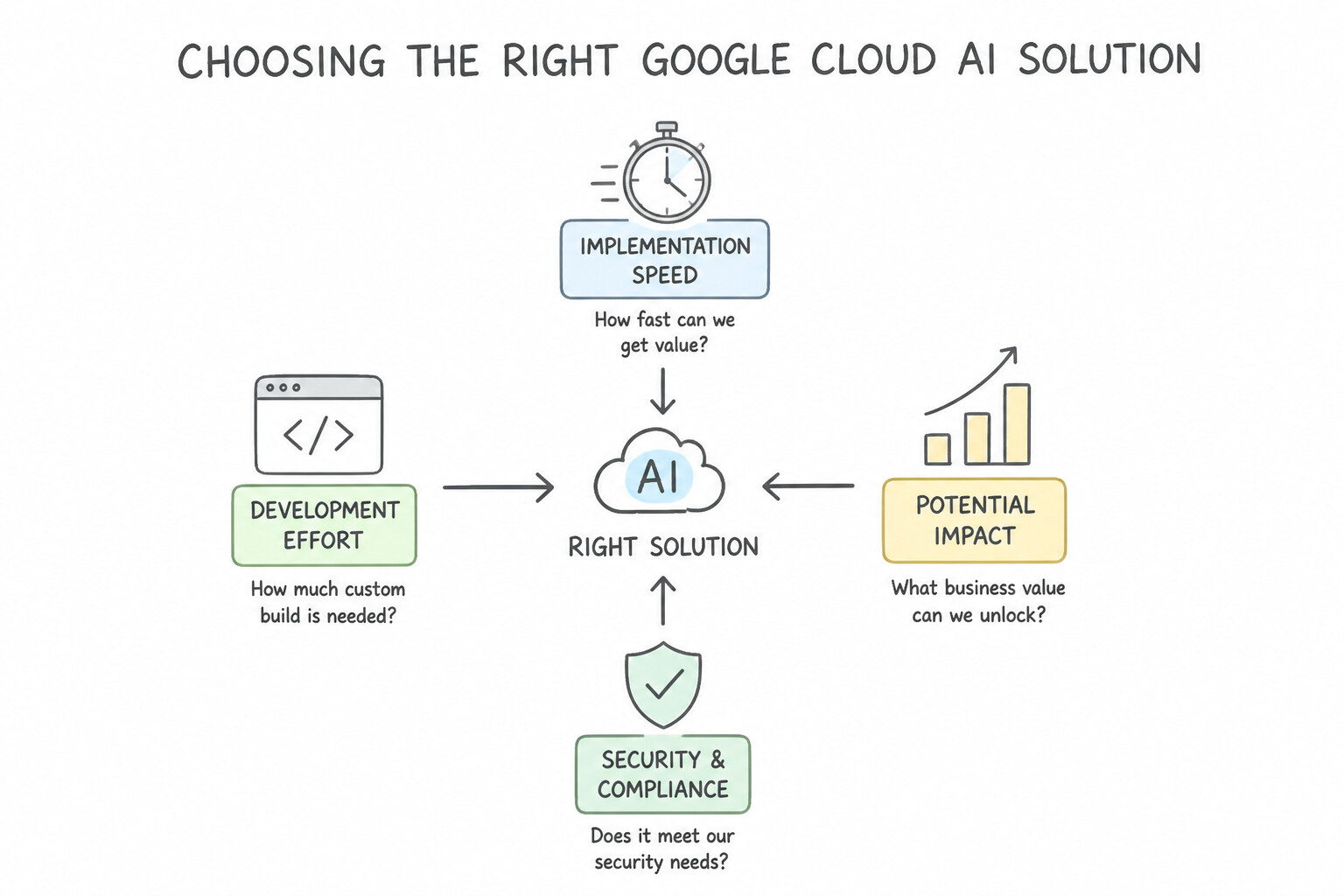
- The Core Trade-Off Triangle (
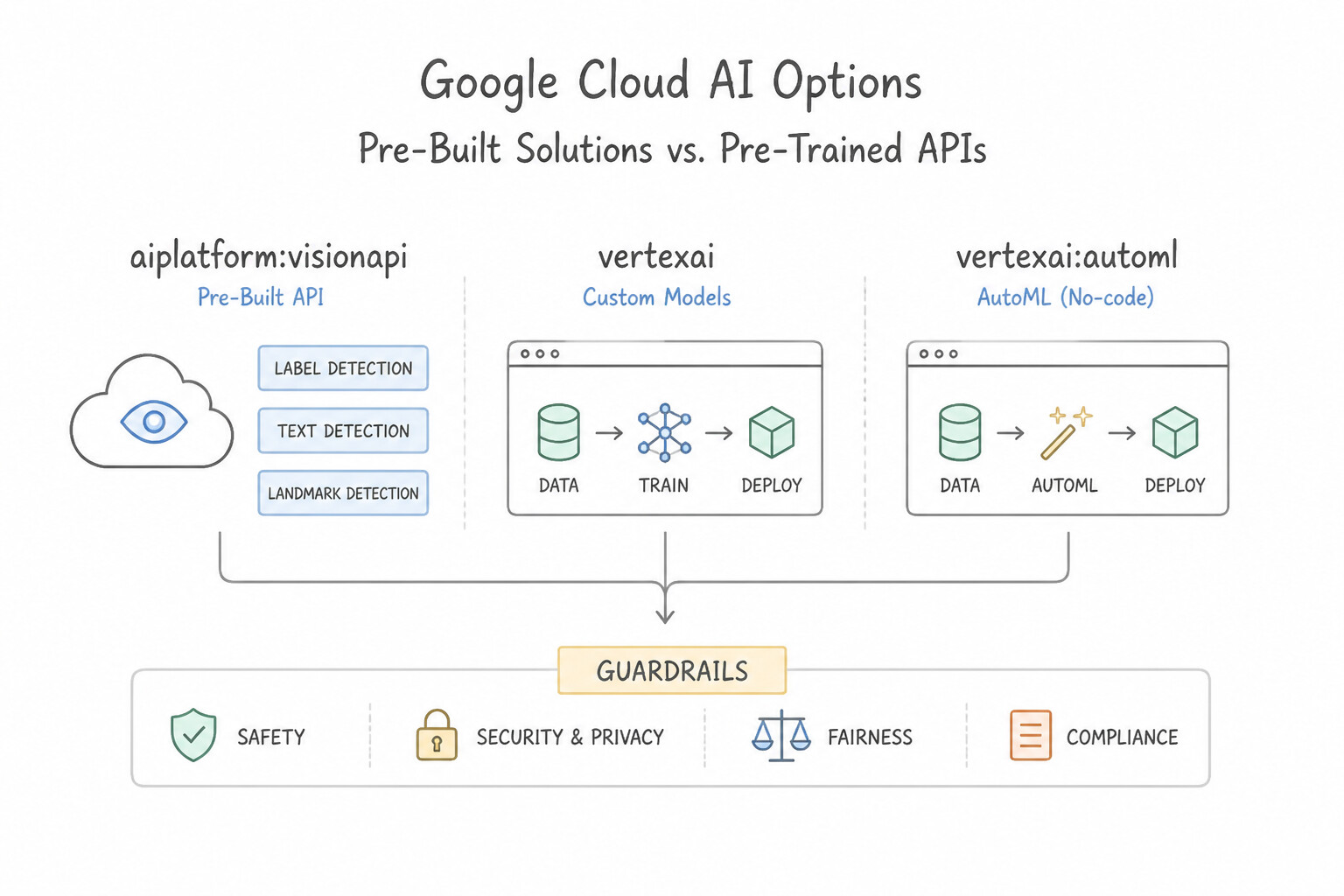
Speed & Effortvs.Differentiation & Control): - Pre-Built Solutions & Pre-Trained APIs: Maximize implementation speed and minimize development effort / ML expertise requirements, making them ideal for standard capabilities (OCR, translation, speech transcription). However, because every competitor can call the same API, they offer lower proprietary model differentiation.
- Custom Models (
AutoML,BigQuery ML,Vertex AI Custom Training): Require proprietary training data and higher development effort, but create unique competitive differentiation tailored to an organization's domain-specific data (e.g., proprietary medical diagnostics or supply-chain forecasting).
Key Implementation Patterns
- Pre-trained APIs for Rapid Deployment: Use Use the pre-trained Vision API to detect landmarks in the photos. The Vision API offers ready-to-use landmark detection, fitting the lack of ML expertise and the short deadline. (Avoid alternative: Custom modeling requires specialized data science skills and time, which the scenario explicitly rules out.)
- Custom AI Models for High Business Differentiation: Use Use Vertex AI to train an AutoML model with your labeled images. AutoML allows training on custom data without code, fitting the 'no ML engineer' constraint. (Avoid alternative: Pre-trained models are generic and cannot detect proprietary defects without custom training.)
- AutoML for Low-Code Domain-Specific Customization: Use Use Vertex AI custom training to build and train the model using your own code and frameworks. Custom training provides the necessary control over code and architecture to build novel, differentiated solutions. (Avoid alternative: Pre-trained APIs do not offer the customization required to build novel algorithms or control model architecture.)
Key Takeaways (3.2a)
- Use pre-trained APIs (like Vision API, Natural Language API) for common tasks to save time and effort.
- Choose custom model training (Vertex AI) only when pre-trained models do not meet specific business requirements.
- Lack of data science expertise points towards using managed, pre-trained services or AutoML solutions.
- Pre-trained APIs are for generic tasks and offer the fastest speed to deployment.
Consideration 3.2b: Describe the functionality of Gemini Enterprise Agent Platform and identify potential business use cases
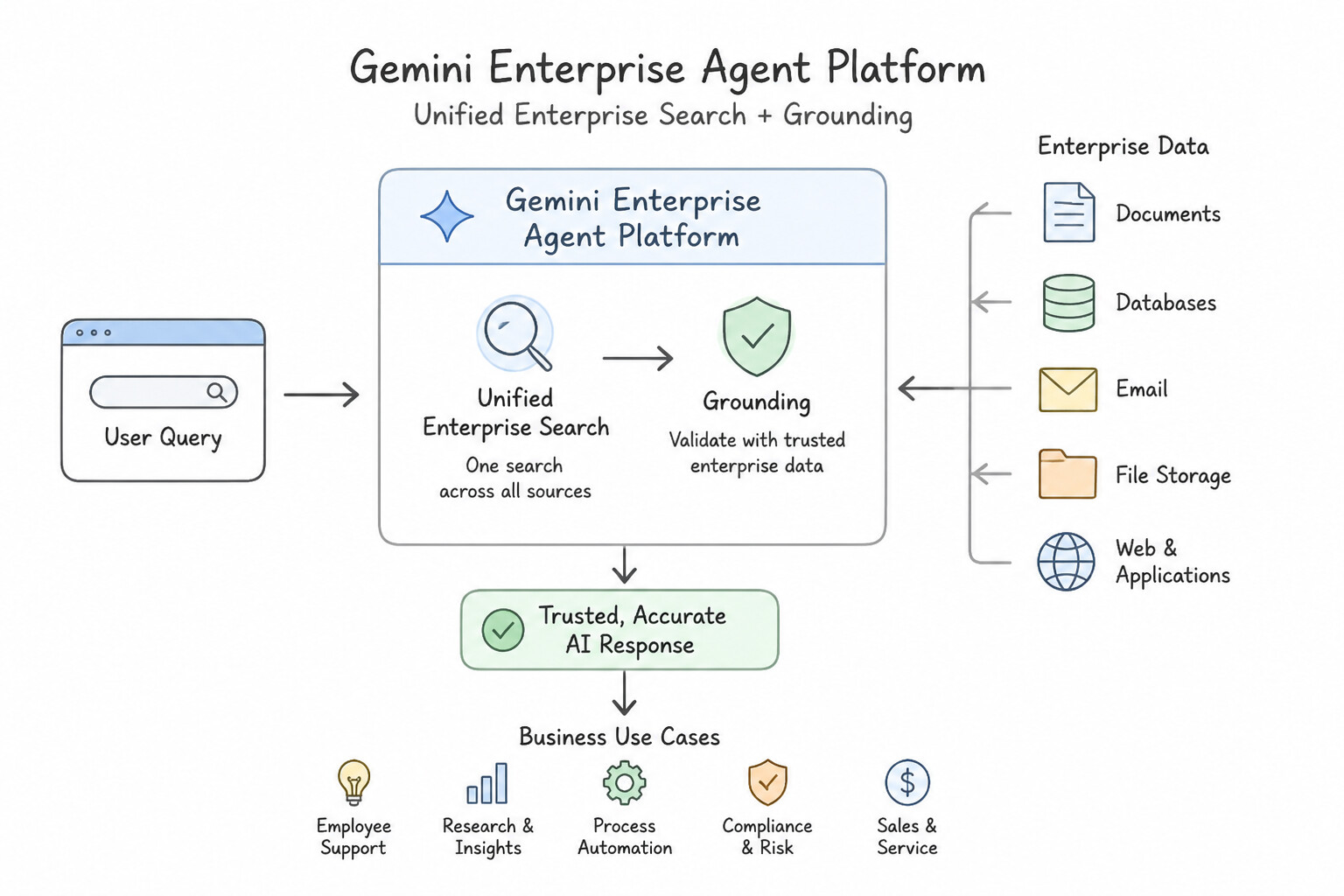
- Unified Enterprise Search, Grounding, and Agent Orchestration: Gemini Enterprise (and the Vertex AI Agent Platform) connects Google's frontier models securely to an organization's internal knowledge repositories (Google Workspace, Microsoft SharePoint, Jira, ServiceNow, Salesforce, BigQuery).
- Core Business Value: Employees can search across siloed enterprise applications from a single conversational interface with strict ACL/permission enforcement, synthesize complex research reports grounded in internal truth, and deploy no-code/low-code workflow agents that automate repetitive cross-application tasks.
Key Implementation Patterns
- Functionality of Gemini Enterprise Agent Platform: Use Use the Gemini Enterprise Agent Platform to build, ground, and deploy the conversational AI agents. Gemini Enterprise Agent Platform is specifically designed to build and deploy conversational agents that can reason and interact with business systems.
- Enterprise Search Grounding in Agent Platform: Use Use data grounding to connect the agent directly to a data store containing your internal policy documents. Data grounding forces the agent to base its answers on your specified enterprise documents, preventing hallucinations.
- Multi-Agent Orchestration for Operations: Use Use Vertex AI Agent Builder to design a multi-agent workflow. Configure specialized agents for seats, vouchers, and SMS, and allow them to collaborate. Multi-agent workflows allow specialized AI agents to collaborate, making complex automated tasks more reliable and easier to manage.
Key Takeaways (3.2b)
- AI Agents can reason through complex tasks and use external tools to execute actions, going beyond simple chat capabilities.
- Grounding is the process of connecting generative AI models to factual enterprise data to improve accuracy and reduce hallucinations.
- Google Cloud offers fully managed platforms to build, ground, and orchestrate AI agents, reducing the need to manage complex infrastructure.
- Generative AI models can hallucinate or invent facts when they lack specific information.
Consideration 3.2c: Match the Google Cloud pre-trained API and foundation model to various business use cases (e.g., Agent Platform API, Vision API, Cloud Translation API, Speech-to-Text API, Gemini)
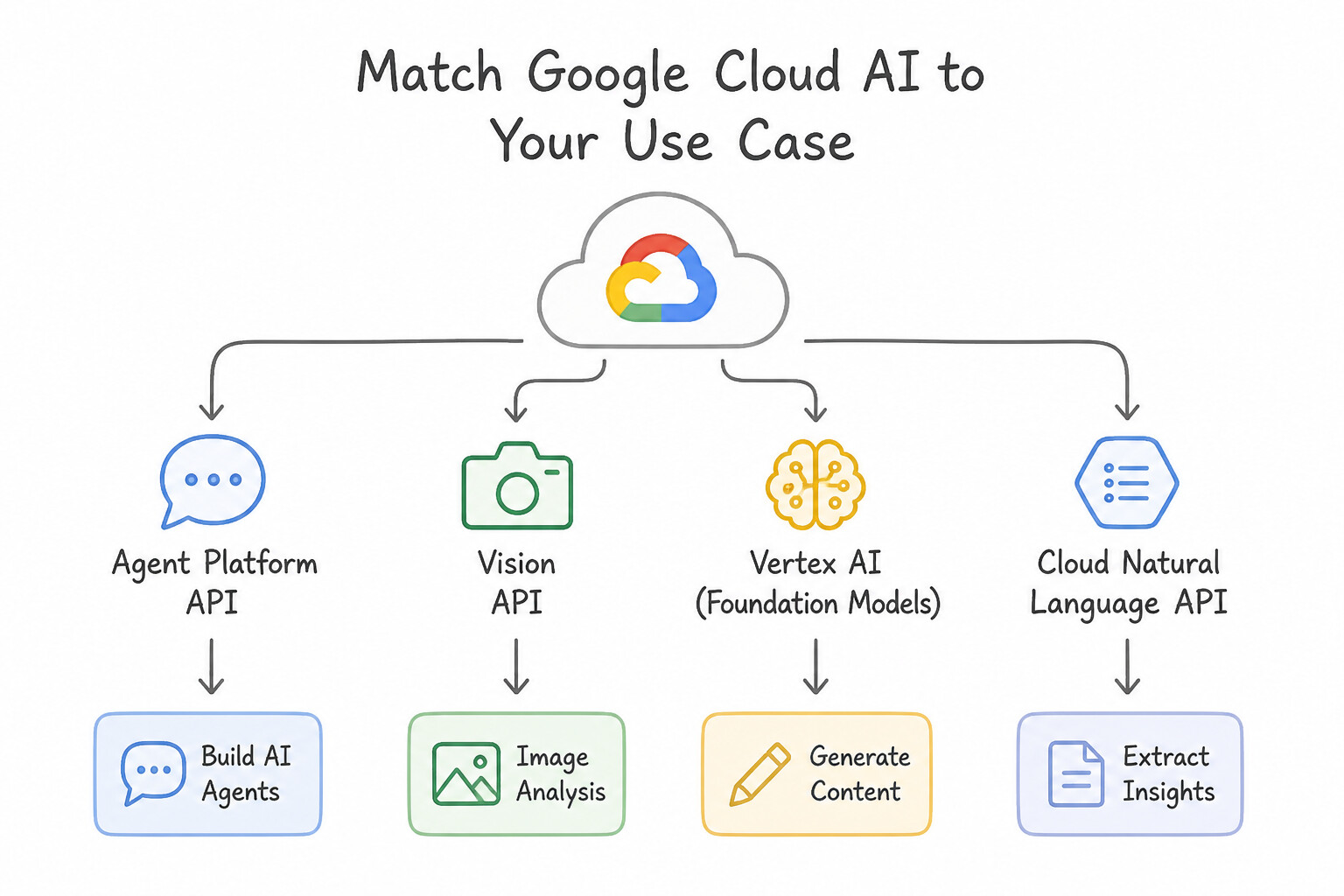
- Vision API: Detects objects, faces, product logos, explicit content (SafeSearch), and extracts printed/handwritten text (OCR) from images using pre-trained vision models.
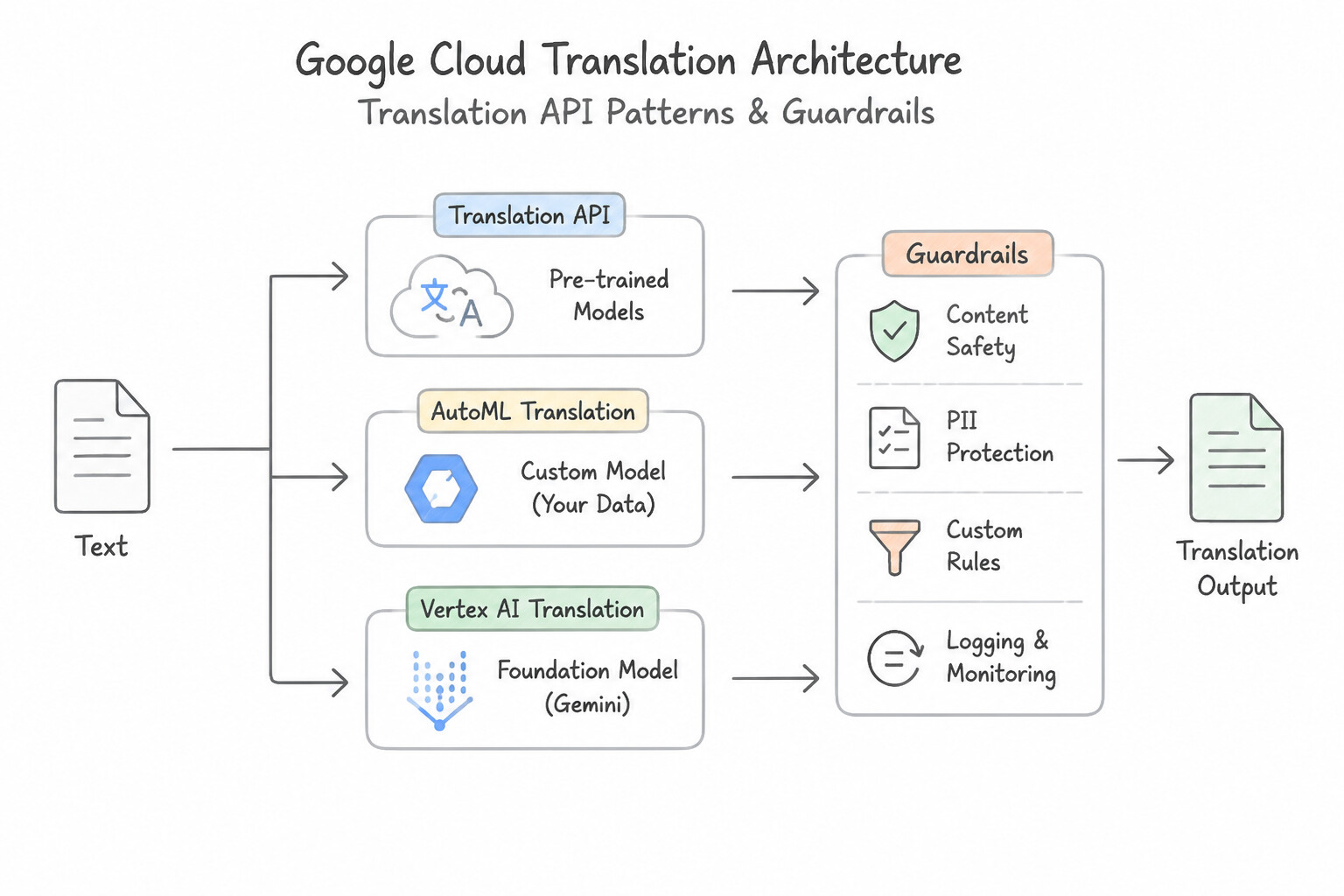
- Cloud Translation API: Dynamically translates text and documents across 100+ languages in real time to localize global apps and customer support.
- Speech-to-Text API & Text-to-Speech API: Speech-to-Text transcribes live or recorded audio into written text (e.g., call-center analytics, voice commands); Text-to-Speech synthesizes natural-sounding human speech from text (e.g., IVR phone systems, accessibility readers).
- Cloud Natural Language API: Extracts sentiment (positive/negative tone), entities (people, places, products), and syntax from unstructured text.
- Gemini & Agent Platform API (Vertex AI): Multimodal foundation models capable of reasoning across text, code, images, audio, and video simultaneously.
Key Implementation Patterns
- Automated Customer Service Agent with ERP Grounding: Use Enable the Cloud Translation API to translate messages automatically. The Cloud Translation API offers pre-trained translation capabilities that are ready to use immediately without data science expertise. (Avoid alternative: AutoML requires training data and time to build a model, which conflicts with the need for immediate implementation.)
- Conversational HR Policy Assistant: Use Use Vertex AI AutoML to train a model with your images. Vertex AI AutoML enables custom model training on specific data without requiring advanced coding skills. (Avoid alternative: Pre-trained APIs detect generic objects but cannot identify unique, specific defects without custom training.)
- Action Execution via API Integrations: Use Use Vertex AI Custom Training to run the team's custom code. Custom Training allows you to use your own code and frameworks, offering full control over the model architecture. (Avoid alternative: The Vision API is pre-trained and does not support creating custom algorithms or training from scratch.)
Key Takeaways (3.2c)
- Use Pre-trained APIs (like Cloud Translation API) for common tasks requiring speed and no ML expertise.
- Use AutoML when you have custom data but limited ML coding skills.
- Use Custom Training on Vertex AI only when you have specialized needs and a data science team.
- Use Pre-trained APIs for common, generic tasks (e.g., OCR, detecting common objects).
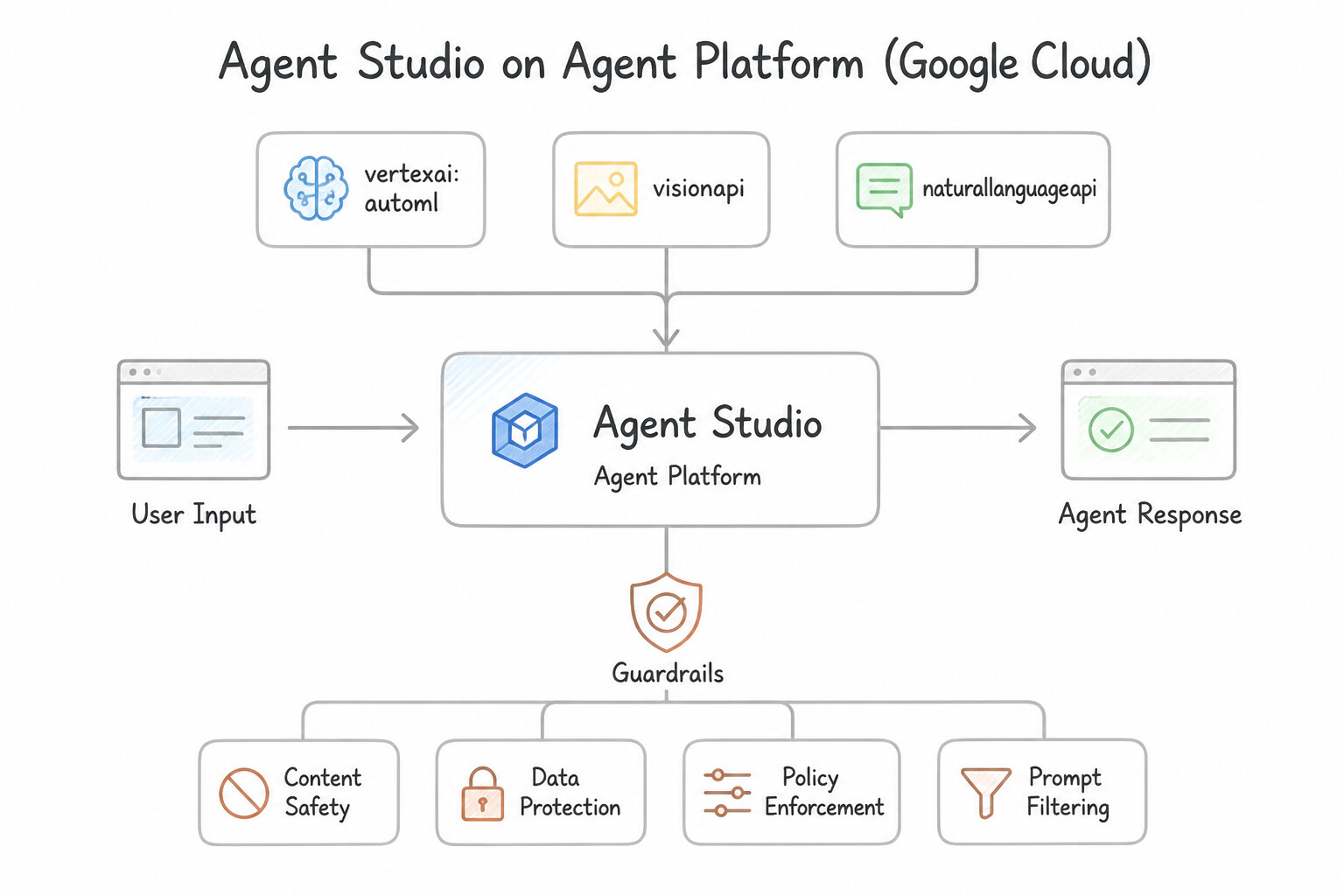
Consideration 3.2d: Explain how an organization can build custom models using their own data to create business value (e.g., Agent Studio on Agent Platform, AutoML on Agent Platform)
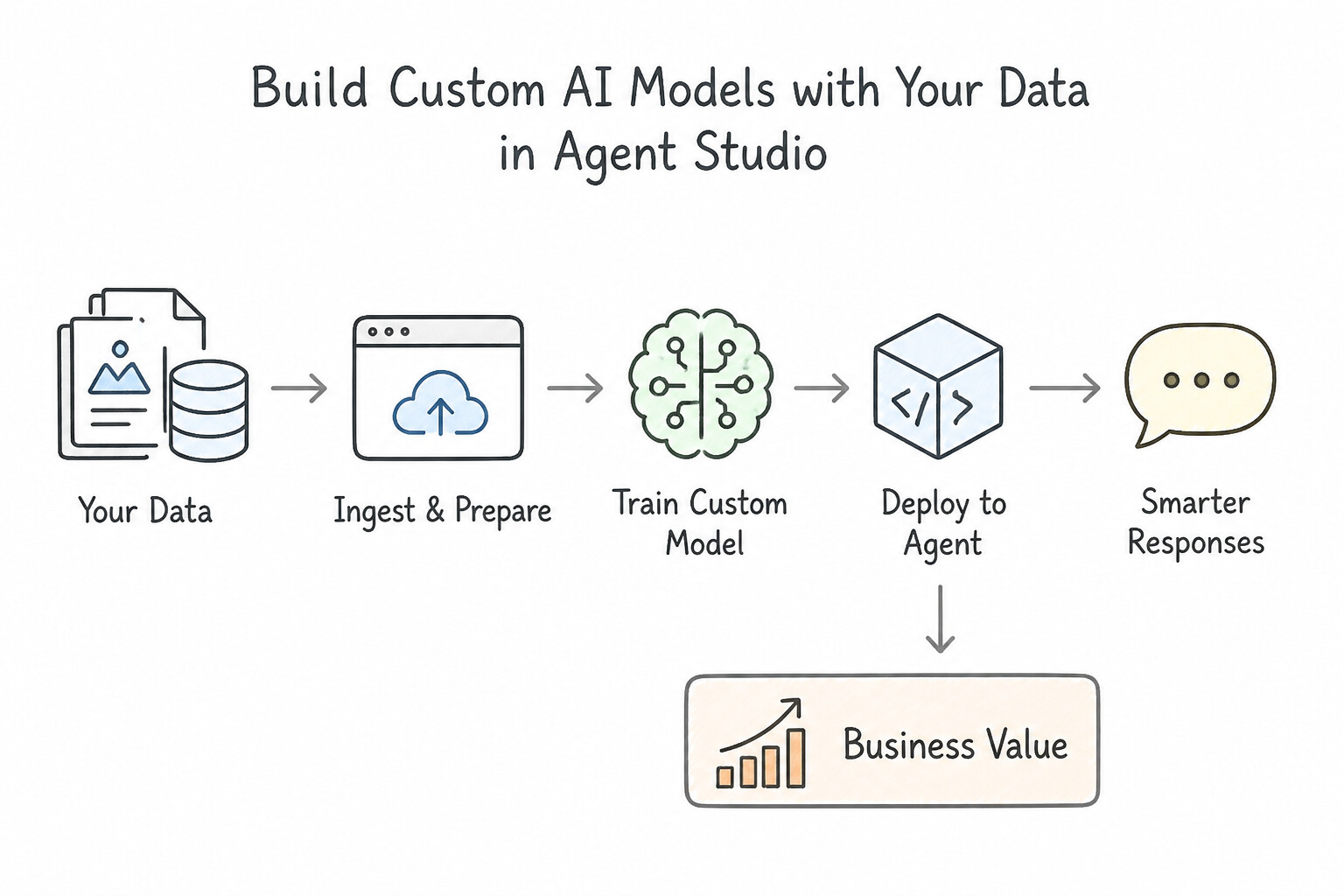
- AutoML on Vertex AI / Agent Platform: Enables teams with limited ML coding expertise to train high-accuracy custom models (for image, tabular, text, or video data) using their own labeled business datasets via an automated, no-code GUI that handles feature engineering, neural architecture search, and hyperparameter tuning.
- Agent Studio on Agent Platform: Provides a visual, low-code builder to design, ground, test, and deploy custom AI agents that connect to internal business APIs, enterprise data stores (RAG), and human-in-the-loop escalation paths.
Key Implementation Patterns
- Custom Image Classification for Retail: Use Use Vertex AI AutoML to train a model using your labeled image dataset. Vertex AI AutoML enables you to train custom models with your own data without writing code, perfect for specific business categories. (Avoid alternative: The Cloud Vision API is pre-trained on generic data and cannot recognize custom, brand-specific categories without further training.)
- Optimizing Customer Support Routing: Use Use AutoML Natural Language to train a custom model using your historical ticket data and team labels. AutoML Natural Language allows you to train a custom machine learning model on your own data to recognize proprietary terms and custom categories.
- Predicting Loan Defaults with Structured Data: Use Use Vertex AI AutoML to train a model using the structured data. Vertex AI AutoML allows users with limited ML coding experience to build models using structured (tabular) data automatically. (Avoid alternative: Cloud Vision API is for analyzing images, not structured tabular data found in CSV files.)
Key Takeaways (3.2d)
- Pre-trained APIs are best for generic, common tasks (e.g., text, face, or object detection) and require no training data.
- AutoML is the best choice when you need a custom model based on your own data but lack machine learning coding expertise.
- Custom Training is for advanced users who need full control over the model architecture and training process using code.
- Use Pre-trained APIs for general tasks (sentiment analysis, standard entity recognition) where no custom data is needed.
Consideration 3.2e: Recognize the core components of Google Cloud's AI Hypercomputer and how organizations benefit by gaining improved performance and efficiency for AI workloads (e.g., GPUs and TPUs, industry-leading software and open standards, cost control with flexible consumption models)
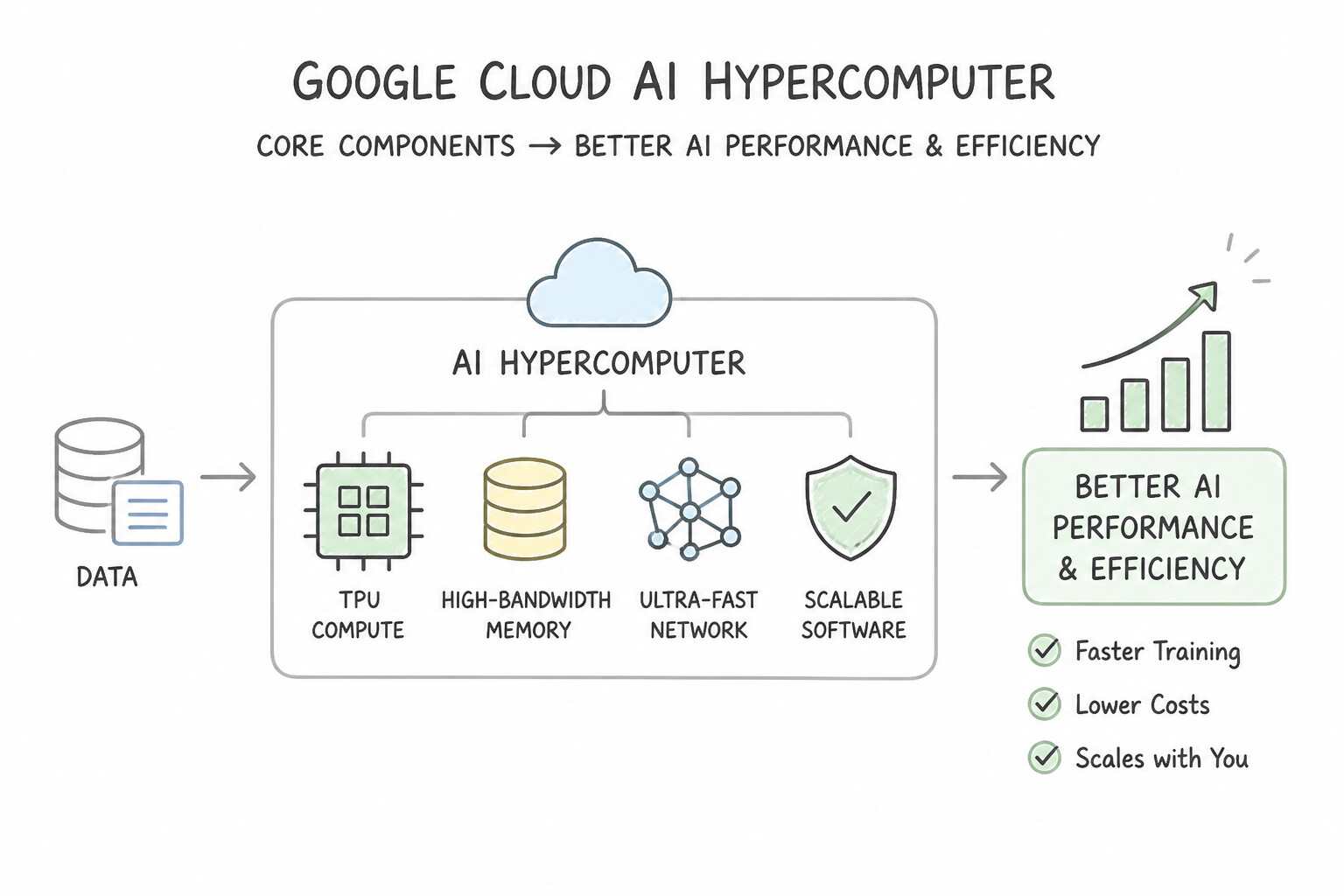
- Supercomputing Architecture Purpose-Built for AI: AI Hypercomputer is not just a chip—it is a co-designed system integrating three layers:
- Performance-Optimized Hardware: Google's custom Cloud TPUs (Tensor Processing Units)—purpose-built ASICs for matrix math in deep learning and LLM training/inference—alongside the latest NVIDIA GPUs, linked by ultra-low-latency optical networking and high-performance storage.
- Open Software & Frameworks: Native optimization for open standards including PyTorch, JAX, TensorFlow, Kubernetes (GKE), and Ray.
- Flexible Consumption Models: Organizations control costs using Dynamic Workload Scheduler (DWS), Spot VMs, Committed Use Discounts (CUDs), and reservation blocks matching their training/inference budgets.
Key Implementation Patterns
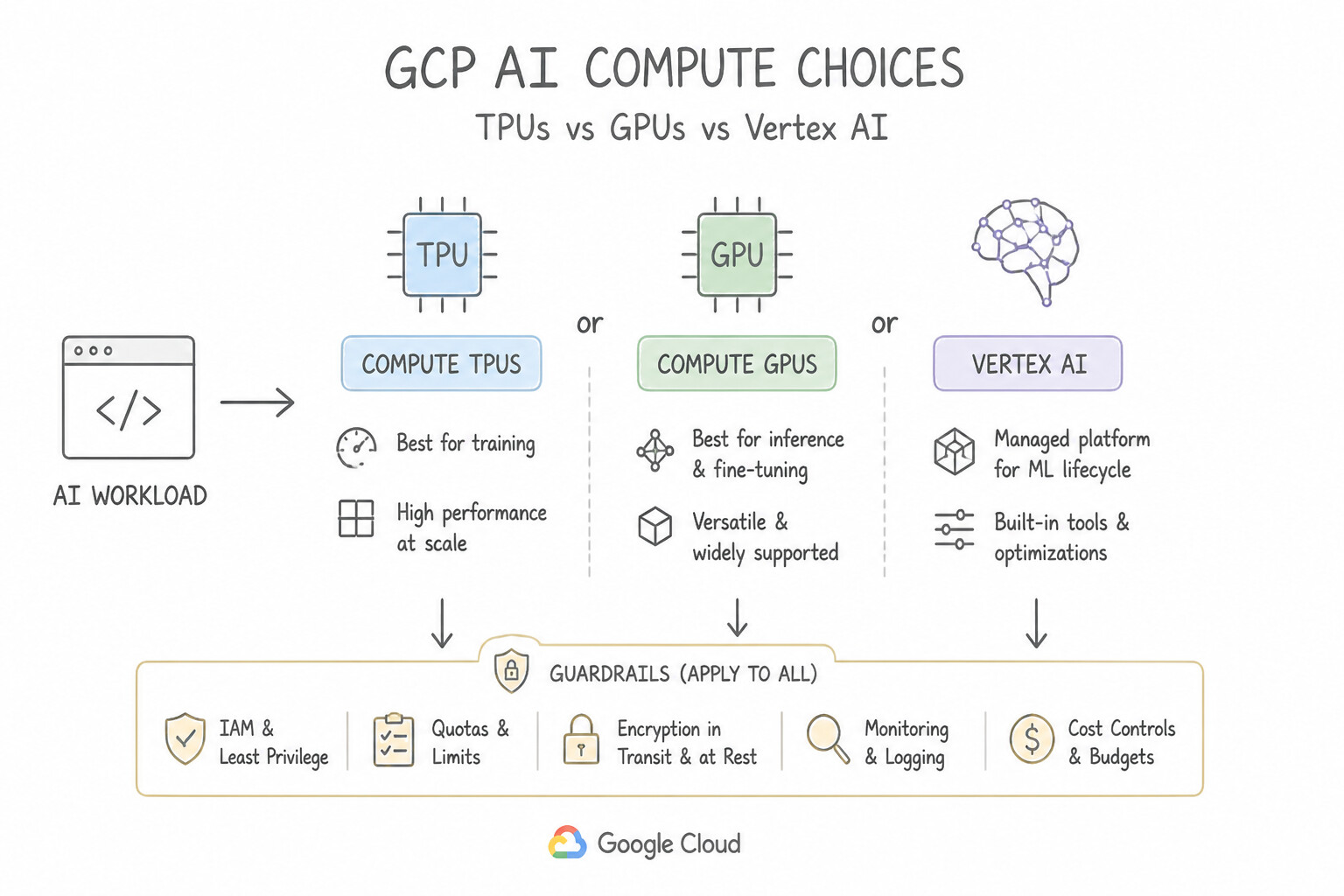
- Identifying Hardware Acceleration for Deep Learning: Use Provision Tensor Processing Units (TPUs). TPUs are Google's custom hardware designed specifically to accelerate machine learning matrix calculations. (Avoid alternative: GPUs are general-purpose accelerators, not the hardware custom-built by Google specifically for machine learning.)
- Mobile and Edge ML Deployment: Use Convert and run the model using TensorFlow Lite. TensorFlow Lite is optimized for on-device machine learning, providing low latency and small binary size without internet connectivity. (Avoid alternative: Cloud TPU is cloud-based hardware and requires an internet connection, failing the local execution requirement.)
- Selecting a Flexible Open-Source Framework: Use Use TensorFlow to design and build the custom model architecture. TensorFlow is an open-source framework that allows for deep customization and portability of machine learning models. (Avoid alternative: BigQuery ML is for SQL-based models on structured data, not custom image neural networks.)
Key Takeaways (3.2e)
- CPUs are for general-purpose computing.
- GPUs are accelerators for parallel processing and graphics.
- TPUs are Google's custom ASICs designed specifically to accelerate machine learning and deep learning models.
- TensorFlow Lite is used for on-device machine learning (mobile/edge).
Consideration 3.2f: Discuss how BigQuery ML lets users create and execute machine learning models in BigQuery by using standard SQL queries and flexibility to experiment with data
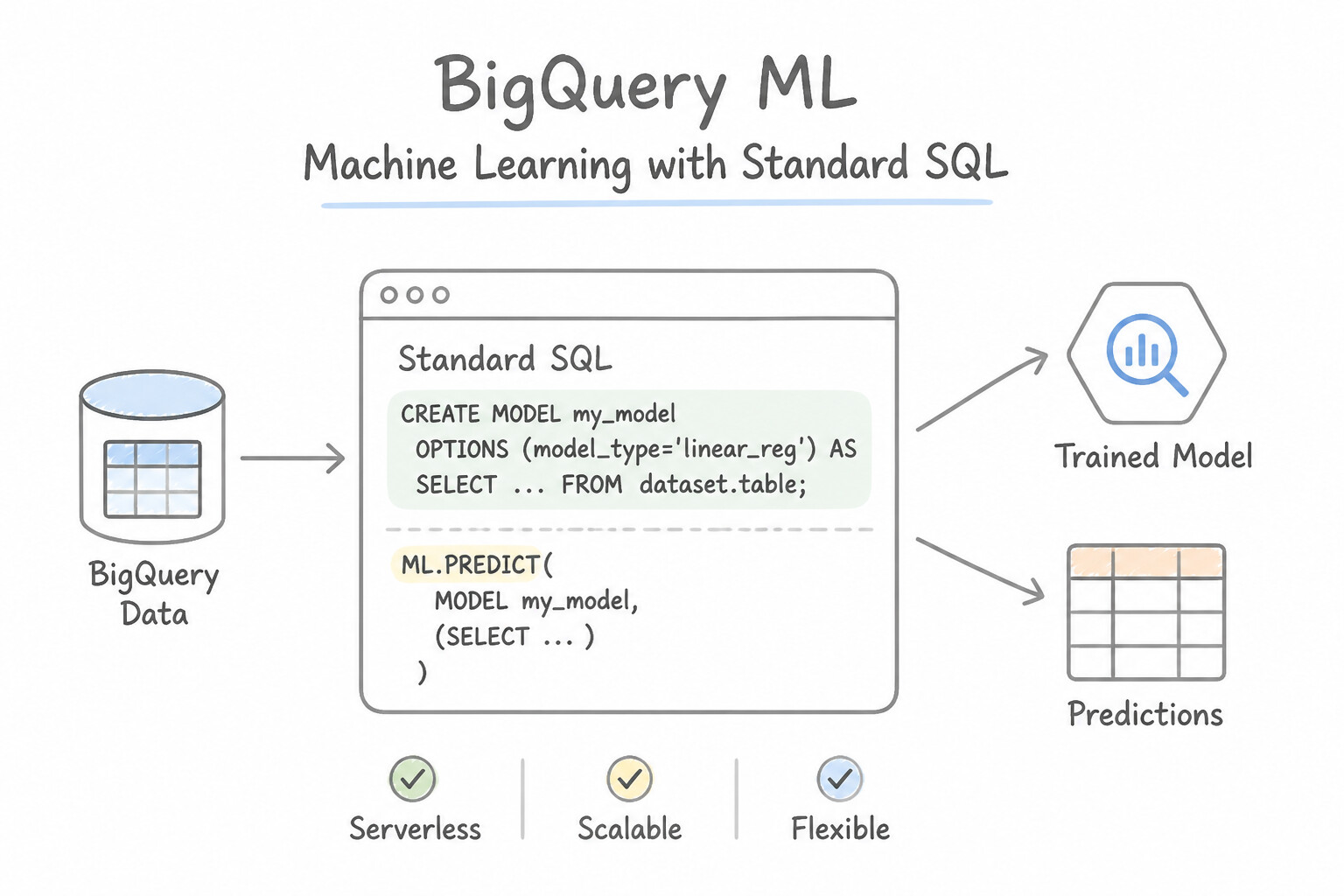
- Bring ML to the Data Using Standard SQL: Normally, training an ML model requires exporting terabytes of warehouse data into external files, spinning up Python clusters, and waiting on scarce data scientists. BigQuery ML (BQML) lets SQL data analysts create, train, evaluate, and run ML models (forecasting, classification, clustering, recommendation, and even remote Vertex AI Gemini calls) using familiar
CREATE MODELSQL syntax directly inside BigQuery. - Key Business Benefits: Eliminates data movement (preserving governance and security), dramatically accelerates experimentation speed, and expands ML authoring to every analyst who already knows SQL.
Key Implementation Patterns
- Leveraging Existing Analyst Skill Sets: Use Use BigQuery ML to create and train models using standard SQL queries. BigQuery ML enables SQL users to build machine learning models directly inside the data warehouse. (Avoid alternative: Cloud Vision API is for image analysis, not for predictive analytics on tabular transaction data.)
- Data Sovereignty and Movement Restrictions: Use Use BigQuery ML to create and train the model using SQL queries. BigQuery ML enables model training directly inside the data warehouse using SQL, avoiding data movement. (Avoid alternative: Streaming data to an external cluster violates the requirement to avoid data movement.)
Key Takeaways (3.2f)
- BigQuery ML enables data analysts to build ML models using standard SQL.
- Data does not need to be moved from the data warehouse to train models with BigQuery ML.
- Utilizing existing team skills (like SQL) accelerates adoption and reduces the need for specialized hires.
- BigQuery ML enables model training directly inside BigQuery using SQL, eliminating data movement.
Quick Decision Cheat Sheet (Subsection 3.2)
If the Scenario Requires... | Choose This Google Cloud AI Product | Avoid This Common Mistake |
|---|---|---|
"SQL analysts want to build & execute ML models directly inside the data warehouse without Python or exporting data" | BigQuery ML (BQML) | Vertex AI Custom Training or Dataflow |
"Train a custom model on proprietary company images/data with a no-code / point-and-click interface" | AutoML (on Vertex AI / Agent Platform) | Pre-trained Vision API (cannot learn custom classes) or Custom Training |
"Detect generic objects, faces, logos, explicit content, or OCR text from images out-of-the-box" | Vision API | AutoML or BigQuery ML |
"Transcribe customer call audio to text" vs. "Convert written text into natural spoken audio" | Speech-to-Text API vs. Text-to-Speech API | Natural Language API (processes text only, not raw audio) |
"Analyze customer reviews for positive/negative sentiment and extract named entities" | Cloud Natural Language API (or Gemini API) | Speech-to-Text API or Translation API |
"Turnkey enterprise search across internal SaaS apps + no-code workflow agents for employees" | Gemini Enterprise / Agent Platform ( Agent Studio) | Cloud TPUs or BigQuery ML |
"Purpose-built supercomputing architecture combining Cloud TPUs, GPUs, open frameworks, and flexible consumption" | Google Cloud AI Hypercomputer | Standard Compute Engine general-purpose VMs |
Further Reading (Subsection 3.2)
- Vision API Overview — The product page details the features of the Vision API, including landmark detection, and highlights how it allows developers to integrate vision detection features without needing ML expertise.
- Vertex AI documentation — Overview of Vertex AI and how it unifies AutoML and custom training into a single platform.
- Prepare image training data for classification — Explains how to use AutoML for image classification tasks without writing training code.
- Introduction to BigQuery ML — Provides an overview of how BigQuery ML allows the use of SQL to create ML models and lists supported model types like Linear Regression for forecasting.
- Vertex AI Agent Builder — Google Cloud provides platforms to build conversational agents, ground them in enterprise data, and equip them with tools to take actions in third-party systems.
- Vertex AI Agent Builder overview — Concept page covering ADK, Agent Garden, agent tools, and the agent lifecycle.
Book TOC · Previous · Chapter 3 of 7 · Next
AwesomeGCP.com Learning
The approach taken is a question-led learning approach: you explore realistic project scenarios where you need to make decisions or take actions to achieve business goals within specific constraints. Instead of passive learning, you are challenged to think and work through the options to master the Cloud Digital Leader (CDL) certification!