Book TOC · Previous · Chapter 8 of 8
Chapter 8: Master Service Disambiguation Matrix & Exam-Day Playbook
Google Cloud Certified Professional Agentic Architect — Cross-Cutting Architectural Synthesis & Rapid Decision Rules
Chapter Consolidation Telemetry: Synthesizes the complete PAA Look-Alike Disambiguation Matrix, the 5-Step Exam-Room Decision Protocol, and 30 Cross-Cutting Multi-Domain Production Scenarios with 5 Curated Architectural Diagrams.
Welcome to the Final Crucible. In Chapters 1 through 11, you mastered every single section and subsection of the Google Cloud Professional Agentic Architect (PAA) exam with a progressive fade in instructional scaffolding. However, during Chapters 1–11 you had one subtle advantage that you will not have in the real exam room: you knew which chapter you were in. When you were reading Chapter 7, your brain was primed to look for
MCP,A2A, orParallelAgent.On exam day, Question 1 might test Principal Access Boundary (
5.1), Question 2 might test Antigravity Pre-Tool Hooks (2.1), and Question 3 might test CX Agent Studio Transition Routes (1.1). Cognitive science calls this Interleaved Retrieval Practice—the ability to rapidly classify the domain, spot the look-alike distractor trap, and select the winning architecture from a cold start.
Part 1: The Complete 28-Tool Look-Alike Disambiguation Matrix
Before starting the 3 Practice Exam Sets below, study this Look-Alike Disambiguation Matrix. Over 80% of difficult exam distractors work by swapping two tools from this table that sound similar but operate at different architectural layers:
Look-Alike Pair / Triad | Choose Tool A When... | Choose Tool B (or C) When... | The Classic Exam Trap |
|---|---|---|---|
Gemini Enterprise vs. CX Agent Studio vs. ADK | Gemini Enterprise ( Agent Designer): Business/non-technical teams need a no-code internal assistant grounded on Workspace/SaaS connectors. | CX Agent Studio: Conversational UX teams need visual state machines ( Pages, Transition Routes, Event Handlers) for contact centers.ADK: Engineers need code-first Python/TS orchestration, custom tools, Git CI/CD, and cyclic graphs. | Building custom cyclic Python orchestration inside Gemini Enterprise, or writing raw state machines from scratch when visual CX Agent Studio Pages are requested. |
Agent Search vs. RAG Engine vs. Vector Search 1.0 | Agent Search (Vertex AI Search): You need turnkey managed search with out-of-the-box chunking, grounding, and native third-party document ACL inheritance. | RAG Engine: You need a customizable RAG pipeline (custom Document AI layout chunkers, custom embeddings, cross-encoder rerankers). Vector Search 1.0: You need the underlying low-latency ANN vector database supporting Hybrid Search (Dense + Sparse BM25) and streaming index updates. | Using custom Vector Search from scratch when turnkey SharePoint/Drive ACL inheritance is required (use Agent Search). |
Antigravity Skill vs. Antigravity Rule vs. Extension Hook | Skill ( SKILL.md): On-demand procedural playbook + scripts loaded via progressive disclosure only when relevant. | Rule: Brief, always-on formatting or coding style guideline injected into every turn. Extension Hook ( Pre-Tool / Post-Tool): Deterministic lifecycle script that inspects/blocks dangerous commands or auto-runs linters with 100% reliability. | Putting a 4,000-line playbook in an always-on Rule (bloats context), or relying on a Rule/Skill to block rm -rf instead of a Pre-Tool Execution Hook. |
Skill Registry vs. Agent Registry vs. Agent Gateway | Skill Registry: Publishing and versioning reusable SKILL.md procedural skill bundles across developer and agent environments. | Agent Registry: Enterprise catalog of deployed agents ( Agent Cards) and approved MCP servers for discovery and lifecycle governance.Agent Gateway: Inline runtime traffic proxy enforcing rate limits, quotas, W3C tracing, and kill-switches. | Expecting Agent Registry to throttle live network traffic (that's Agent Gateway), or storing Docker containers in Skill Registry. |
MCP vs. A2A (Agent2Agent) | MCP (North–South): Connecting an agent to deterministic tools ( tools/call), database queries, or read-only context (resources/read). | A2A (East–West): Delegating a complex goal to a peer autonomous reasoning agent (discovered via its Agent Card) with opaque internal state and async task updates. | Wrapping a stateless SQL query in an A2A agent, or trying to negotiate multi-step autonomous peer delegation over a stateless MCP tool schema. |
Managed Sessions vs. Memory Bank vs. Firestore vs. Memorystore for Redis | Managed Sessions: Short-term within-conversation working state ( session.state) on Agent Runtime.Memory Bank: Long-term cross-session semantic/episodic user facts extracted asynchronously. | Firestore: Serverless external document checkpoint store for custom Cloud Run agents & HITL suspension. Memorystore for Redis: Sub-millisecond in-memory store for ultra-low-latency state, distributed locks, and Semantic Caching. | Dumping raw 50-turn transcripts into Memory Bank synchronously on every turn, or storing multi-turn Cloud Run state in local /tmp memory. |
Agent Runtime vs. Cloud Run vs. GKE | Agent Runtime (Agent Engine): Turnkey managed hosting for stateful ADK/LangGraph agents with built-in Sessions & Memory Bank. | Cloud Run: Serverless containers & remote MCP servers that scale to zero (use min-instances for cold starts).GKE: Self-hosted open-weight models on GPUs/TPUs or untrusted code execution in GKE Sandbox ( gVisor). | Provisioning a 24/7 GKE cluster for a simple stateless MCP webhook, or running untrusted LLM-generated Python inside the main agent container. |
Model Armor vs. Principal Access Boundary (PAB) vs. VPC Service Controls (VPC-SC) | Model Armor: Inspects prompts, retrieved RAG chunks, and outputs to block Direct/Indirect Prompt Injection, jailbreaks, and toxic content. | PAB: Identity-centric policy bound to an Agent Identity restricting which resources that principal can ever access.VPC-SC: Network/service perimeter around GCP APIs (BigQuery, GCS, Vertex AI) preventing data exfiltration. | Using Model Armor to restrict cross-project IAM permissions (use PAB), or using prompt instructions to stop Indirect Prompt Injection (use Model Armor + deterministic gates). |
Auth Manager (OAuth 2.0 OBO) vs. Agent Identity (Service Account) | Auth Manager (OAuth 2.0 On-Behalf-Of / Authorization Code): When an agent acts on behalf of a human user and must respect that user's exact downstream permissions. | Agent Identity (Workload Identity / OIDC): When an agent runs autonomously in the background or accesses shared agent-level infrastructure with least-privilege IAM. | Using a single privileged Service Account to query user-specific HR/CRM records for all employees. |
Cloud Trace vs. Cloud Logging vs. Agent Evaluation | Cloud Trace: Visualizing end-to-end waterfall latency spans across multi-agent/MCP hops using W3C traceparent. | Cloud Logging: Recording structured JSON audit/trajectory payloads linked via trace_id.Agent Evaluation: Scoring Trajectory ( Exact/In-Order/Any-Order) and Autorater rubrics against a Golden evalset. | Debugging distributed latency bottlenecks without W3C traceparent propagation, or grading open-ended LLM answers with BLEU/ROUGE regexes. |
Part 2: The 5-Step Exam-Room Decision Protocol
When you read each of the 30 scenarios in the 3 Practice Exam Sets below, execute this exact 5-step mental checklist in under 60 seconds:
- Step 1 — Read the Final Sentence First: Identify whether the question asks for lowest operational overhead, lowest latency, strict deterministic security, cost optimization, or root-cause remediation.
- Step 2 — Highlight the 2–3 Structural Constraints: Look for the telltale signals ("no-code business team", "independent subtasks", "preserve end-user permissions", "untrusted external documents", "scale to zero").
- Step 3 — Eliminate the 2 Rule-Violating Distractors Immediately: Cross out any option that uses static API/JSON keys, system prompt rules for security/isolation, local container memory for multi-turn state, or unbounded retry loops.
- Step 4 — Break the Tie Between the Final 2 Contenders Using the Disambiguation Matrix: Ask: Is this North–South (
MCP) or East–West (A2A)? Is this principal boundary (PAB) or network perimeter (VPC-SC)? Is this short-term working memory (Managed Sessions) or cross-session fact retention (Memory Bank)? - Step 5 — Commit to Your Selections and Check the TL;DR Answer Section at the End.
Part 3: Cross-Cutting Multi-Domain Production Architecture Takeaways
Why Cross-Cutting Patterns Matter: The hardest questions on the exam combine constraints from multiple sections simultaneously (e.g., Identity + Networking + Data Security + Observability + Cost). The table and visual diagrams below synthesize the 30 capstone cross-cutting scenarios into rapid architectural decision rules.
# | Cross-Cutting Scenario & Multi-Domain Constraints | Winning End-to-End Architecture | Critical Distractor Trap to Reject |
|---|---|---|---|
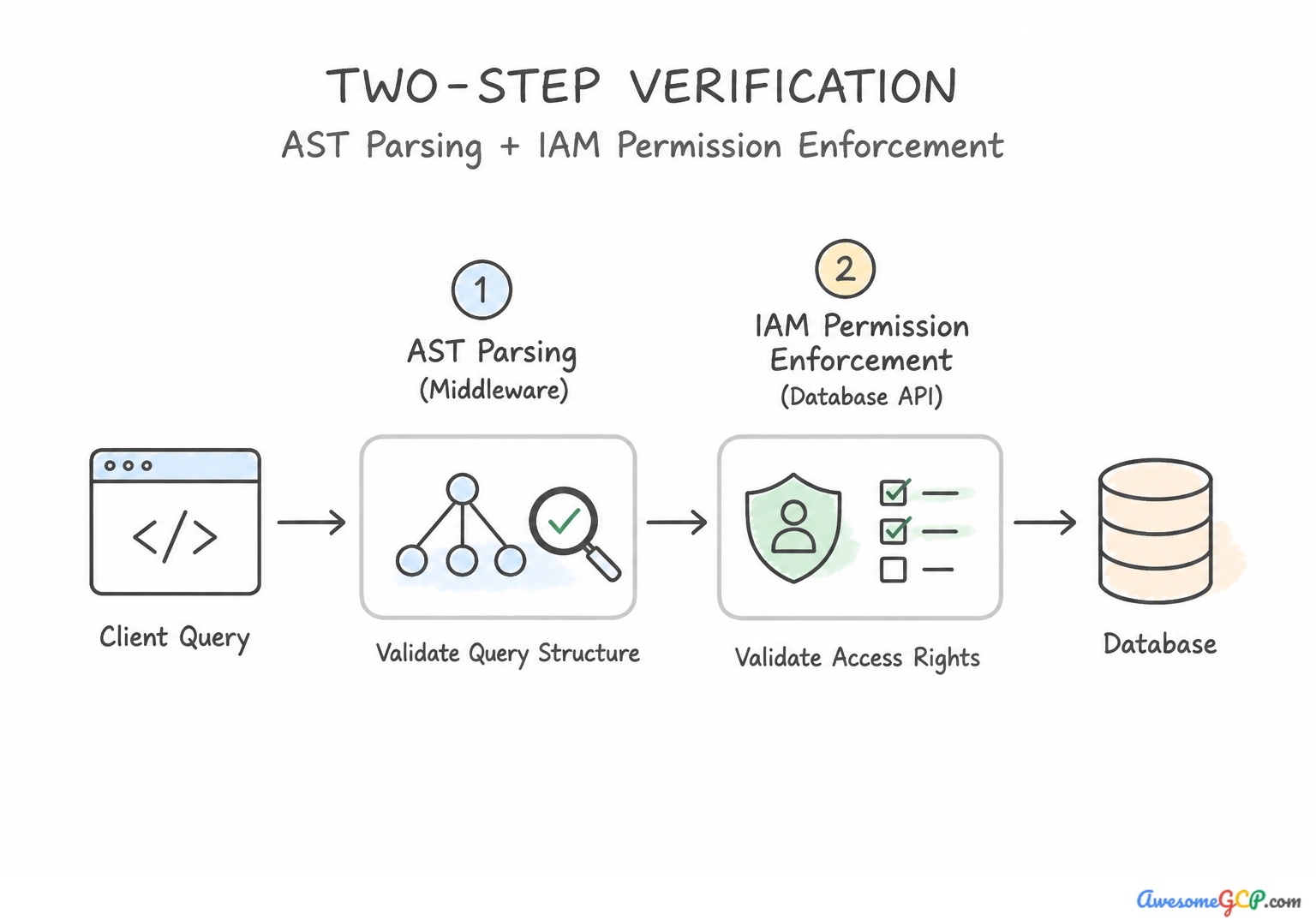
1 | Deterministic security guardrails and least-privilege configurations for an LLM agent: The scenario requires an automated agent to generate and execute SQL queries against BigQuery while strictly guaranteeing that destructive DDL (such as DROP TABLE) and DML (such as DELETE FROM) statements can never run. The analysis must identify guardrail mechanisms that operate deterministically rather than probabilistically. | Enforce read-only IAM permissions on the BigQuery Service Account and validate SQL statements with query parser hooks. Implementing least privilege IAM roles prevents unauthorized modifications at the platform level, while query parser hooks validate statements programmatically before execution. | Requiring human verification for every query slows down the agent workflow and fails to provide programmatic security guarantees. |
2 | Pass custom HTTP headers to an external Model Context Protocol (MCP) server: An agent communicating with an external Model Context Protocol (MCP) server. The external server enforces multi-tenancy through custom HTTP headers. | Configure the MCP client transport options to include the required tenant headers in outgoing requests. Configuring the HTTP transport options on the MCP client ensures that every outgoing request automatically carries the required tenant headers. | System instructions guide language generation, not network transport options for external MCP server connections. |
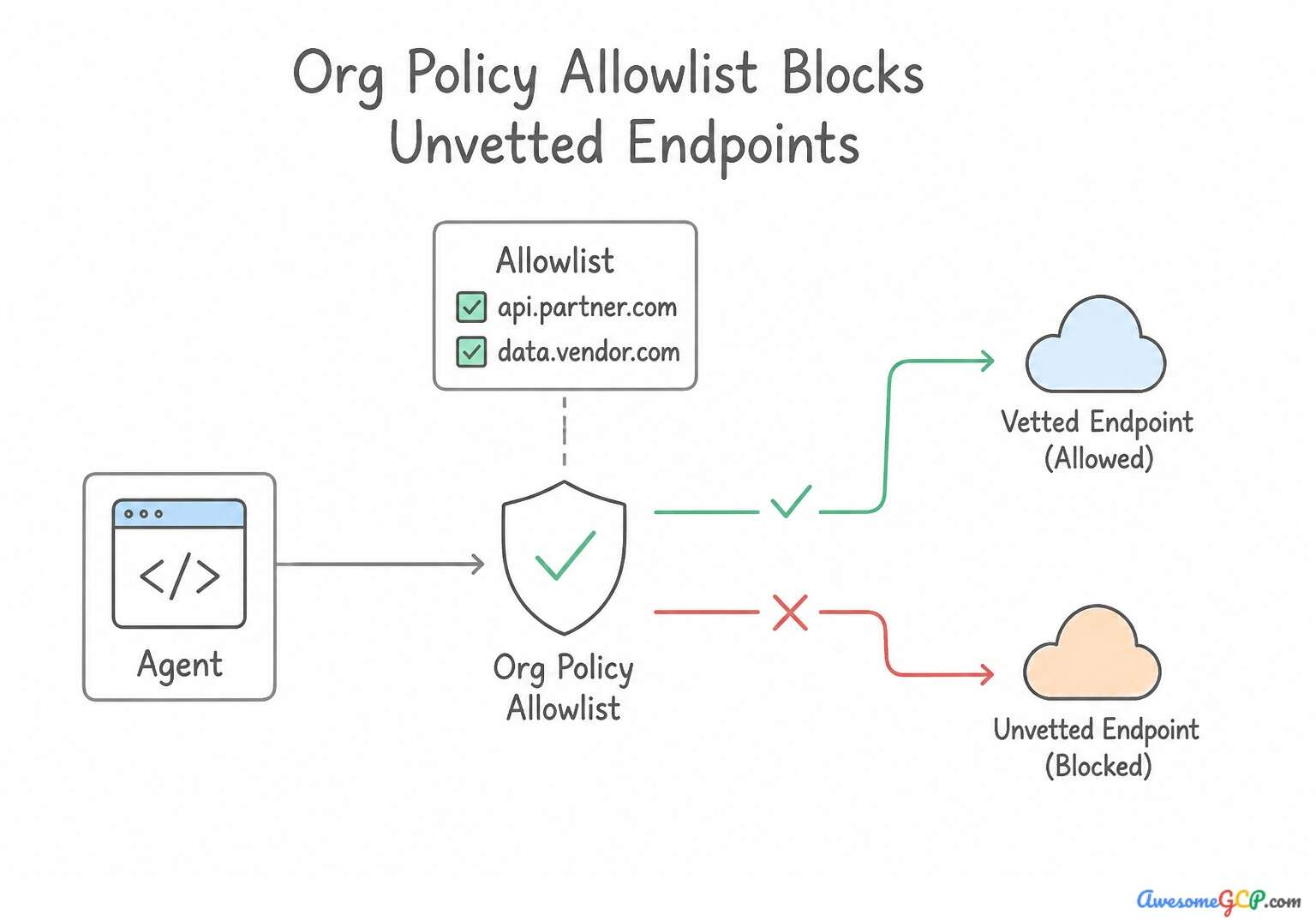
3 | Restricting Unauthorized Tool Bindings via Organizational Policy and Registry Controls: The scenario requires stopping developers from binding arbitrary, unapproved third-party APIs to AI agents in a financial institution. The solution must provide centralized governance and enforce the attachment of only security-approved tools and schemas across the organization. | Define an Organization Policy constraint and configure Agent Registry controls to restrict extension endpoints to an allowlist of approved schemas. Enforce an Organization Policy constraint with Agent Registry allowlists to restrict agent extensions to verified schemas. | Model Armor filters prompt content during runtime rather than governing tool registration and infrastructure bindings. |
4 | Configuration in Vertex AI Search to maintain fresh document embeddings and indices: A data freshness lag in an enterprise agent that relies on technical policy documentation. Employees observe that policy changes published a few hours prior are missing from the responses of the agent. | Configure automated incremental indexing pipelines in Vertex AI Search to ingest document updates promptly. Automated incremental indexing updates the data store with fresh documentation shortly after publication. | Monthly index rebuilds fail to resolve freshness delays that require hourly synchronization. |
5 | Proper online evaluation and deployment strategy to test an AI agent prompt update: The core task requires evaluating a modified agent system prompt on a small subset (five percent) of production users before broad release. Key requirements include: (1) isolating exposure to a specific percentage of real traffic, and (2) gathering quantifiable metrics on user satisfaction. | Conduct an online A/B test with traffic splitting in Cloud Run and monitor user conversion and rating metrics. Configuring traffic splitting in Cloud Run safely directs five percent of live traffic to evaluate the new prompt against baseline metrics. | Email surveys do not test actual prompt execution on five percent of live traffic. |
6 | Asynchronous Long-Running Task Coordination in A2A: A multi-agent orchestration architecture where a coordinating agent delegates an autonomous job that takes 45 minutes to execute. Standard synchronous communication fails because HTTP requests time out after short intervals. | Implement an asynchronous A2A pattern where the orchestrator receives a task ID immediately and receives completion notifications through Cloud Pub/Sub or a webhook callback. Asynchronous delegation returning a task ID and notifying through Cloud Pub/Sub or webhooks prevents HTTP timeouts on long-running tasks. | Holding open 60-minute synchronous HTTP connections is unreliable and exceeds standard gateway timeout thresholds. |
7 | Securing Custom Tool Execution via Cloud Run IAM Authentication: A scenario where a custom conversational agent in Vertex AI Agent Builder calls a backend Cloud Run microservice through an OpenAPI tool extension. The Cloud Run service requires IAM authentication. | Grant the Cloud Run Invoker (roles/run.invoker) role on the Cloud Run service to the service account of the agent. Configure the tool authentication with an OpenID Connect (OIDC) ID token that specifies the Cloud Run service URL as the audience. Grant roles/run.invoker on the Cloud Run service to the agent service account and configure OIDC ID token authentication targeting the service URL. | API keys and basic authentication are unsupported for IAM authentication on Cloud Run. |
8 | Practical implication of high groundedness combined with moderate or lower answer: Two specific evaluation metrics from a Retrieval-Augmented Generation (RAG) or AI agent assessment: groundedness (98%) and answer relevance (80%). To answer correctly, one must understand the distinct definitions of groundedness (faithfulness to reference material) and answer relevance (alignment with the user's explicit question). | The responses were factually grounded in the source context, but failed to address the specific question asked by the user. High groundedness indicates adherence to the reference context, whereas lower relevance indicates the response did not fully answer the prompt. | Hallucination leads to low groundedness scores, not high groundedness scores. |
9 | Managed Google Cloud service tailored for ultra-low latency, in-memory data storage: The question contains two critical requirements: distributed session state and ultra-low latency in-memory session caching across microservices. Microservices often need externalized session stores because any stateless worker node may handle incoming user requests. | Cloud Memorystore for Redis. Cloud Memorystore for Redis delivers sub-millisecond, in-memory caching suited for centralized session state management across microservices. | Cloud Storage Coldline storage class is designed for infrequent data archiving, not low-latency session caching. |
10 | Concurrency control and persistence mechanism to maintain shared state integrity across: A multi-agent architecture where autonomous sub-agents execute concurrent operations against a shared data structure (the task board). The core problem requires avoiding race conditions, dirty reads, and lost updates while maintaining system scalability and persistence. | Use distributed transactions or optimistic concurrency locking in Cloud Firestore for session state updates. Cloud Firestore transactions provide atomic reads and writes with optimistic concurrency controls that prevent race conditions across concurrent agents. | Executing all sub-agents sequentially eliminates concurrency advantages and severely limits scalability. |
11 | Restricting Tool Access Using Credential Access Boundaries: The scenario requires an AI agent to execute tools with dynamically restricted permissions per session. The service account holds broad access across multiple Cloud Storage buckets, but each tool invocation should only access one session-specific bucket without changing static IAM configurations. | Generate a downscoped OAuth 2.0 access token by applying a Credential Access Boundary rule that restricts access to the session bucket. Downscoped tokens with Credential Access Boundaries dynamically restrict existing OAuth tokens to specific resources. | Creating and deleting service accounts dynamically causes latency and violates IAM scalability limits. |
12 | Recommended architectural design pattern for integrating JSON-native AI agents: An integration challenge: modern generative AI models and agent frameworks (such as the Agent Development Kit, or ADK) interact best with structured JSON payloads through function calling. However, the target service is a legacy SOAP API that strictly accepts XML. | Create an intermediate tool adapter in ADK that translates JSON function calls from the model into SOAP XML requests. An intermediate adapter translates clean JSON function call arguments into SOAP XML payloads and converts the response back to JSON. | Prompting the model to generate raw XML increases syntax errors and token usage while bypassing standard function-calling mechanisms. |
13 | Architectural pattern required to centrally govern, inspect, and rate limit agentic: A scenario where enterprise artificial intelligence (AI) agents need access to external Model Context Protocol (MCP) servers located outside Google Cloud. The critical technical constraints require: (1) central inspection of outgoing requests, (2) sensitive data leak prevention, and (3) centralized rate limiting. | Deploy Agent Gateway as an intermediary proxy between agents and external MCP servers. An Agent Gateway serves as a centralized intermediary proxy to inspect requests, enforce rate limits, and sanitize sensitive payloads before reaching third-party endpoints. | Embedding API keys inside public clients exposes secrets and creates major security vulnerabilities. |
14 | Architectural pattern required to achieve omnichannel conversational state persistence: The key requirements are maintaining conversation context across disparate channels (web chat, mobile application, and SMS) and ensuring that the transition is seamless. This necessitates decoupling state management from individual frontend clients and placing session persistence into a centralized shared data store. | Bind user interactions across all channels to a centralized persistent user profile and session ID in Cloud Firestore. A centralized persistent store like Cloud Firestore allows all channels to share and retrieve session state seamlessly. | Isolated in-memory sessions prevent conversation history from syncing across different devices or channels. |
15 | Evaluation metric and dataset type for validating agent safety guardrails and refusal: A scenario where an AI agent must handle safety-critical requests by refusing to answer instructions that cause harm (specifically creating dangerous chemicals). To verify proper safety alignment, you need an evaluation metric that benchmarks policy enforcement against intentionally harmful inputs. | Safety compliance and refusal accuracy on adversarial red-teaming evalsets. Safety compliance and refusal accuracy on red-teaming datasets directly measures an agent's capability to refuse harmful and prohibited prompts. | Context recall evaluates retrieval completeness for knowledge bases, not safety guardrails or harmful prompt refusals. |
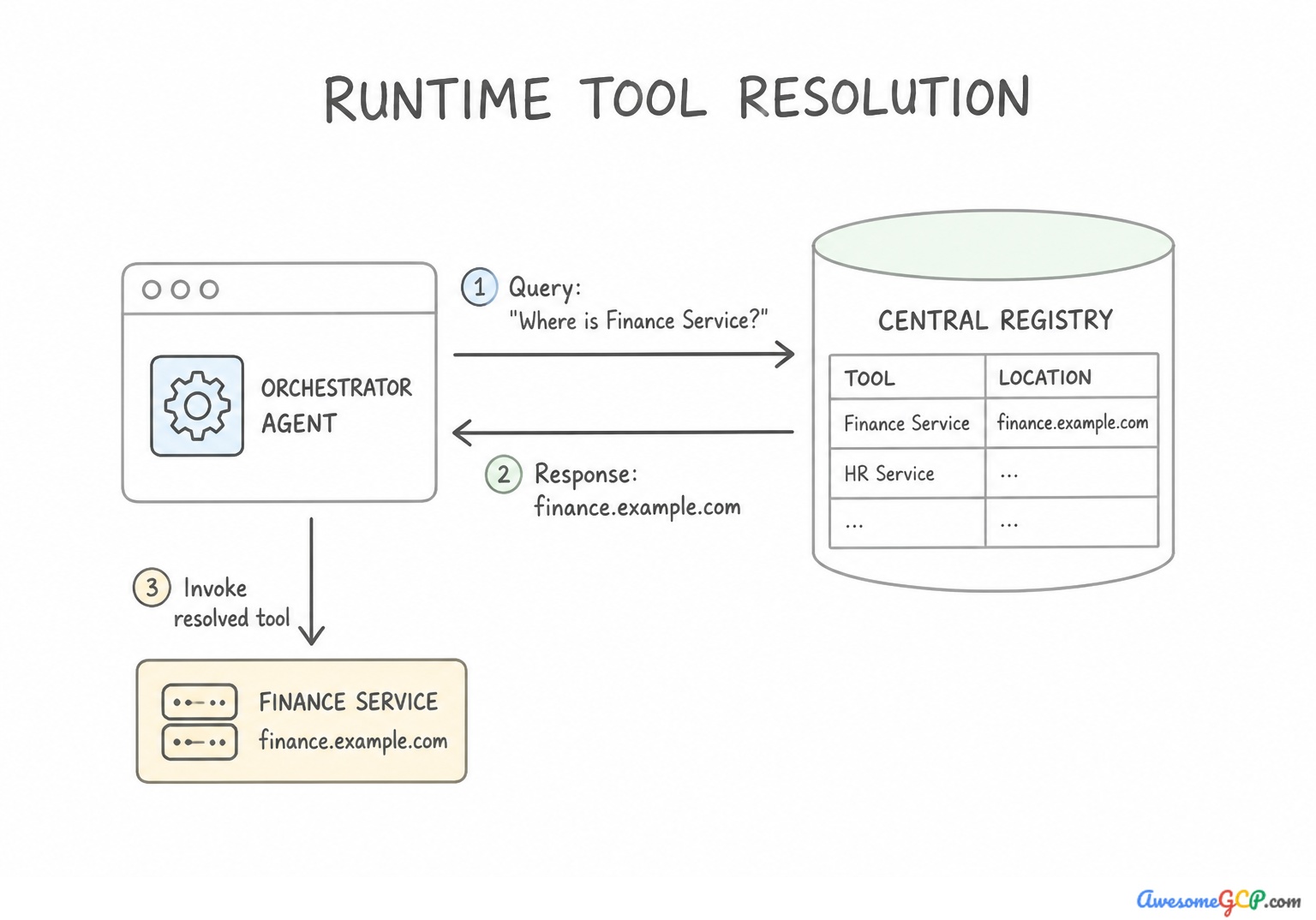
16 | Architectural approach that allows agent orchestrators to discover service endpoints: The question specifies two critical requirements: dynamic discovery and connection at runtime, and the avoidance of hardcoded service URLs within an agent orchestrator context. | Configure the orchestrator agent to query Agent Registry to resolve endpoint definitions dynamically. An Agent Registry resolves tool and service endpoints dynamically at runtime, removing the need for hardcoded URLs. | Prompting end users introduces severe security risks and a poor user experience. |
17 | Dynamic Metadata Filtering for Multi-Tenant Data Isolation: The scenario requires restricting document retrieval across multiple tenants sharing a single centralized data store. Key requirements are: (1) multi-tenant data isolation, (2) dynamic assignment based on the user's client ID, and (3) avoiding the administrative complexity of managing separate data stores per tenant. | Configure the client ID as a filterable metadata property during data ingestion, and apply a dynamic filter expression in the agent data store tool settings. Configuring filterable metadata fields at ingestion and applying dynamic filter expressions at query time achieves secure multi-tenant data isolation. | Creating separate data stores per tenant violates the requirement and introduces severe management overhead. |
18 | Standard automated pipeline architecture in Google Cloud to test prompt latency: The scenario requires incorporating automated performance testing into a CI/CD pipeline specifically to enforce latency service level objectives (SLOs) for generative AI agent prompts. The key elements are automated CI/CD testing and verifying latency thresholds to prevent regressions. | Execute automated performance and evaluation benchmarks in Cloud Build and gate deployment on latency thresholds. Automate evaluation benchmarks in Cloud Build and halt deployment if latency exceeds established service level objectives. | Removing monitoring ignores performance degradation rather than solving it. |
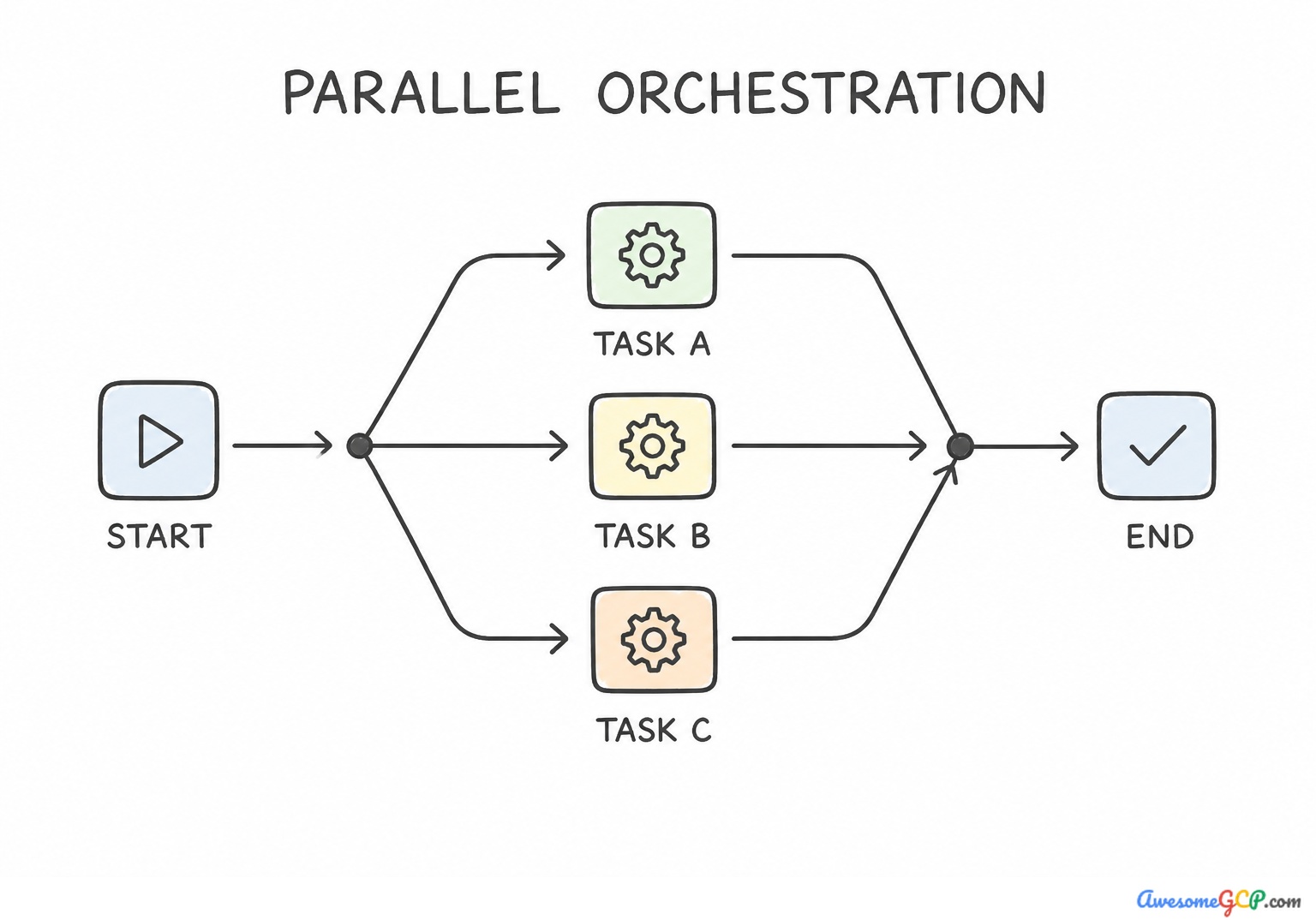
19 | Multi-agent design pattern that executes independent sub-tasks concurrently to reduce: The scenario requires orchestrating workflows across multiple SaaS applications with two specific goals: minimize latency and avoid token waste for independent sub-tasks. The key architectural decision centers on how independent agent tasks are scheduled and executed. | Execute independent sub-tasks concurrently using parallel agent branches in ADK. Concurrent execution through parallel agent branches reduces total processing latency and isolates contextual token overhead for independent tasks. | Sequential execution forces independent steps to run one after another, maximizing end-to-end latency and accumulating unnecessary token context. |
20 | IAM Least Privilege and Workload Identity for Automated Sandbox Workers: The scenario requires configuring authentication for an automated agent running in a GKE sandbox. The agent must interact with Google Cloud APIs with least-privilege permissions without gaining access to the broader GKE node credentials. | Enable Workload Identity on the GKE cluster, create a dedicated Google Service Account with scoped permissions, and bind it to the Kubernetes ServiceAccount of the agent pod. Workload Identity securely binds a Kubernetes ServiceAccount to an IAM Google Service Account with least privilege. | Node-level service accounts share broad permissions across all pods on the node. |
21 | Standard AgentOps practice for assessing model behavior during network latency: Validating the resilience, fallback mechanisms, and behavioral stability of an AI agent when external integrations degrade. A resilient agent architecture requires proactive testing against simulated network failures. | Perform chaos testing and synthetic fault injection on tool endpoints during staging evaluation. Injecting artificial latency and errors in staging tests the resilience and error-handling capabilities of the agent before production release. | Testing solely in zero-latency environments prevents uncovering real-world tool execution failures. |
22 | Architectural design pattern that connects an enterprise agent tool to private backend: The scenario defines two mandatory technical constraints for an enterprise agent executing an internal tool: keep network traffic entirely within private channels (never traversing the public internet) and prevent interception of transmitted data. | Connect through Direct VPC Egress with Mutual TLS (mTLS) within a VPC Service Controls perimeter. Direct VPC Egress keeps traffic inside private networks, mTLS encrypts communications, and VPC Service Controls mitigates data exfiltration risks. | Assigning a public IP address exposes the database to the public internet and disables protective network boundaries. |
23 | Multi-Tenant Context Isolation: A multi-tenant B2B system where conversation context from one organization is leaking into another organization's session. The root cause is identified: session IDs generated by the calling application lack tenant namespacing, leading to collisions or shared memory retrieval in the Agent Engine managed session backend. | Configure the application to prefix session IDs with a unique tenant identifier and enforce tenant-level metadata filtering when querying the memory bank. Prefixing session IDs and metadata with tenant identifiers creates isolated namespaces in shared multi-tenant memory. | Provisioning a separate agent instance per user is impractical, expensive, and unscalable. |
24 | Standard architectural pattern for sharing intermediate data across multiple agents: The question tests knowledge of multi-agent state management within Google Cloud's Agent Development Kit (ADK) and Vertex AI Agent Builder. | Use the shared ADK session state context object to pass structured variables between sub-agents. ADK session state provides a managed, in-memory context object designed specifically for sharing structured data between sub-agents across a workflow. | Repeatedly querying databases introduces significant latency and directly contradicts the explicit prompt requirement. |
25 | Detecting Tool Execution Sequencing and Dependency Drift: An agentic workflow with a strict order-of-operations dependency: KYC verification must happen before portfolio rebalancing. The evaluation pipeline must detect when this order is violated. Key indicators are 'strict policy', 'execute verify_kyc before initiate_portfolio_rebalance', and 'detect sequencing violations'. | Implement a trajectory evaluation metric in the evaluation pipeline to validate the directed sequence of executed tool calls against permissible state transitions. Implement trajectory evaluation to check the sequence and order of tool executions against valid state transitions. | Latency evaluators measure tool response duration, not the sequential order of operations. |
26 | Intermittent Batch Agent Evaluation and Simulation: Three critical technical parameters: 1) The agent simulation workload is episodic (executes once weekly for 35 minutes), 2) It processes data to completion asynchronously without an HTTP listener endpoint, and 3) The organization must avoid idle compute costs during weekdays. | Package the agent workload into a container and execute it as a Cloud Run job triggered on a schedule by Cloud Scheduler. Cloud Run jobs runs containerized non-HTTP batch tasks to completion and incurs zero cost when idle. | Cloud Run services requires an HTTP server interface to handle incoming web traffic. |
27 | Cloud Run autoscaling configuration that provides elastic capacity during traffic spikes: The scenario requires deploying an enterprise agent application on Cloud Run with two explicit criteria: (1) handle sudden traffic surges without dropping requests, and (2) optimize cloud costs during idle periods. | Configure Cloud Run autoscaling with minimum instances set to zero (or low baseline) and appropriate maximum instance limits. Cloud Run autoscaling automatically provisions instances during demand surges up to the maximum instance limit and scales down to zero (or a low baseline) during idle periods to minimize costs. | Disabling autoscaling and dropping concurrent requests directly contradicts the requirement to handle traffic spikes. |
28 | Form Filling Parameter Event Handler vs Page Event Handler: The scenario requires prompting the user with a specific error message when an invalid format is entered for a particular form field (a 10-digit national ID), while preventing generic page-level fallback behavior. The key requirement is understanding the hierarchy and scoping of event handlers in state-based visual agent design. | Add a sys.no-match-default event handler directly within the national identification form parameter settings. Configuring event handlers directly inside the form parameter handles validation failures specifically for that parameter during slot filling. | Webhooks on the start page introduce unnecessary complexity when native parameter event handlers fulfill the requirement. |
29 | Latency and Token Optimization through Agent Profiling: Two specific issues: high API costs (driven by high token consumption) and 15-second latency delays during multi-file refactoring. The prompt specifies that you need to inspect context assembly and reduce redundant token overhead. | Run the agents CLI profile command to analyze context assembly and token distribution, then enable prompt caching and context trimming in the agent configuration. Profile context assembly with the CLI and apply prompt caching with context trimming to reduce redundant token processing and latency. | Network socket tracing and adjusting model temperature do not address token bloat or context assembly latency. |
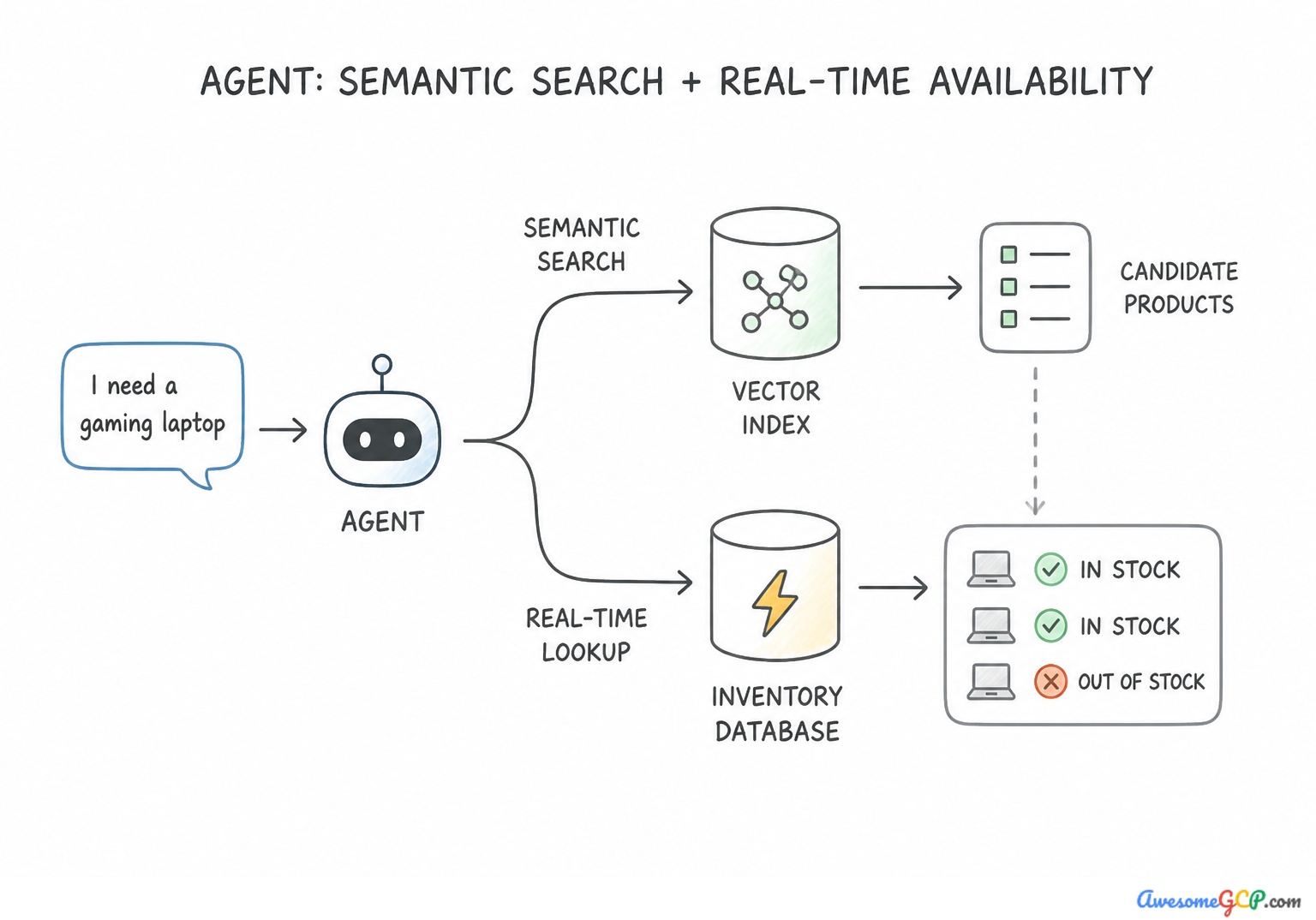
30 | An enterprise agent architecture that balances semantic discovery with real-time: An e-commerce agent handling two distinct data characteristics: unstructured, descriptive information (the dynamic product catalog) and fast-changing, volatile transactional data (inventory levels changing throughout the day). The ideal solution must support semantic discovery while guaranteeing real-time operational accuracy. | Implement hybrid retrieval that combines vector search for catalog exploration with live database tool lookups for inventory status. Hybrid retrieval pairs semantic vector search for product matching with deterministic database tool calls for real-time inventory checks. | Language models must not guess or approximate exact transactional data such as real-time product inventory. |
Part 4: Final Exam-Day Checklist — Top 25 Golden Rules
- Never rely solely on system prompt instructions for security boundaries or access controls.
- Implement defense-in-depth by pairing least-privilege IAM roles with application-layer query validation.
- Grant read-only roles such as
roles/bigquery.dataViewerandroles/bigquery.jobUserto prevent destructive DDL/DML execution at the API layer. - Model Context Protocol (MCP) connects agents to external resources through standardized transport protocols like HTTP/SSE and stdio.
- Tenant identification and authentication headers must be declared within the MCP client transport configuration options.
- Do not place network credentials or transport metadata into user prompts or model system instructions.
- Never disable server tenant security to resolve client-side integration requirements.
- Use Organization Policy constraints to enforce enterprise-wide infrastructure and resource guardrails.
- Agent Registry controls ensure agents only bind to vetted, pre-approved OpenAPI schemas and tools.
- Model Armor is designed for runtime prompt and payload filtering, not structural resource configuration governance.
- Use incremental indexing in Vertex AI Search to keep search datastores synchronized with source document modifications.
- Avoid using model fine-tuning for dynamic enterprise facts; leverage RAG retrieval layers instead.
- Full index rebuilds are costly and unsuitable for real-time or hourly data freshness requirements.
- Online A/B testing evaluates prompt enhancements against genuine user behavior and business metrics.
- Cloud Run supports native traffic splitting across revisions to conduct canary releases and fractional testing.
- User satisfaction is quantified through explicit signals (ratings) and implicit signals (conversion rates, session duration, abandonment).
- Synchronous agent-to-agent communication is suitable only for fast, short-lived tasks.
- Long-running sub-agent operations require an asynchronous contract: non-blocking job submission, task IDs, and event-driven notifications (Cloud Pub/Sub or webhooks).
- Avoid extending synchronous timeouts or rapidly retrying initial requests for long compute workloads.
- Cloud Run service-to-service authentication requires an OpenID Connect (OIDC) ID token, not an OAuth 2.0 access token or API key.
- The calling service account must possess the
roles/run.invokerrole on the target Cloud Run service. - The audience (
aud) field of the ID token must match the URL of the target Cloud Run service. - Always apply least privilege by scoping the invoker role directly to the specific Cloud Run service resource rather than project-wide.
- Groundedness evaluates faithfulness to the provided source documents (absence of hallucinations).
- Answer Relevance evaluates how well the generated answer fulfills the user prompt.
Book TOC · Previous · Chapter 8 of 8
AwesomeGCP.com Learning
The approach taken is a question-led learning approach: you explore realistic project scenarios where you need to make decisions or take actions to achieve business goals within specific constraints. Instead of passive learning, you are challenged to think and work through the options to master the Professional Agentic Architect (PAA) certification!