Book TOC · Previous · Chapter 6 of 8 · Next
Chapter 6: AgentOps: Evaluation, Autoraters, Deployment, Tracing & Cost Optimization
Official Exam Guide Subsections Consolidated: 4.1, 4.2
Chapter Consolidation Telemetry: Synthesizes 82 architectural scenarios across 2 Exam Subsections and 7 Official Considerations into consolidated takeaway pillars, paired with 2 Reference Architecture Mermaid Diagrams and 18 Curated Visual Illustrations.
Chapter Focus: Gen AI Evaluation Service, LLM-as-a-Judge rubrics, trajectory precision/recall, Agent Engine vs. Cloud Run vs. GKE, OpenTelemetry tracing, and context caching.
Subsection 4.1: Evaluating and testing agents
Section 4: Testing, Deploying, Monitoring, and Scaling Production Agents (22%) · 4 Official Considerations · 40 Scenarios Consolidated
Domain Overview and Reference Architecture
Why Traditional Software Unit Tests Fail on Autonomous Agents
In deterministic software engineering, assert add(2, 2) == 4 is sufficient. In agentic systems, an agent can produce a polite, grammatically flawless final answer while having called the wrong tool, hallucinated an intermediate parameter, or taken 14 redundant loop iterations to get there. Even worse, because LLMs are non-deterministic, a single passing test run proves nothing—you must evaluate both the intermediate execution trajectory and the final response/retrieval quality statistically across a curated Golden Dataset (evalset).
Section 4.1 of the PAA exam tests four interconnected engineering practices:
- Curating Golden Test Sets (
4.1a): Designing representative test suites covering happy paths, multi-turn context switches, adversarial edge cases, and sanitized production failure traces. - Continuous Tool Execution Evaluation Pipelines (
4.1b): Automating CI/CD quality gates that verify tool selection, JSON parameter validity, and trajectory ordering (Exact,In-Order,Any-Order). - Selecting Evaluation Frameworks & Custom Autoraters (
4.1c): Knowing when to use ADK Evaluation (evalset), Agent Platform Gen AI Evaluation Service, and rubric-basedLLM-as-a-Judgecustom autoraters calibrated against human domain experts. - Evaluating RAG & Response Quality Against Golden Datasets (
4.1d): Measuring the RAG Triad (Context Relevance, Groundedness/Faithfulness, and Answer Relevance) to pinpoint whether a failure lives in the retriever or the generator.
Exam Scope Covered in This Chapter
4.1aCreating Test Sets for Agent Evaluation: Building comprehensive Golden Datasets combining normal user journeys, boundary/edge cases, tool failure injections, and PII-redacted production regressions.4.1bCreating Continuous Evaluation Pipelines for Tool Execution: Automating CI/CD gates that grade intermediate Agent Trajectories (Exact Match,In-Order Match,Any-Order Match), tool selection precision/recall, and parameter accuracy.4.1cDetermining the Appropriate Evaluation Framework and Tooling: Choosing between ADK evaluation tooling (evalset), Agent Platform Gen AI Evaluation Service, and Custom Autoraters (LLM-as-a-Judge) calibrated to human raters.4.1dEvaluating Response and Retrieval Quality Against a Golden Dataset: Diagnosing retrieval vs. generation defects using Context Precision/Recall, Groundedness (Faithfulness), and Answer Relevance.
Core Foundational Primitives & Mental Models (Subsection 4.1)
Core Concept / Service | Winning Architectural Rule & Default Behavior | Common Exam Trap to Avoid |
|---|---|---|
Golden dataset (Services: vertex_ai:evaluation, vertex_ai:genai_evaluation) | A golden dataset is the industry-standard term for a curated ground-truth reference dataset used to evaluate and benchmark model or agent outputs. | Production telemetry measures operational metrics and system performance rather than semantic benchmark accuracy. |
evalset (Services: vertex_ai:agent_builder, vertex_ai:evaluation) | An evalset organizes test cases and ground-truth expectations to systematically benchmark agent tool calling and reasoning. | Kubectl is a Kubernetes cluster management utility, not an agent evaluation feature. |
Agent Platform evaluation service (Services: vertex_ai:agent_builder, vertex_ai:evaluation) | Agent Platform evaluation service provides automated metrics and evaluation pipelines to assess generative AI agent response quality at scale. | Cloud DNS manages domain name resolution and has no relationship to evaluating AI agents. |
Autoraters (Services: vertex_ai:evaluation, vertex_ai:agents) | Autoraters utilize specialized scoring prompts or models to automatically grade agent and model outputs. | Hypervisors manage virtual machines on physical hardware, not generative AI evaluation. |
Tool execution assessment (Services: vertex_ai:agents, vertex_ai:evaluation) | Tool execution assessment validates that the model selects the right function and provides properly structured arguments. | VPC flow analysis examines network telemetry and packet flow rather than agent reasoning or tool parameter generation. |
Retrieval quality (Services: vertex_ai:rag, vertex_ai:search, vertex_ai:evaluation) | Retrieval quality directly measures the relevance and accuracy of retrieved documents relative to user queries in RAG systems. | RAM clock speed is a hardware metric, not a semantic evaluation metric. |
Edge cases (Services: vertex_ai:agents, vertex_ai:evaluation) | Edge cases test atypical, malformed, or extreme inputs to verify graceful degradation and robust agent handling. | Smoke tests check broad, high-level functionality rather than specific boundary and malformed conditions. |
Detect regression in behavior (Services: vertex_ai:gen_ai_evaluation, vertex_ai:agents, cloud_build) | Continuous evaluation in CI/CD automatically tests agent performance to detect behavioral regressions caused by prompt, model, or code updates. | Renewing certificates handles network security and transport encryption, not agent behavioral testing. |
Assess robustness and safety (Services: vertex_ai:genai_evaluation, vertex_ai:agents) | Evaluating edge cases determines whether an agent can handle unusual, out-of-distribution, or adversarial inputs safely and reliably. | Evaluating prompt edge cases assesses model behavior, not container build performance. |
Tool selection accuracy (Services: vertex_ai:agents, vertex_ai:evaluation, vertex_ai:reasoning_engine) | Tool selection accuracy measures whether the agent chooses the expected function or API to solve the user task. | Disk read throughput measures storage transfer rates, not generative AI tool routing. |
Official Exam Considerations & Consolidated Takeaways (Subsection 4.1)
Consideration 4.1a: Creating test sets for agent evaluation (e.g., golden data, prompts, and edge cases)
When designing a Golden Dataset (evalset) for an enterprise agent:
- Anatomy of a Complete Agent Test Case: Unlike standard LLM prompts that only store
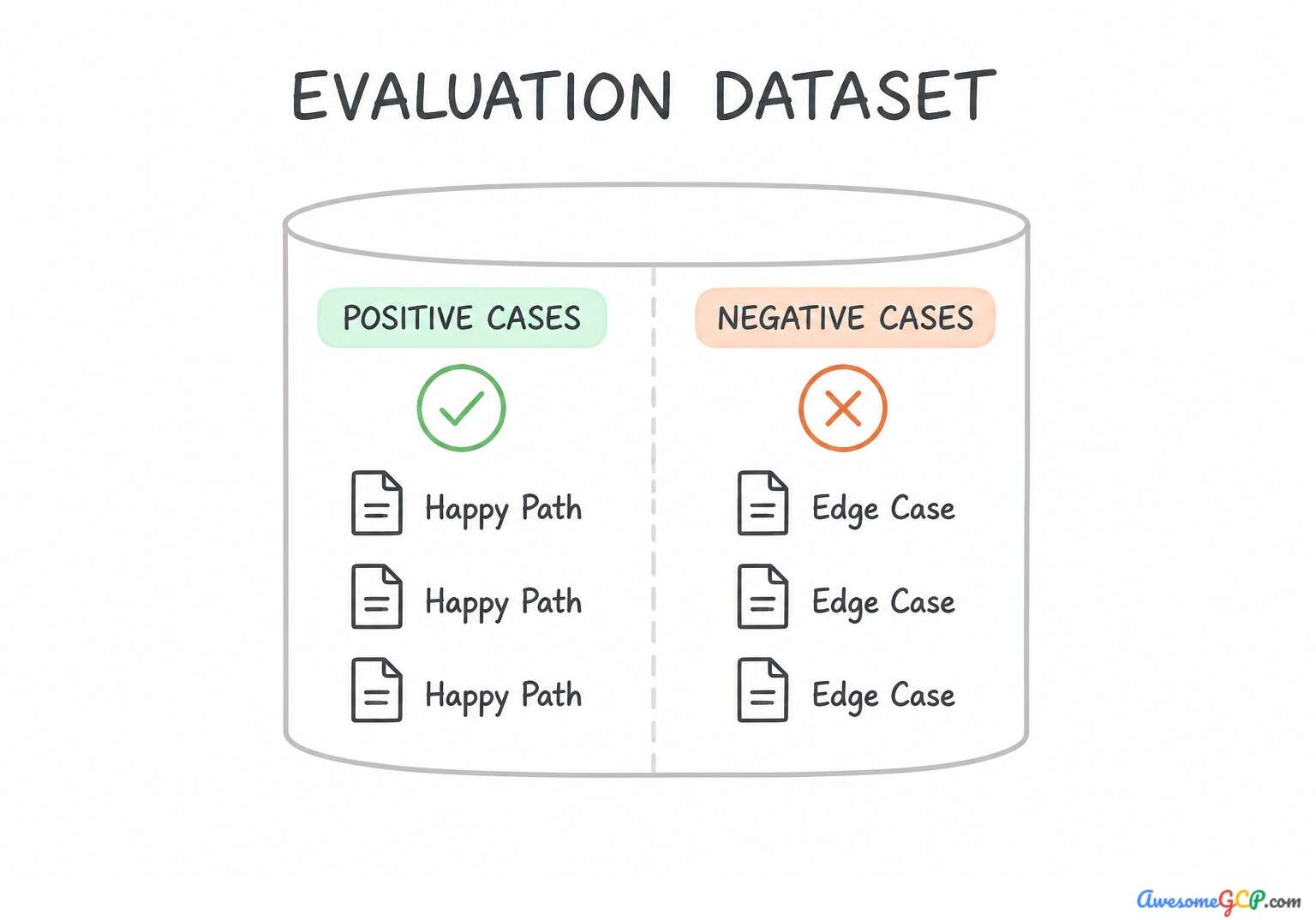
(input, expected_output), an agentic golden record must capture: user_query(and multi-turn conversation history / session state).expected_tool_trajectory(the ordered or unordered list of expected tool calls and required JSON arguments).mock_tool_responsesor deterministic test fixtures (so evaluations are reproducible without mutating live production databases).reference_responseand domain rubric criteria.- Include Edge Cases & The Production Data Flywheel: Always include adversarial/out-of-scope prompts, ambiguous user requests requiring clarification, and simulated downstream API errors (
500/429). Continuously enrich the golden dataset by sampling failed or thumbs-down production traces from Cloud Logging, stripping PII via Sensitive Data Protection (DLP), and having domain experts annotate the expected trajectory.
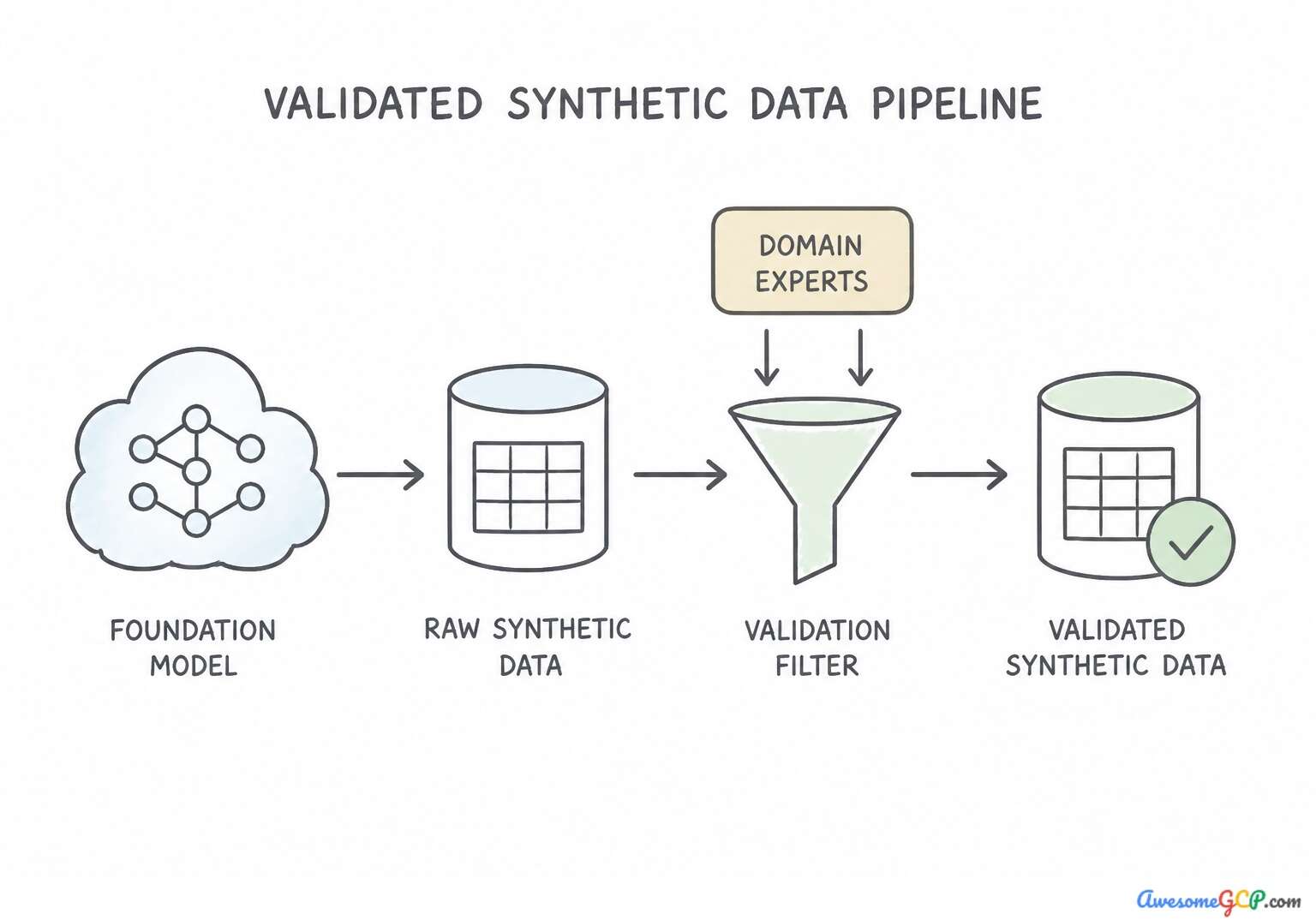
Takeaway 1: Synthetic Golden Dataset Generation with Human-in-the-Loop Validation (vertex_ai:evaluation · vertex_ai:gemini)
- Core Concept: Generating synthetic golden datasets using foundation models combined with subject matter expert (SME) curation for agent evaluation.
- Scenario Trigger & Requirement: Two critical requirements: maintaining strict compliance with healthcare privacy regulations (avoiding real patient conversation logs) and establishing a high-quality golden evaluation test set that covers diverse symptoms, complex conditions, and edge cases.
- Winning Architecture & Implementation: Generate synthetic patient interactions with Gemini by providing few-shot clinical templates, then have medical subject matter experts review and curate the outputs to establish the ground truth test set. Generating synthetic datasets with foundation models like Gemini allows you to create diverse, privacy-safe patient interaction scenarios covering common symptoms, complex comorbidities, and edge cases.
- Exam Traps to Reject: Manually authoring thousands of dialogues from scratch is inefficient and resource-prohibitive compared to SME-curated synthetic generation. Anonymizing raw patient records risks privacy leakage, and exact string matching fails to capture semantic conversational nuances.
Takeaway 2: Multi-Turn Context Drift and State Preservation Test Sets (vertex_ai:agent_builder · vertex_ai:evaluation)
- Core Concept: Structuring multi-turn conversational test suites to evaluate memory retention, context switching, and goal completion across extended dialogs.
- Scenario Trigger & Requirement: The core problem is that an agent loses context and forgets active progress when a user introduces a digression (such as an intermediate billing question). The requirement is to structure an evaluation dataset that specifically measures memory retention and state preservation across conversations.
- Winning Architecture & Implementation: Create multi-turn conversational test scripts that include topic digressions and verify that state variables are preserved across turns. When an agent must maintain context across long dialogs with interruptions, single-turn prompts are insufficient. Creating multi-turn conversational trajectory test sets allows you to simulate real-world user behaviors like side questions, context switching, and interruptions.
- Exam Traps to Reject: Single-turn datasets cannot test conversational memory or context retention across multiple dialog turns. N-gram overlap metrics like BLEU and ROUGE evaluate surface text similarity on single responses, not dialog context preservation.
Takeaway 3: Continuous Test Set Updating from Production Drift Telemetry (vertex_ai:evaluation · bigquery:analytics · cloud_logging)
- Core Concept: Mining low-confidence production logs and human-escalated interactions to systematically refresh test datasets without introducing bias.
- Scenario Trigger & Requirement: A common problem in production generative AI and agent workflows: distribution drift caused by external factors such as new regulations and terminology. The agent must update its golden test dataset to evaluate and maintain quality over time without introducing unverified or noisy data.
- Winning Architecture & Implementation: Query BigQuery logs for interactions with low confidence scores, negative user ratings, or human escalations, and have domain experts curate and label these edge cases for the golden test set. Mining production logs from BigQuery for low-confidence queries, negative feedback, and human escalations allows you to capture real-world data drift and edge cases.
- Exam Traps to Reject: Replacing the golden set with unverified raw transcripts causes regressions and introduces data noise. Unreviewed synthetic outputs risk circular errors and inaccurate ground truth.
Takeaway 4: Tool-Calling and Parameter Extraction Edge-Case Datasets (vertex_ai:agent_builder · vertex_ai:evaluation)
- Core Concept: Designing evaluation prompts specifically focused on boundary conditions, missing arguments, and malformed entity inputs for deterministic tool execution.
- Scenario Trigger & Requirement: A scenario where an agent crashes or fails in production because users provide ambiguous, malformed, or partial input data when attempting inventory transfers. The goal is to build an evaluation dataset that tests whether the agent correctly asks the user for clarification rather than executing tools with bad parameters.
- Winning Architecture & Implementation: Construct an evaluation dataset of negative and boundary test prompts with missing or malformed parameters, and verify that the agent requests clarification instead of invoking the tool. When building tool-enabled agents, evaluation suites must contain both positive cases and negative edge cases. Boundary and negative test prompts contain missing parameters, malformed entity values, or ambiguous instructions.
- Exam Traps to Reject: Default placeholders for missing arguments can trigger unintended operations instead of safe clarification. Testing only valid inputs ignores parameter-handling failures when inputs are missing or ambiguous.
Consolidated Golden Rules (Consideration 4.1a):
- Golden datasets are essential reference benchmarks for evaluating agent reasoning and task completion.
- When privacy constraints block real-world data usage, combine synthetic foundation model generation with few-shot prompting to achieve scale and scenario diversity.
- Always incorporate subject matter expert (SME) validation to review and curate synthetic datasets in mission-critical and regulated domains.
- Use multi-turn trajectory test datasets to evaluate conversational agents that require memory retention across topic switches.
- Verify state variables and goal completion at each turn of the conversation to catch context drift.
- Single-turn datasets and surface lexical metrics (such as BLEU or ROUGE) are inadequate for measuring multi-step agent workflows.
Consideration 4.1b: Creating continuous evaluation pipelines to assess an agent's tool execution based on established success criteria
When automating CI/CD pipelines to assess tool execution:
- Trajectory Match Modes in ADK:
Exact Match: The agent must call the exact sequence of tools with zero additional tool calls (ideal for strict financial/compliance pipelines).In-Order Match: The agent must execute mandatory milestone tools in the right sequence (e.g.,verify_identity→issue_refund), but is allowed to make extra intermediate lookup/clarification calls in between.Any-Order Match(Precision/Recall): Ideal when an agent gathers facts from 3 independent tools where execution order does not matter.- Mocking Side-Effecting Tools in CI/CD: Never let your CI/CD evaluation pipeline execute real credit card charges or delete real tickets. Use deterministic tool mocks / sandbox fixtures in
adk evalso trajectory tests are fast, idempotent, and side-effect-free.
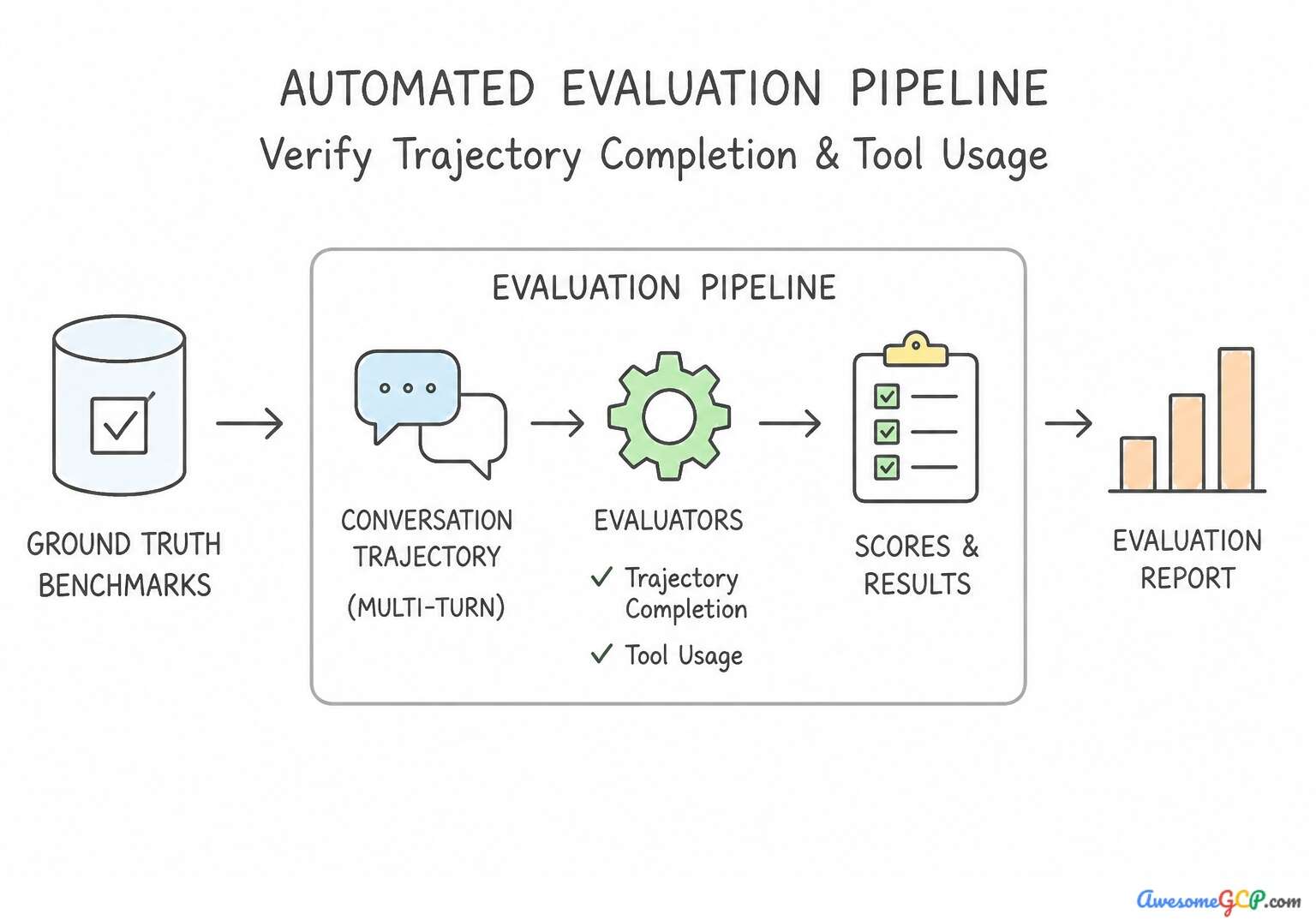
Takeaway 1: Automating Production Tool Call Quality Audits (vertex_ai:pipelines · vertex_ai:evaluation · cloud_logging · bigquery)
- Core Concept: Continuous Evaluation Pipeline Architecture using Vertex AI Gen AI Evaluation Service
- Scenario Trigger & Requirement: The scenario requires an automated, daily continuous evaluation pipeline for a production customer support agent. The evaluation must assess two core criteria: tool selection accuracy (did the agent select the right banking API?) and tool parameter formatting (are payload arguments structured correctly?).
- Winning Architecture & Implementation: Export sampled conversation logs from Cloud Logging to BigQuery through a log sink. Schedule a Vertex AI Pipelines workflow to run the Vertex AI Gen AI Evaluation Service on the dataset to assess tool call metrics. Google Cloud recommends exporting production traces and conversation logs from Cloud Logging to BigQuery through an automated log sink.
- Exam Traps to Reject: Custom scripts on Compute Engine VMs introduce unnecessary operational overhead compared to managed Vertex AI evaluation tools. Regular expression matching in Cloud Functions cannot evaluate complex tool calling trajectories or provide standardized evaluation metrics.
Takeaway 2: Distinguishing Semantic Tool Argument Errors vs Schema Invalidation (vertex_ai:evaluation · vertex_ai:agent_builder)
- Core Concept: Selecting Appropriate Evaluation Metrics for Tool Parameter Correctness
- Scenario Trigger & Requirement: A scenario where an agent produces structurally valid JSON payloads for an API tool call, yet the semantic values inside the payload are incorrect (swapping city for billing state). You must choose the evaluation approach that identifies semantic data extraction errors that bypass standard schema validation.
- Winning Architecture & Implementation: Add a semantic tool argument quality metric to your continuous evaluation pipeline to compare extracted parameters against conversation context. Syntactic validation ensures that a payload conforms to data types and required fields defined in a JSON schema, but it cannot verify if the extracted values are factually or contextually accurate.
- Exam Traps to Reject: Higher temperatures introduce randomness and worsen parameter extraction accuracy. Schema validation only checks data types and structure, which cannot detect when valid string values are swapped.
Takeaway 3: CI/CD Deployment Gating Based on Tool Selection Success Rate (vertex_ai:pipelines · cloud_build)
- Core Concept: Automated Quality Gates and Rollback Deployment Integration
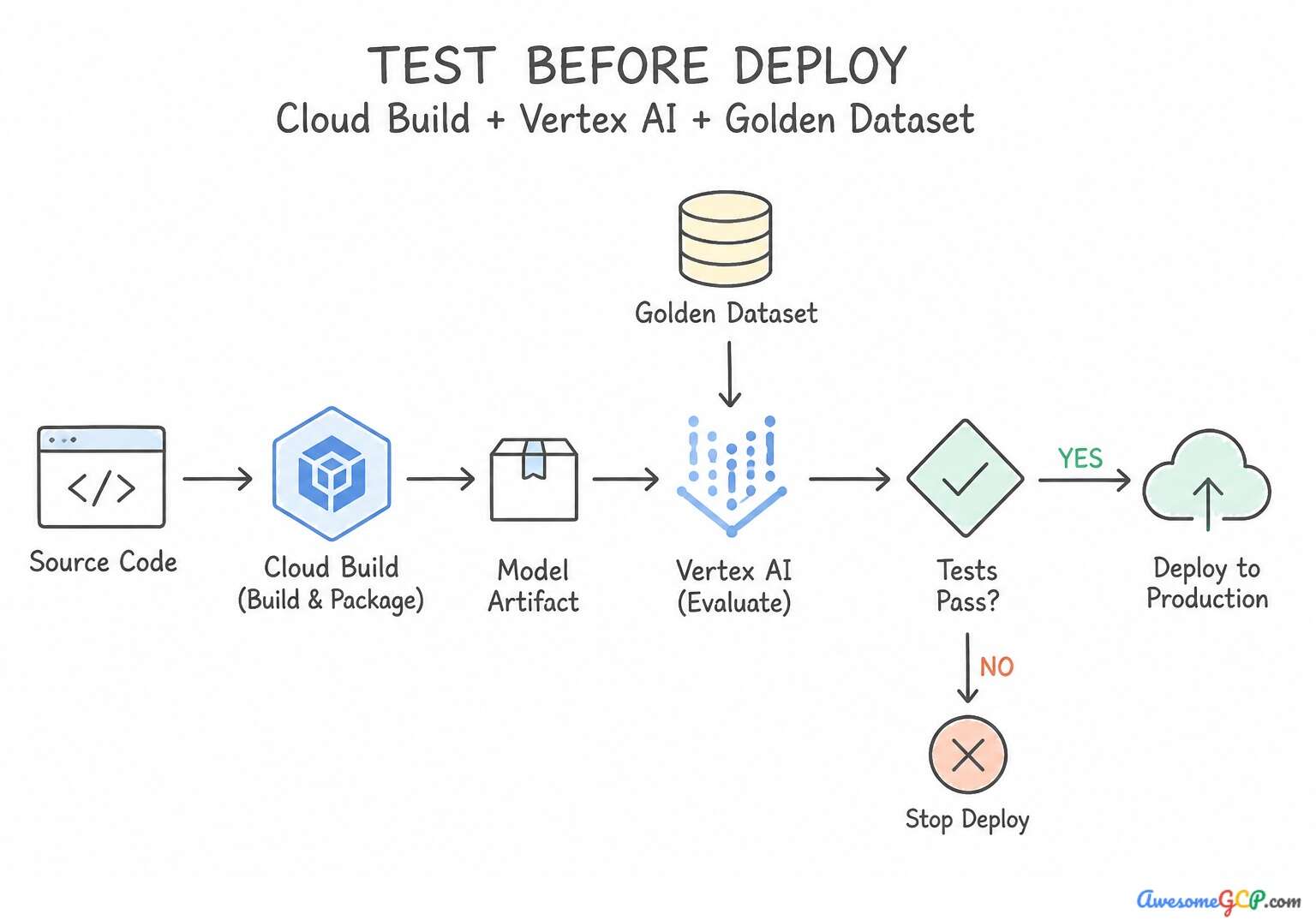
- Scenario Trigger & Requirement: A continuous deployment scenario for an agentic triage workflow. The requirement is to evaluate new prompt templates and tool definitions before production release, evaluate performance against an enterprise golden dataset, and automatically halt deployment if the tool selection F1-score does not meet the specified threshold.
- Winning Architecture & Implementation: Create a Cloud Build continuous integration pipeline that triggers a Vertex AI Pipelines run to evaluate the agent against the golden dataset, and gate production deployment on the tool selection F1-score metric threshold. Integrating Cloud Build with Vertex AI Pipelines enables automated continuous integration and continuous deployment (CI/CD) quality gates.
- Exam Traps to Reject: Post-deployment monitoring and rollback do not satisfy the requirement for pre-deployment quality gating. Weekly scheduled evaluations cannot act as an automated gate in a continuous deployment pipeline.
Consolidated Golden Rules (Consideration 4.1b):
- Continuous evaluation pipelines for generative agents combine Cloud Logging sinks, BigQuery storage, and Vertex AI Pipelines.
- Vertex AI Gen AI Evaluation Service provides built-in metrics to assess tool selection correctness and parameter accuracy without custom evaluation logic.
- Vertex AI Model Monitoring for tabular models evaluates feature drift, whereas the Gen AI Evaluation Service evaluates generative agent responses and tool usage.
- Schema validation checks structure and types, not semantic truth.
- Tool parameter correctness requires semantic evaluation metrics to compare extracted values against context.
- Continuous evaluation pipelines should assess both tool selection accuracy and parameter quality.
Consideration 4.1c: Determining the appropriate evaluation framework and tooling (e.g., adk evaluation tooling (evalset), agent platform gen ai evaluation service, and custom autoraters)
Match the evaluation tool to the requirement:
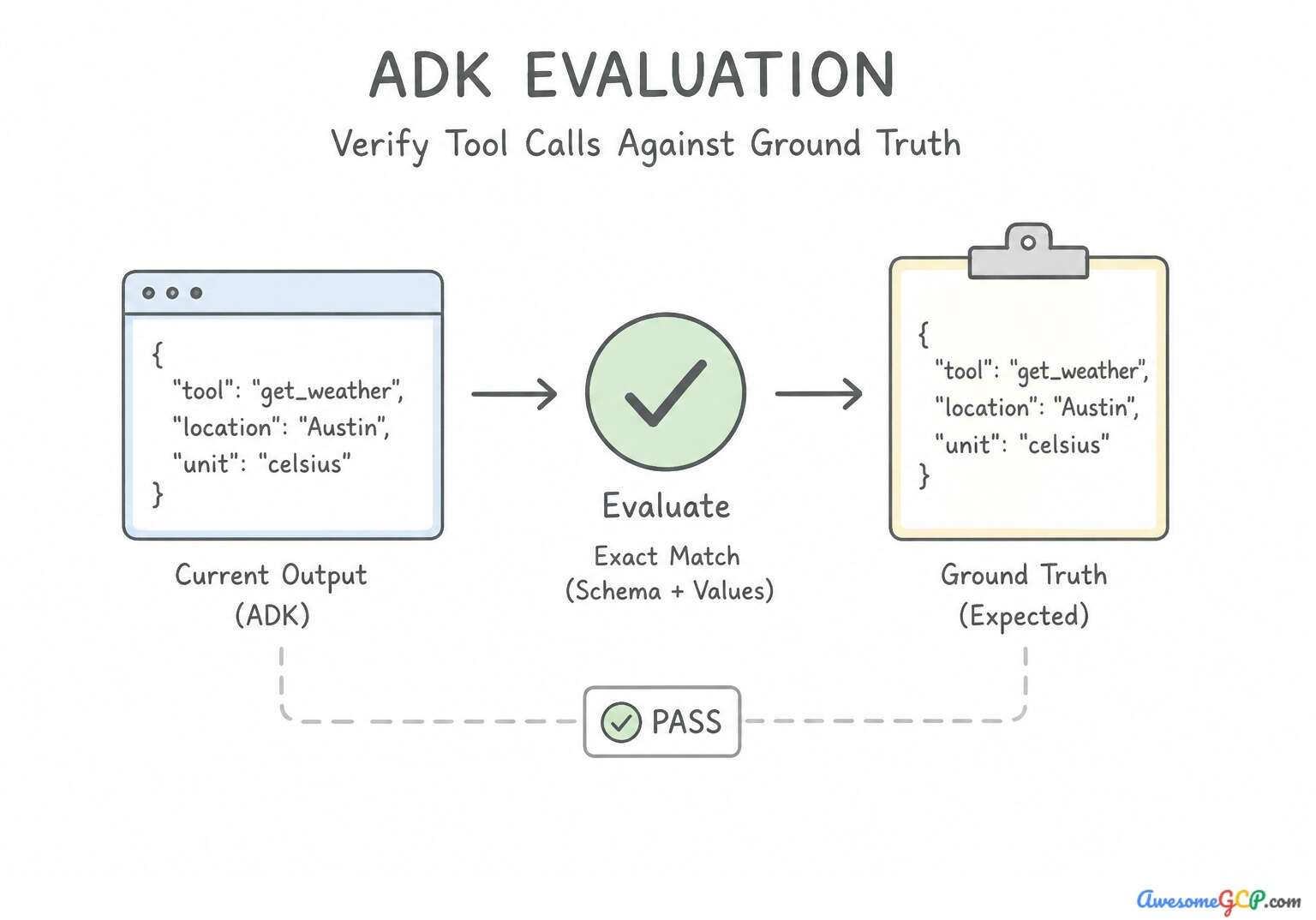
- ADK Evaluation Tooling (
evalset/adk eval): Best for developer inner-loop testing and CI/CD regression checks on ADK agent trajectories, tool calls, and session state transitions. - Agent Platform Gen AI Evaluation Service & Custom Autoraters (
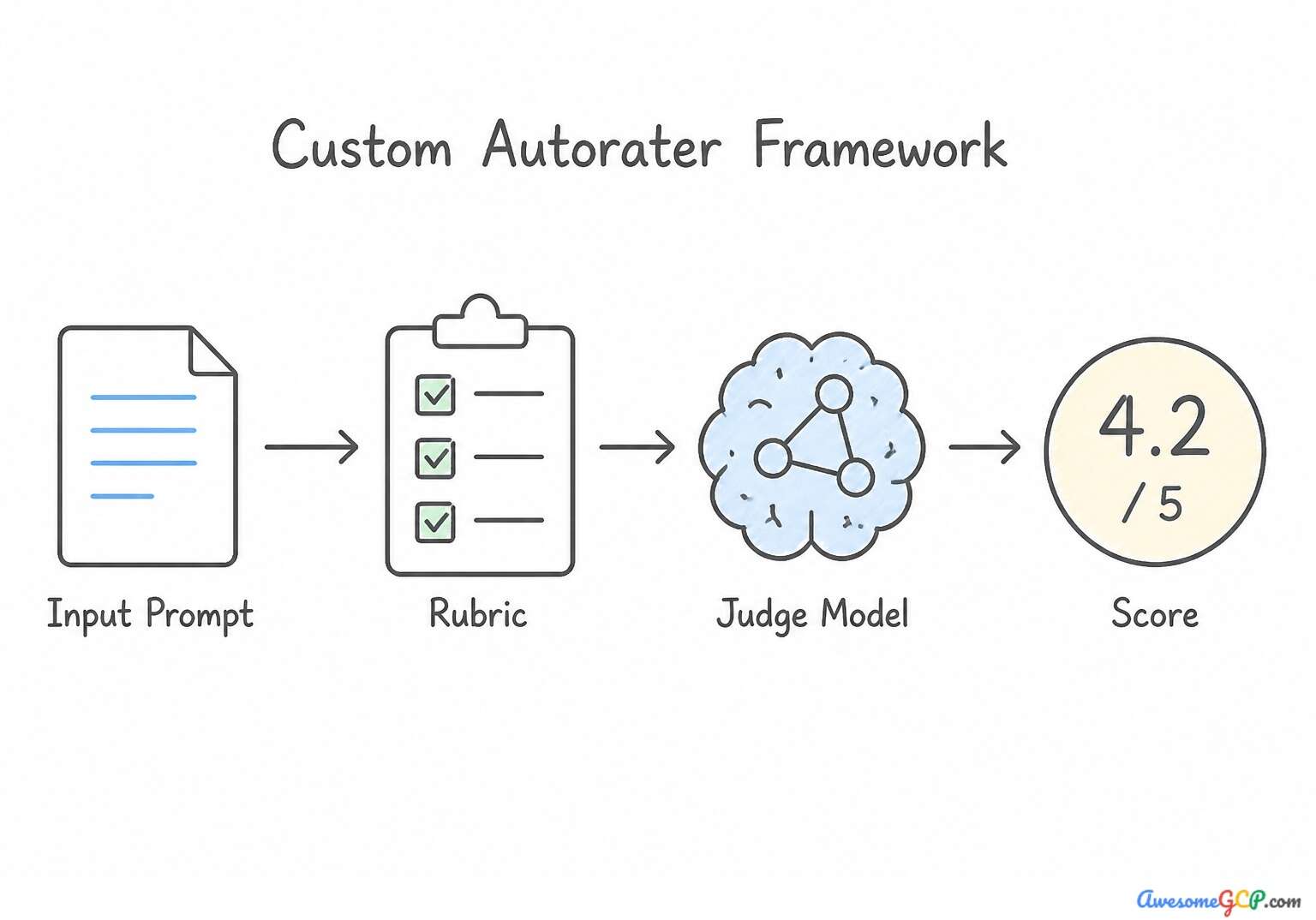
LLM-as-a-Judge): Best for large-scale, statistically rigorous grading of open-ended response quality, tone, safety, and domain-specific compliance. - Why
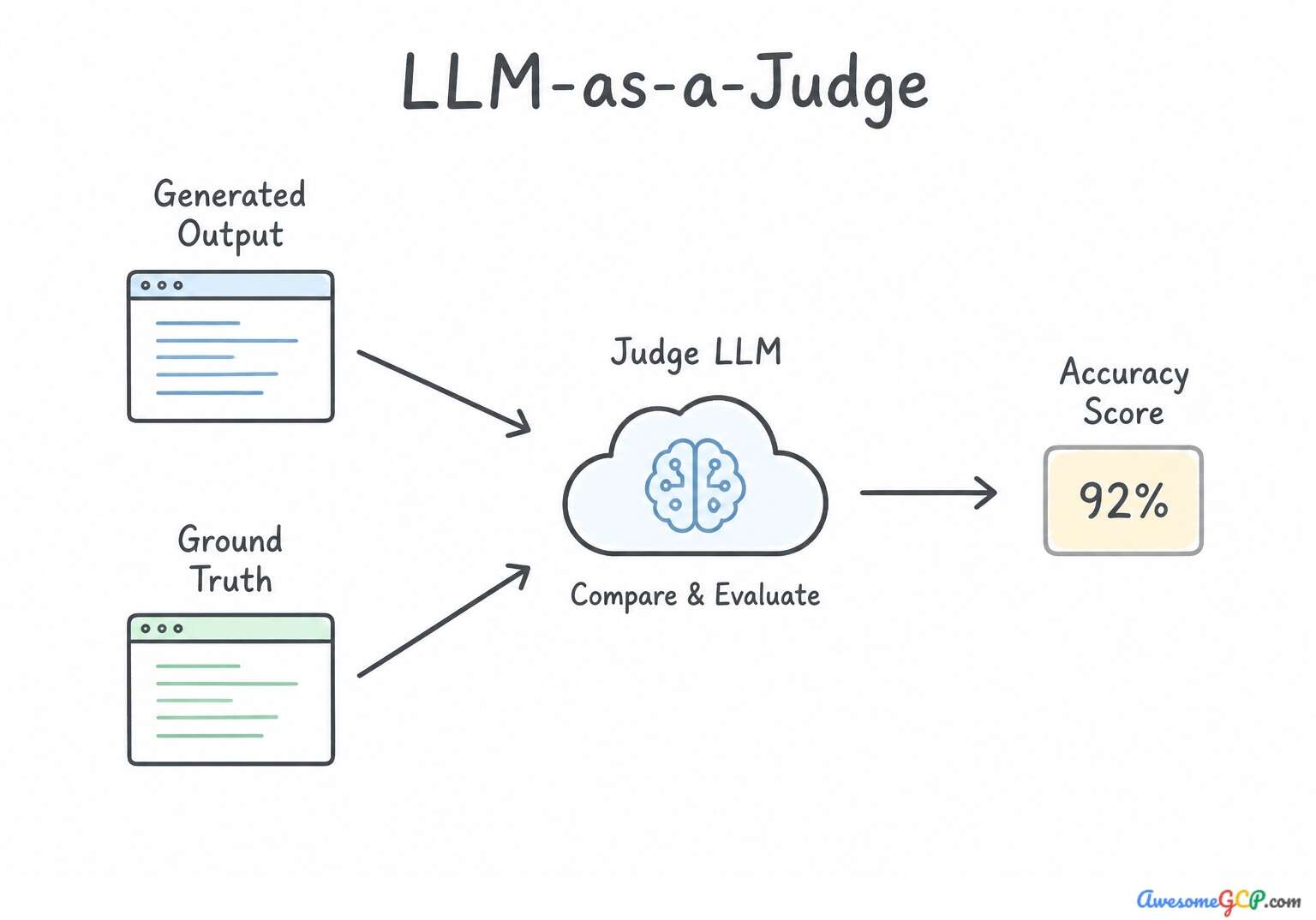
LLM-as-a-JudgeBeatsROUGE/BLEU: Never use lexical string overlap (BLEU,ROUGE, exact regex) to evaluate conversational answers—two differently worded sentences can be 100% semantically equivalent, while a sentence with 90% word overlap (e.g., adding "not") can mean the exact opposite. Instead, configure a Custom Autorater with an explicit pointwise (1–5) or pairwise scoring rubric and calibrate it against a human-annotated validation set.
Takeaway 1: Local CI/CD Regression Testing with ADK Evalset (vertex_ai:agents · vertex_ai:evaluation · developer_tools:ci_cd)
- Core Concept: Using Agent Development Kit (ADK) evalsets for deterministic pre-merge validation of tool execution paths
- Scenario Trigger & Requirement: The question specifies three key constraints: pre-merge continuous integration (CI) testing, local execution without calling remote cloud endpoints, and deterministic verification of specific tool invocations and parameter formats against predefined ground truth datasets.
- Winning Architecture & Implementation: Run test suites with the ADK evaluation tooling using evalsets to validate tool execution paths against predefined ground truth trajectories. Agent Development Kit (ADK) evaluation tooling allows developers to define and run
evalsetslocally or in CI/CD pipelines. - Exam Traps to Reject: Vertex AI Evaluation Service is a managed cloud service that adds unnecessary latency and cost to local pre-merge testing. Production autoraters evaluate live traffic after deployment rather than catching regressions prior to code merge.
Takeaway 2: Pairwise Model Comparison using Vertex AI Gen AI Evaluation Service (vertex_ai:evaluation_service · vertex_ai:model_garden)
- Core Concept: Utilizing Vertex AI Gen AI Evaluation Service for side-by-side (pairwise) model version benchmarking
- Scenario Trigger & Requirement: The scenario requires comparing two foundation model versions (an older baseline and Gemini 1.5 Pro) across 1,000 multi-turn transcripts. The core requirement is to generate win rates and preference margins automatically without writing custom evaluation or scoring code.
- Winning Architecture & Implementation: Run a pairwise side-by-side (AutoSxS) evaluation job with the Vertex AI Gen AI Evaluation Service. Vertex AI Gen AI Evaluation Service provides managed pairwise side-by-side (AutoSxS) evaluation. AutoSxS compares the outputs of two models (a baseline model and a candidate model) against an evaluation dataset.
- Exam Traps to Reject: Live A/B testing tests on end users instead of benchmarking against pre-existing transcripts. Embedding cosine similarity does not determine win rates or quality preferences and requires custom scoring logic.
Takeaway 3: Production Monitoring of Hallucination via Managed Groundedness Metrics (vertex_ai:evaluation · vertex_ai:generative_ai)
- Core Concept: Employing Vertex AI Gen AI Evaluation Service managed groundedness metrics on production inference logs
- Scenario Trigger & Requirement: The scenario requires monitoring an active production agent for hallucinations by ensuring that generated responses are strictly supported by the retrieved context (policy documentation). The solution must operate on sampled production logs, provide automated weekly evaluation, and require minimal operational overhead.
- Winning Architecture & Implementation: Schedule a recurring pipeline that submits sampled production logs to the Vertex AI Gen AI Evaluation Service using the managed Groundedness metric. The Vertex AI Gen AI Evaluation Service provides managed, model-based metrics (autoraters) designed specifically to measure model output quality.
- Exam Traps to Reject: Regular expressions and keyword matching cannot capture semantic meaning or evaluate factual groundedness accurately. Static pre-deployment evalsets test historical benchmarks rather than live production inference logs.
Takeaway 4: Domain-Specific Regulatory Auditing via Custom Autoraters (vertex_ai:evaluation · vertex_ai:genai_evaluation_service · vertex_ai:autorater)
- Core Concept: Implementing Custom Autoraters (LLM-as-a-judge with specialized rubrics) for proprietary compliance scoring
- Scenario Trigger & Requirement: A scenario where a healthcare organization needs to evaluate agent summaries against unique, proprietary compliance rules and local statutes. Key constraints include: standard metrics (BLEU, ROUGE, out-of-the-box groundedness) are inadequate, and the solution must be automated and scalable.
- Winning Architecture & Implementation: Define a custom model-based autorater in Vertex AI Gen AI Evaluation Service with explicit rubric criteria for your institutional phrasing and regulatory rules. When standard out-of-the-box evaluation metrics (such as BLEU, ROUGE, or default groundedness) cannot capture domain-specific or proprietary compliance guidelines, you should implement a custom model-based autorater (also known as LLM-as-a-judge).
- Exam Traps to Reject: Manual review of every generated summary is not an automated or scalable evaluation strategy. Standard lexical metrics like BLEU and ROUGE measure exact word overlaps rather than complex rule adherence and semantic compliance.
Consolidated Golden Rules (Consideration 4.1c):
- Use ADK evaluation tooling and evalsets for fast, deterministic, pre-merge regression tests in continuous integration pipelines.
- Evalsets allow verification of expected tool names, execution order, and parameter values against predefined ground truth data.
- Managed cloud evaluation services are better suited for broader offline benchmarking, while autoraters monitor live runtime interactions.
- Pairwise (AutoSxS) evaluation in Vertex AI compares candidate models against baseline models to deliver win-rate metrics.
- AutoSxS removes the need to build and maintain custom autorater microservices.
- Pointwise evaluation evaluates single model outputs, whereas pairwise evaluation directly compares two competing model outputs side by side.
Consideration 4.1d: Evaluating an agentic system against a golden dataset to assess agent response and retrieval quality (e.g., using adk)
When an agent grounded in RAG produces poor answers, isolate the root cause using the RAG Triad against your golden dataset:
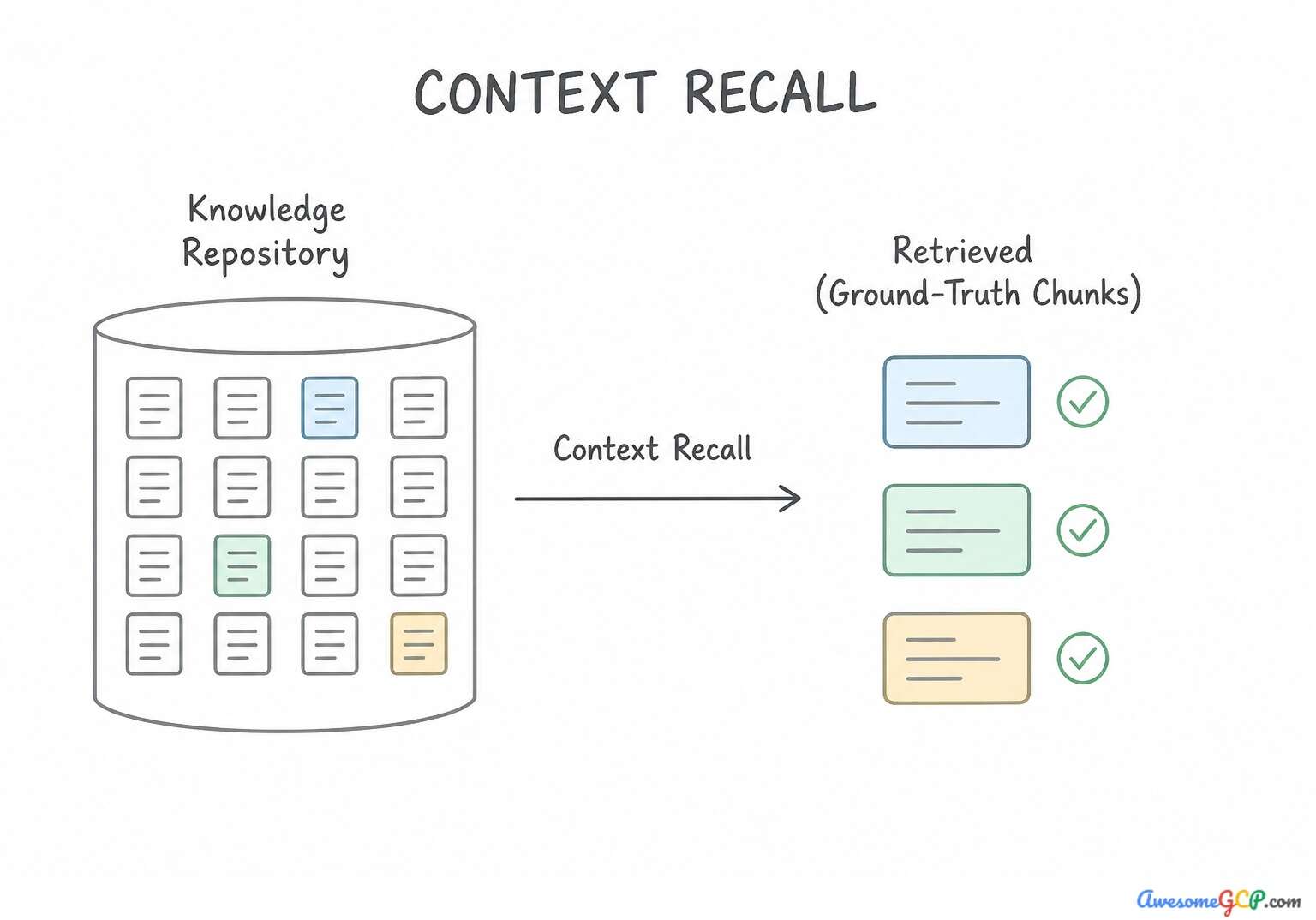
- 1. Context Relevance / Retrieval Recall (Retriever Metric): Did the RAG Engine / Vector Search retrieve the golden document chunks containing the answer? (If low → fix chunking, metadata filters, or enable Hybrid Search + Reranking).
- 2. Groundedness / Faithfulness (Generator Anti-Hallucination Metric): Did the LLM stick strictly to the facts present in the retrieved chunks without inventing external claims? (If low → tighten system instructions, lower temperature, or add a groundedness check).
- 3. Answer Relevance / Completeness (End-to-End Metric): Did the final response actually address every part of the user's question?
Takeaway 1: Retrieval Quality Assessment Using Context Precision and Recall (vertex_ai:evaluation · vertex_ai:rag)
- Core Concept: Measuring retrieval performance (Context Precision vs Context Recall) using Agent Development Kit (ADK) and golden reference documents.
- Scenario Trigger & Requirement: A failure where critical compliance exemptions are omitted from an agent's answers. You have a golden evaluation dataset with user queries and ground-truth document chunks. The specific goal is to evaluate if all required chunks are retrieved from the knowledge source.
- Winning Architecture & Implementation: Measure the context recall metric with Vertex AI evaluation to verify that all golden document chunks are retrieved. Context recall evaluates whether all relevant information or ground-truth chunks specified in the golden dataset are present in the context retrieved by the agent.
- Exam Traps to Reject: Context precision measures ranking quality and noise reduction, not total chunk coverage. Hallucination metrics evaluate generation faithfulness rather than retrieval completeness.
Takeaway 2: Agent Tool-Call Trajectory Evaluation Against Golden Sequences (vertex_ai:agent_builder · vertex_ai:evaluation)
- Core Concept: Assessing intermediate agent actions and tool selection accuracy against predefined golden trajectories in ADK.
- Scenario Trigger & Requirement: An agent that generates correct final responses but executes suboptimal, out-of-order intermediate tool calls (such as checking billing before checking whether the order exists). The goal is to evaluate intermediate tool-selection behavior systematically against a golden dataset.
- Winning Architecture & Implementation: Define golden trajectories that specify the expected tool sequence and arguments, and evaluate the run with trajectory evaluation metrics. When evaluating multi-step agentic workflows, final response accuracy alone does not guarantee efficient or correct reasoning.
- Exam Traps to Reject: Increasing temperature increases randomness and degrades deterministic tool calling. Semantic similarity only measures final output text, ignoring intermediate tool-call sequences.
Takeaway 3: Groundedness and Hallucination Evaluation in RAG-Based Agents (vertex_ai:evaluation · vertex_ai:agent_builder)
- Core Concept: Evaluating answer faithfulness (groundedness) versus reference texts using Model-as-a-Judge capabilities in the Gen AI Evaluation Service.
- Scenario Trigger & Requirement: A common problem in RAG-based architectures: hallucination. While the agent produces fluent text, it includes claims (fabrications about dental coverage) not present in the retrieved reference context. You must select the precise evaluation metric and service capable of identifying claims that lack grounding in the retrieved passages.
- Winning Architecture & Implementation: Run an evaluation job with the Groundedness metric in Vertex AI Gen AI Evaluation Service to compare generated responses against the retrieved context. Groundedness (also known as faithfulness) evaluates whether every claim in the generated response can be directly inferred from the retrieved context.
- Exam Traps to Reject: BLEU only measures word overlap with a reference text and cannot detect whether claims are supported by the retrieved context. QA Relevance measures whether the response answers the question, not whether the facts are supported by retrieved context.
Takeaway 4: Automated CI/CD Quality Gates for Agent Prompt Iterations (cloud_build · vertex_ai:evaluation · cloud_storage)
- Core Concept: Integrating automated golden dataset evaluation runs into Cloud Build CI/CD pipelines to prevent agent regression.
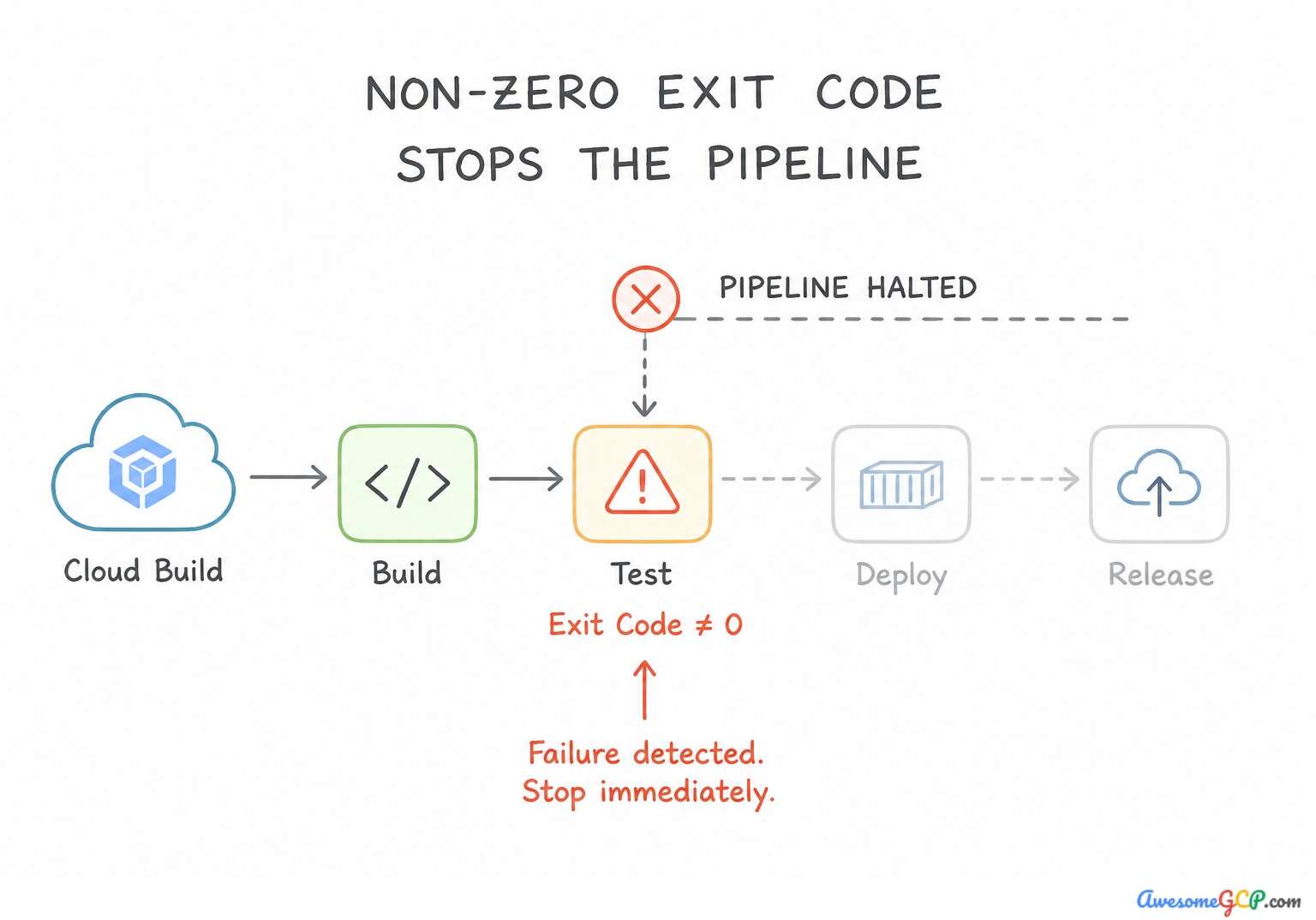
- Scenario Trigger & Requirement: The scenario requires establishing an automated CI/CD quality gate in Cloud Build. The goal is to evaluate prompt changes against a versioned golden dataset in Cloud Storage before deployment to staging, stopping the build automatically if quality metrics (e.g., groundedness, relevance) do not meet minimum score thresholds.
- Winning Architecture & Implementation: Add a Cloud Build step that executes an Agent Development Kit (ADK) evaluation script against the golden dataset from Cloud Storage, and exit with a non-zero status code if scores fall below the threshold. Running an automated evaluation step directly within Cloud Build ensures quality gates are enforced before deployment. The Agent Development Kit (ADK) Python SDK or CLI can run automated evaluation runs against a versioned golden dataset stored in Cloud Storage, measuring metrics such as groundedness, safety, and relevance.
- Exam Traps to Reject: A scheduled daily BigQuery query cannot act as an inline CI/CD pipeline blocker. Monitoring production feedback occurs after deployment and does not prevent regressions before staging.
Consolidated Golden Rules (Consideration 4.1d):
- Use Context Recall to evaluate whether the retriever fetched all necessary ground-truth document chunks.
- Use Context Precision to evaluate whether retrieved chunks are ranked appropriately without excessive noise.
- Use Groundedness / Faithfulness to evaluate if the agent's response is supported by the retrieved context.
- Evaluating agent systems requires assessing both final outputs and intermediate tool-call trajectories.
- Golden datasets for agents should include expected tool names, execution order, and input arguments alongside expected final responses.
- ADK trajectory evaluation metrics help identify unnecessary, missing, or misordered API calls.
Multi-Constraint Production Architecture Scenarios (Subsection 4.1)
Production Scenario & Hard Constraints | Winning Google Cloud Architecture | Why Look-Alike Alternatives Fail |
|---|---|---|
Recommended automated testing and quality assurance methodology required before updating: A common operational risk in Generative AI: upgrading the underlying foundation model version for a live customer support agent. The goal is to verify that existing capabilities (such as tool calling, structured outputs, and domain knowledge retrieval) remain functional and that quality does not degrade. | Run an automated ADK evaluation pipeline against a curated golden evalset before deploying to production. Automated evaluation against a curated golden evalset validates that model updates maintain response quality and do not cause regressions. | Direct production deployment without prior validation exposes end users to unvetted failures and behavioral regressions. Two manual prompts do not provide sufficient coverage to detect quality degradation or broken tool calls. |
Agent evaluation methodology that examines step-by-step reasoning, intermediate tool: A discrepancy between final output correctness and operational efficiency. The final answer is accurate, but the agent displays suboptimal intermediate execution: invoking three redundant database tools and incurring a fifteen-second latency penalty. | Perform trajectory evaluation to assess tool call sequences, intermediate steps, and tool argument accuracy. Trajectory evaluation analyzes intermediate reasoning steps and tool execution paths to detect unnecessary actions, latency issues, and parameter errors. | User feedback only rates end-user satisfaction with the final answer and cannot inspect intermediate agent steps or tool inefficiency. BLEU measures textual n-gram similarity of the final response and provides zero visibility into intermediate tool execution paths or latency. |
Proper evaluation metrics in Vertex AI to measure factual alignment with retrieved: Goal: evaluate whether an AI agent answers queries based strictly on reference context without hallucinations or fabricated statements. The key phrases are 'answers user questions based strictly on retrieved grounding documents' and 'without fabricating facts'. | Faithfulness and groundedness metrics using Vertex AI Gen AI Evaluation service. Groundedness and faithfulness metrics directly assess whether model answers are supported by source context rather than hallucinated. | Packet loss measures networking health, not generative model output quality. Perplexity measures model prediction uncertainty during language modeling, not factual adherence to grounding documents. |
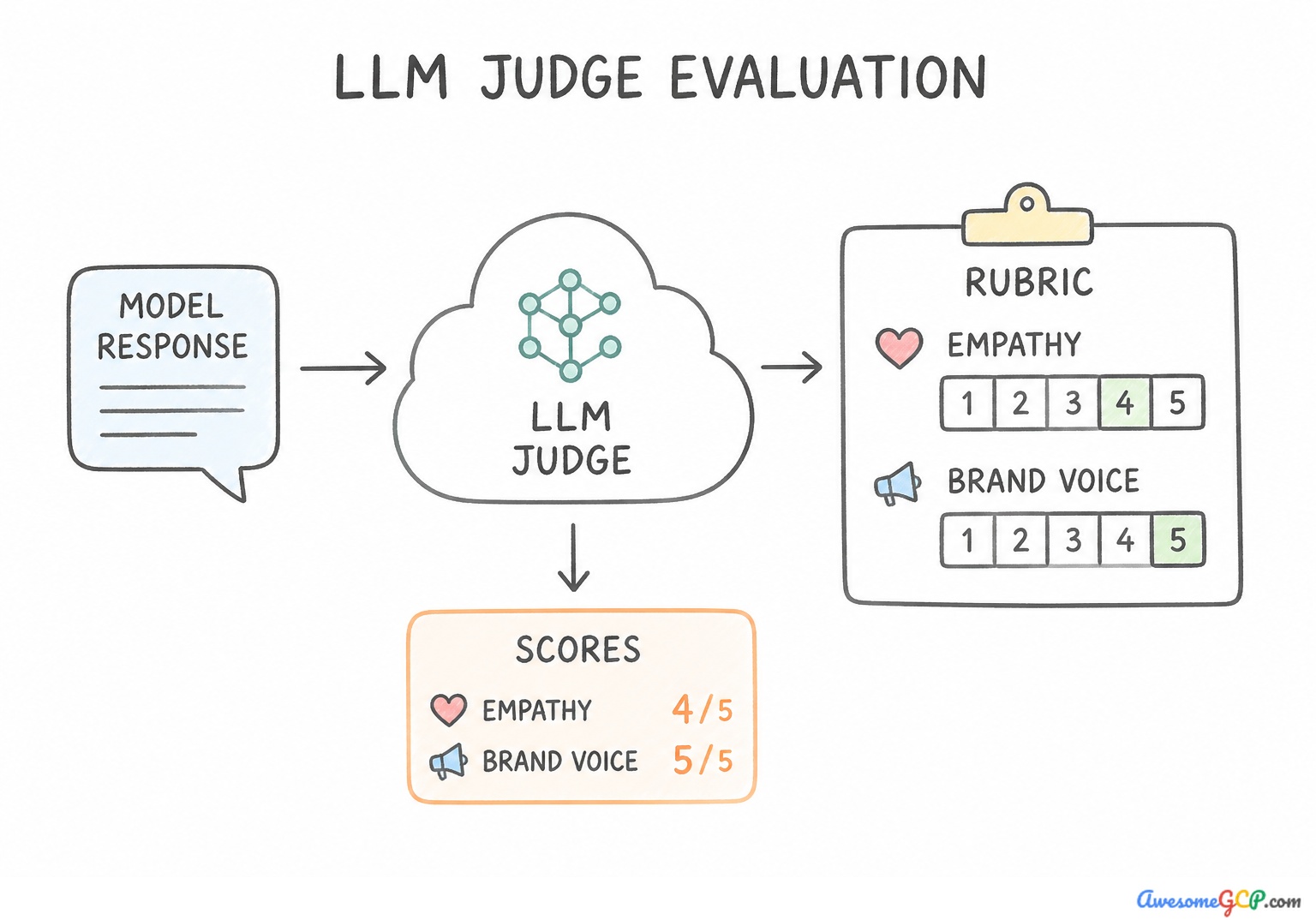
Standard methodology for assessing qualitative, open-ended conversational agent: The question requires evaluating open-ended agent responses against subjective, multi-faceted qualitative criteria (such as empathy, brand voice, and clarity). The scenario explicitly notes that exact string matching cannot be applied due to the variability of human language. | Implement rubric-based evaluation using an LLM-as-a-judge with structured scoring rubrics. LLM-as-a-judge with structured rubrics accurately evaluates qualitative dimensions like tone, empathy, and brand voice that deterministic metrics cannot evaluate. | ROUGE-1 measures token overlap rather than subjective, qualitative business criteria like empathy or clarity. Regex only matches deterministic string patterns and cannot evaluate qualitative dimensions such as tone or empathy. |
Critical characteristics and components of a comprehensive evaluation dataset: The question asks what components constitute a high-quality evaluation dataset (evalset) for a specialized agent in a financial domain. | Diverse input queries, expected ground truth responses, expected tool trajectories, and edge-case scenarios. A comprehensive evalset requires diverse queries, ground truth answers, expected tool trajectories, and edge-case testing. | Repeating a single greeting fails to test financial reasoning, tool selection, or conversational breadth. Data without clear user intents and reference answers prevents systematic, objective evaluation. |
Standard evaluation technique for diagnosing tool selection failures after prompt: Prompt engineering side effects in agentic systems. Modifying system prompt instructions for conciseness inadvertently suppressed tool calling capabilities. Diagnosing and resolving this regression requires an automated, traceable methodology to evaluate agent reasoning paths across standardized test sets. | Inspect trajectory regression reports across evalset runs to identify where tool selection failed. Trajectory regression reports reveal step-by-step agent decisions and highlight where tool selection failed across evaluation runs. | Deleting failing tests masks errors rather than identifying and resolving prompt-induced behavioral regressions. Manual testing without version tracking eliminates automated reproducibility and conceals prompt-induced regressions. |
Standard Google Cloud approach to continuously sample and evaluate production: The question specifies the requirement to establish continuous evaluation for an agent in production. The key constraints are sampling live interactions and scoring these samples against quality benchmarks. The correct solution must provide an automated, ongoing mechanism designed for production telemetry. | Configure continuous evaluation in Vertex AI to sample production logs and score them with automated evaluation metrics. Continuous evaluation in Vertex AI automates the sampling and scoring of production interactions against quality benchmarks. | Annual manual reviews do not provide continuous monitoring and delay detection of agent quality issues. Disabling evaluation eliminates visibility into model degradation and policy compliance. |
Retrieval metric in Vertex AI to assess whether an agent retrieved all ground-truth: The core objective in this question focuses on evaluating retrieval performance in an AI agent or retrieval-augmented generation (RAG) system. Specifically, the scenario asks how to verify whether the agent successfully gathered all relevant documents needed to generate a complete answer. | Context recall metric in the Vertex AI evaluation framework. Context recall evaluates whether all necessary ground-truth information required to formulate an answer was successfully retrieved. | Model parameter count is a static property of the model architecture, not an evaluation metric for retrieval. Context precision measures relevance ranking and signal-to-noise ratio in retrieved items, not retrieval completeness. |
Establish an automated evaluation gate in Cloud Build that executes evaluation runs: The scenario requires automating generative AI agent testing within a CI/CD workflow executed by Cloud Build. The critical constraints are: 1) Automated execution within the CI/CD pipeline, and 2) Enforcing a strict numerical quality gate where safety or groundedness scores lower than 0.85 cause the build to fail and prevent deployment. | Add an automated ADK evaluation step in Cloud Build that asserts metric thresholds before triggering deployment. An automated evaluation step running ADK scripts in Cloud Build asserts metrics against the 0.85 threshold and fails the build when scores are insufficient. | Manual console testing does not fulfill the requirement to automate testing inside Cloud Build. Deploying before testing risks exposing end users to unsafe outputs and violates the requirement to fail the build. |
Establish an empirical, multi-dimensional evaluation procedure to compare candidate: The scenario requires choosing between two candidate foundation models for an agent workflow where one excels at latency and cost (Model A) while the other excels at tool selection precision (Model B). | Run both models across the same standardized evalset and compare trajectory accuracy, latency, and cost metrics side by side. Benchmarking models side by side on a standardized evalset provides empirical data to weigh trajectory accuracy against latency and cost. | Skipping domain-specific benchmarking prevents verifying whether precision gains justify higher latency and pricing. Prioritizing cost over accuracy risks deploying a model that fails agentic task execution. |
Standard quantitative metrics and methodologies for evaluating multi-step agent tool: Requires a quantitative metric to evaluate whether an AI agent executed the optimal sequence of tool invocations during multi-step reasoning. To measure sequence correctness, the evaluation must compare the generated tool invocation path against a reference standard. | Measure tool trajectory exact match and tool call precision/recall against expected golden trajectories in ADK. Trajectory exact match alongside tool precision and recall assesses whether an agent executed the intended sequence of tool calls against golden benchmarks. | Sentence count of the input prompt evaluates input length rather than agent execution trajectory. Character length measures output size, not multi-step tool sequence quality or reasoning accuracy. |
Best practices for deprecating agent tools and resolving tool selection conflicts during: An agent configuration problem during evaluation. The agent persistently selects a deprecated tool over a new tool. Key elements to evaluate include tool declaration lifecycles, function calling mechanics, and prompt hygiene versus schema configuration. | Update the tool descriptions and schemas to clearly distinguish capabilities, and remove the deprecated tool from the agent definition. Removing the deprecated tool from the configuration and refining tool schemas eliminates ambiguity and forces the model to select the intended tool. | Negative prompt constraints are unreliable when duplicate or deprecated tool definitions remain exposed in the function calling registry. Increasing temperature increases output randomness and degrades tool selection accuracy. |
Recommended Google Cloud approach to generate synthetic evaluation data for testing: Requires an automated method to synthesize test cases that expand an evaluation dataset (evalset) specifically for edge cases and adversarial prompts. Key requirements are automation, diversity of boundary scenarios, and adherence to Google Cloud Gen AI practices. | Use Vertex AI Gen AI Evaluation synthetic dataset generation tools to create varied user queries and edge cases. Vertex AI provides synthetic dataset generation tools specifically designed to produce varied edge cases and adversarial test scenarios. | Disabling edge cases masks real-world vulnerabilities and degrades model safety in production. Duplicating identical prompts fails to provide coverage across diverse edge cases or varied inputs. |
Recommended evaluation practice to diagnose and isolate failures across multi-agent pipelines: A common failure mode in multi-agent workflows: cascading errors. Agent B fails execution because Agent A provided invalid or malformed context. The challenge is identifying whether Agent A deviated from the expected schema, whether Agent B lacked resilience to handle minor format variations, or both. | Perform component-level unit evaluation on Agent A and Agent B independently before running end-to-end multi-agent evaluation. Unit testing each agent independently isolates whether the producer fails schema contracts or the consumer fails to parse expected formats. | Black-box evaluation of only the final output obscures which intermediate agent introduced the error. Combining agents into a single unmonitored script obscures internal interfaces and worsens debugging visibility. |
Establish rigorous safety and accuracy evaluation criteria for high-stakes generative AI: A medical diagnosis assistant agent where safety and factual accuracy are non-negotiable, and false positive guidance is unacceptable. The primary requirement is determining the proper evaluation strategy for a critical, high-risk generative AI deployment. | Set strict zero-tolerance thresholds on hallucination and safety metrics, backed by expert human rubric evaluations. High-risk healthcare applications demand zero-tolerance safety and hallucination thresholds verified by domain-expert human reviewers. | Operational performance metrics do not assess safety, factual correctness, or hallucination rates. Allowing a twenty percent failure rate in a medical context is dangerous and unacceptable. |
Head-to-Head Architectural Trade-Off Clinic (Subsection 4.1)
Scenario / Architectural Requirement | Optimal Google Cloud Solution | Why the Alternative Fails |
|---|---|---|
Verify an agent always calls authenticate_user before lookup_account, even if it makes extra clarifying calls in between | ADK Trajectory Evaluation using In-Order Match | Exact Match (fails whenever the agent performs a valid optional lookup step) or grading only the final text output. |
Evaluate 2,000 agent responses for empathy, policy compliance, and factual groundedness in CI/CD | Gen AI Evaluation Service with Rubric-Based LLM-as-a-Judge Custom Autoraters | BLEU / ROUGE n-gram overlap (penalizes valid paraphrasing and misses subtle factual hallucinations) or manual human review on every PR. |
RAG agent gives hallucinated answers even though the correct policy PDF exists in Cloud Storage; need to find if retrieval or generation failed | Evaluate Retrieval Recall ( Context Relevance) vs. Generation Groundedness separately against a Golden Dataset | Only measuring end-to-end user thumbs-up/thumbs-down or changing the LLM blindly. |
Safely convert real production conversation failures into golden regression tests | Sample logs → Sensitive Data Protection (DLP) de-identification → expert annotation → Golden evalset | Copying raw unredacted customer transcripts directly into Git. |
Rapid Pattern-Trigger Cheat Sheet (Subsection 4.1)
If the Exam Scenario Mentions... | Choose This Architecture / Configuration | Reject This Common Distractor Trap |
|---|---|---|
"Agent gives a plausible final answer, but skipped a mandatory compliance tool call" | Add Trajectory Evaluation ( Exact or In-Order tool match) to the evalset | Evaluating only final response text similarity or groundedness |
"Automated Autorater scores disagree with domain experts on nuanced legal/medical criteria" | Refine the Custom Autorater scoring rubric with few-shot examples and calibrate against a human-annotated golden set | Switching to ROUGE-L string matching or removing automated evaluation |
"CI/CD evaluation tests are failing randomly because live external APIs return changing data or rate-limit test runs" | Mock external tools with deterministic test fixtures inside the ADK evalset pipeline | Running CI/CD unit tests against live production ERP/payment endpoints |
"High Groundedness score (0.98) but low Answer Relevance (0.35) on RAG evaluation" | The LLM is faithfully summarizing the wrong retrieved chunks → improve RAG retrieval (Hybrid Search / Reranking) | Lowering the LLM temperature further (generation is already faithful to the bad context) |
"Low Groundedness score (0.40) even though Retrieval Recall@5 is 0.96" | Retriever found the right chunks, but the LLM is hallucinating → enforce strict grounding instructions & lower temperature | Re-indexing the vector database with different chunk sizes |
Curated Official Google Cloud Documentation (Subsection 4.1)
- Evaluate Generative AI Models with Vertex AI — Provides an overview of evaluation datasets, metrics, and best practices for assessing generative AI models and agents using Vertex AI.
- Evaluate Rapidly with Gen AI Evaluation Service — Covers how to prepare evaluation datasets, configure reference ground truth, and run comparative benchmark evaluations.
- Evaluate agents in Vertex AI Agent Builder — Documentation on configuring automated evaluation datasets and metrics to measure agent response quality in Google Cloud.
- Evaluate Generative AI Models and Agents — Provides guidance on choosing between computation-based metrics, autoraters, and human review.
- Agent evaluation — Covers trajectory and tool-call evaluation to verify agent behavior against expected outcomes.
- Evaluate agents in Vertex AI — Provides guidance on testing and evaluating generative AI agents across varied conversational scenarios and edge cases.
- Responsible AI safety filters and evaluation — Details how to configure safety thresholds and test generative applications against unsafe or adversarial prompts.
- Vertex AI - Function calling with Gemini — Explains how generative models select tools and structure function call requests based on user prompts.
- Google Cloud Architecture Center - Generative AI evaluation methodologies — Best practices for creating ground truth benchmarks and human-in-the-loop curation for generative workflows.
- Vertex AI Agent Builder Documentation — Details on designing, configuring, and testing enterprise conversational agents and state management.
- Exporting Logs to BigQuery - Cloud Logging — Describes how to route and analyze agent conversation logs and telemetry in BigQuery for evaluation.
- Run a pipeline on a schedule in Vertex AI Pipelines — Documentation on scheduling automated pipeline workflows in Vertex AI.
Subsection 4.2: Deploying, monitoring, and troubleshooting agents
Section 4: Testing, Deploying, Monitoring, and Scaling Production Agents (22%) · 3 Official Considerations · 42 Scenarios Consolidated
Domain Overview and Reference Architecture
Where Should Your Agent Live—and How Do You Operate It Under Fire?
Once an agent passes evaluation, you face three operational imperatives tested heavily in Section 4.2:
- Selecting the Optimal Compute Runtime (
4.2a): Choosing between Agent Runtime (formerly Vertex AI Agent Engine), Cloud Run, and Google Kubernetes Engine (GKE) based on statefulness, operational overhead, traffic burstiness, and kernel isolation requirements. - Troubleshooting Live Agent Failures (
4.2b): Diagnosing and fixing model/schema drift, tool invocation latency, infinite reasoning loops, and context window overflow using W3C Distributed Tracing (Cloud Trace) correlated with Structured JSON Logs (Cloud Logging). - Monitoring & Optimizing Performance at Scale (
4.2c): Eliminating cold starts, preventing429 Resource Exhaustedquota errors with Provisioned Throughput, cutting redundant LLM calls with Semantic Caching (Memorystore for Redis), and routing across model tiers (Gemini Flashvs.Gemini Pro).
Exam Scope Covered in This Chapter
4.2aSelecting Optimal Deployment Runtime (Agent Runtime,Cloud Run,GKE): Matching workload characteristics (stateful ADK sessions, scale-to-zero webhooks, self-hosted GPU models, orgVisorsandboxes) to the most cost-effective and operationally appropriate Google Cloud runtime.4.2bTroubleshooting Agent Issues (Drift,Latency,Reasoning Loops,Failures): Using Cloud Trace (W3Ctraceparentpropagation) and Cloud Logging structured JSON logs to isolate slow hops, break infinite loops, handle downstream API schema drift, and apply Circuit Breakers.4.2cMonitoring and Optimizing Agents for Performance: Configuring Provisioned Throughput with PAYG spillover, Memorystore for Redis Semantic Caching, Cloud Runmin-instances, context window compaction, and Model Routing (Gemini Flashvs.Pro).
Core Foundational Primitives & Mental Models (Subsection 4.2)
Core Concept / Service | Winning Architectural Rule & Default Behavior | Common Exam Trap to Avoid |
|---|---|---|
Cloud Run (Services: cloud_run, compute_engine:vm, spanner) | Cloud Run is Google Cloud's fully managed serverless platform for executing containerized microservices that automatically scales from zero to peak traffic. | Bare Metal Solution provides dedicated physical hardware for specialized workloads and is not a serverless container execution platform. |
Agent Runtime (Services: vertex_ai:agent_builder, vertex_ai) | Agent Runtime is the hosting and execution environment in Vertex AI that was formerly referred to as Agent Engine. | Cloud Composer is a managed Apache Airflow orchestration service, not an agent runtime platform. |
Agent drift (Services: vertex_ai:evaluation, vertex_ai:monitoring, vertex_ai:agent_builder) | Agent drift refers to the degradation of performance or output quality over time as real-world user queries, context, and environments evolve. | Token overflow causes immediate context clipping or API errors when prompt limits are exceeded, not gradual performance decay over time. |
Agent reasoning loop (Services: vertex_ai:agent_builder, vertex_ai:reasoning_engine) | An agent reasoning loop occurs when an agent repeatedly invokes identical tool calls without converging on a final answer or making progress. | Cold start latency causes delayed initial responses during resource initialization, not repetitive tool executions. |
Cloud Trace (Services: cloud_trace, google_cloud_observability:cloud_trace) | Cloud Trace is designed specifically for distributed tracing, profiling latency, and mapping end-to-end request paths across distributed systems and agentic workflows. | Cloud Armor protects workloads against DDoS attacks and malicious web requests, but does not provide distributed application tracing. |
Cloud Logging (Services: cloud_logging, google_cloud_observability, vertex_ai:agent_builder) | Cloud Logging is the dedicated Google Cloud Observability service for aggregating, searching, and analyzing runtime execution logs. | Artifact Registry stores build artifacts and container images, not runtime execution logs. |
Hallucination (Services: vertex_ai:agent_builder, vertex_ai:generative_ai) | Hallucination describes an AI agent generating factually inaccurate or fabricated information with high confidence. | A memory leak is a resource management defect where memory is not released, unrelated to content fabrication. |
Google Kubernetes Engine (Services: kubernetes_engine, cloud_functions, firebase) | Google Kubernetes Engine supports StatefulSets, persistent storage, and advanced custom VPC networking required for complex multi-agent clusters. | Cloud Domains manages custom domain names and does not provide container compute services. |
Distributed request tracing (Services: cloud_trace, vertex_ai:agents, cloud_monitoring) | Distributed request tracing instruments call paths across services and records exact spans and latency for agent-to-tool calls. | Disabling TLS compromises security and does not provide diagnostic insight into latency. |
Cloud Run (Services: cloud_run, compute_engine, cloud_storage) | Cloud Run is a fully managed serverless platform that executes containerized workloads and scales to zero instances when idle. | Cloud Interconnect is a network connectivity service and cannot host containerized workloads. |
Cloud Trace (Services: cloud_trace, vertex_ai:agents, cloud_monitoring) | Cloud Trace is Google Cloud distributed tracing service designed specifically to profile and diagnose latency across interconnected microservices and API tool calls. | Cloud Domains handles domain name registration and management, not latency profiling or debugging. |
Official Exam Considerations & Consolidated Takeaways (Subsection 4.2)
Consideration 4.2a: Selecting optimal deployment runtime based on the use case, requirements, and cost (e.g., agent runtime, cloud run, and gke)
Use this decision matrix on every runtime selection question:
- Choose
Agent Runtime (formerly Agent Engine)when: You want the lowest operational overhead for deploying stateful ADK or LangGraph agents with native, turnkey integration for Managed Sessions, Memory Bank, and Agent Evaluation. - Choose
Cloud Runwhen: You are deploying stateless or externally checkpointed containerized agents, remote MCP servers, or event-driven webhooks with spiky/variable traffic that benefit from scaling to zero (paying nothing when idle). - Choose
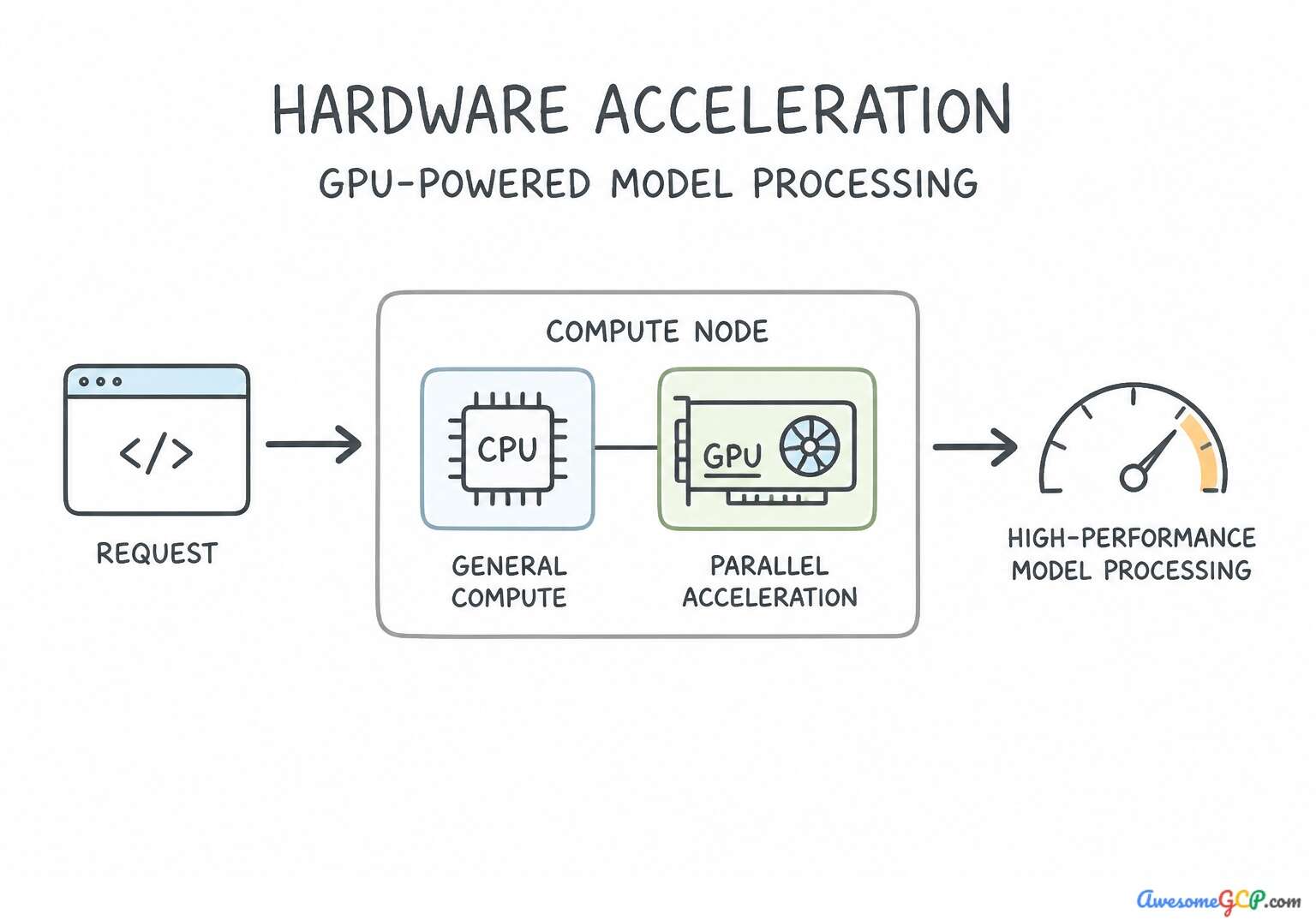
GKEwhen: You must host open-weight models on dedicated GPUs/TPUs, require strict kernel-level sandbox isolation (GKE SandboxwithgVisor) to execute untrusted LLM-generated code, or need fine-grained Kubernetes networking/sidecars.
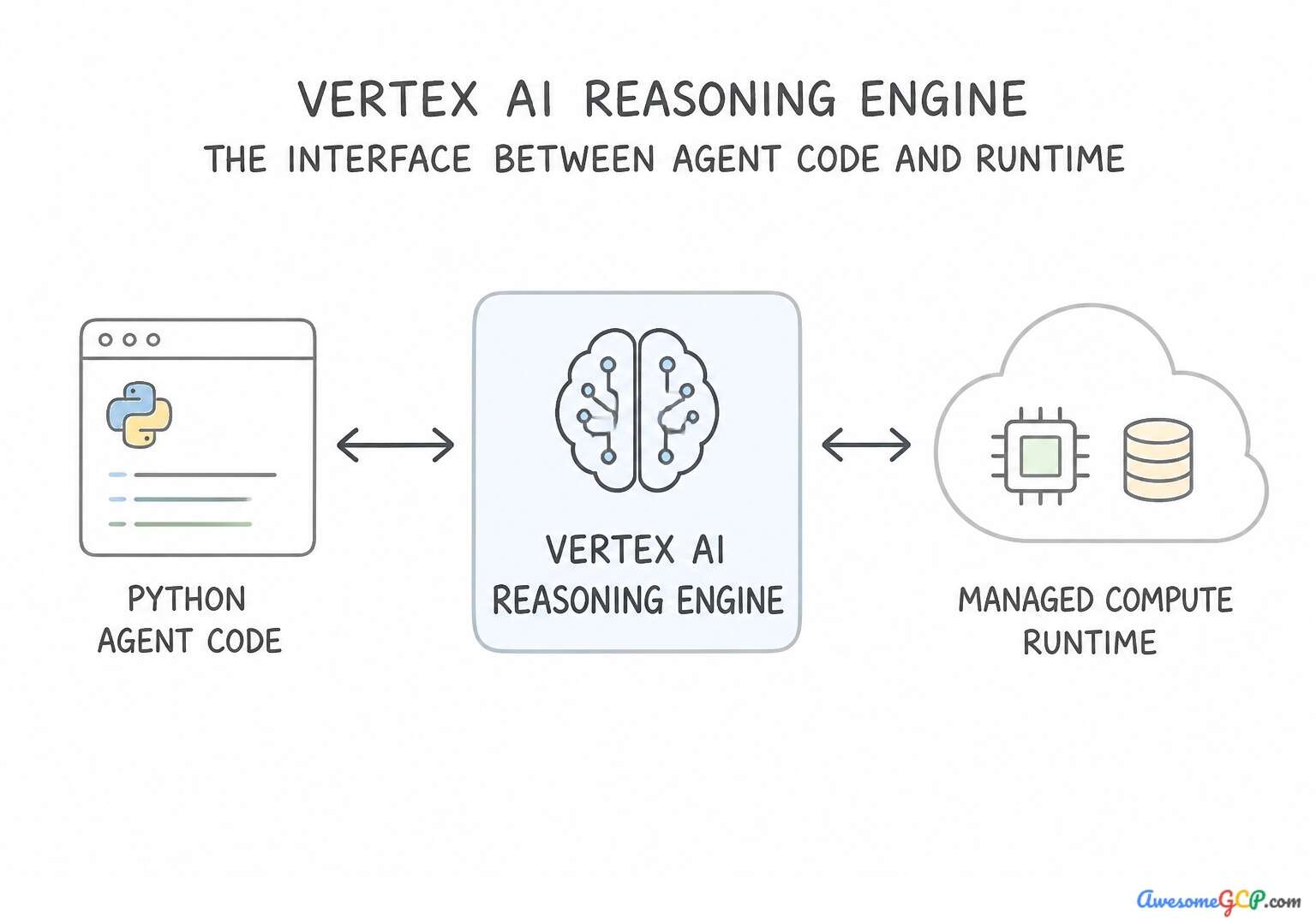
Takeaway 1: Serverless Managed Agent Runtime for Python Frameworks (vertex_ai:reasoning_engine · cloud_run · gke)
- Core Concept: Vertex AI Reasoning Engine (Agent Runtime) vs Containerized Infrastructure
- Scenario Trigger & Requirement: Two core constraints: the team lacks dedicated DevOps personnel and needs a solution that directly accepts Python agent code without requiring container image builds or infrastructure operations.
- Winning Architecture & Implementation: Deploy the agent directly to Vertex AI Reasoning Engine. Vertex AI Reasoning Engine is a managed agent runtime that natively packages and serializes Python agent frameworks such as LangChain and LlamaIndex.
- Exam Traps to Reject: Compute Engine requires virtual machine and operating system management, creating high operational overhead. Cloud Run requires building and maintaining container images, which contradicts the requirement to avoid Docker containers.
Takeaway 2: Bursty Tool Calling Microservices with Scale-to-Zero (cloud_run · compute_engine:vm · gke)
- Core Concept: Cloud Run for Event-Driven Agent Tool Execution
- Scenario Trigger & Requirement: Three critical requirements: (1) containerized agent tool microservices accessed over HTTP, (2) highly bursty workloads with overnight lulls dropping to zero traffic, and (3) a need for cost efficiency and minimal operational overhead.
- Winning Architecture & Implementation: Deploy the tool microservices to Cloud Run with automatic scaling enabled. Cloud Run is a fully managed, serverless platform designed for containerized applications. Cloud Run scales automatically in response to incoming HTTP traffic and scales down to zero instances when no requests arrive.
- Exam Traps to Reject: GKE standard clusters with fixed node pools do not scale down to zero and incur ongoing idle compute costs. App Engine flexible environment with manual scaling cannot scale to zero and fails to adapt automatically to spiky traffic.
Takeaway 3: Low-Latency Agent Workloads with Local Open-Weight Models (gke · compute_engine:gpus · vertex_ai)
- Core Concept: Google Kubernetes Engine (GKE) with Accelerators for Self-Hosted Inference
- Scenario Trigger & Requirement: The requirement asks for a hosting architecture that runs open-weight models and agent orchestration directly within a private network under strict data residency constraints. The solution requires dedicated GPU hardware acceleration, container co-location, and custom node autoscaling.
- Winning Architecture & Implementation: Deploy the models and agent containers on Google Kubernetes Engine (GKE) clusters with dedicated GPU node pools. Google Kubernetes Engine (GKE) is the ideal runtime when you need fine-grained control over compute resources, hardware accelerators such as NVIDIA GPUs or Cloud TPUs, and container orchestration.
- Exam Traps to Reject: App Engine standard environment does not support GPU acceleration or heavy open-weight model serving. External managed foundation model APIs violate the strict internal network data isolation requirement.
Consolidated Golden Rules (Consideration 4.2a):
- Choose Vertex AI Reasoning Engine for pure Python agent frameworks when you want zero container or infrastructure maintenance.
- Choose Cloud Run when you need custom non-Python runtimes or existing containerized microservices.
- Choose GKE when enterprise workloads require fine-grained orchestration, custom sidecars, or specific network topologies.
- Choose Cloud Run for containerized, stateless HTTP workloads with bursty traffic and idle periods.
- Scale-to-zero functionality prevents compute charges during inactive periods.
- Avoid fixed node pools or unmanaged VMs when workloads demand automated elasticity and low maintenance.
Consideration 4.2b: Troubleshooting agent issues (e.g., drift, tool invocation latency, agent reasoning loops, and system failures)
Know the exact diagnostic tool and architectural fix for the 4 classic production failure modes:
- 1. Isolating Multi-Agent Latency Bottlenecks: Propagate W3C Trace Context (
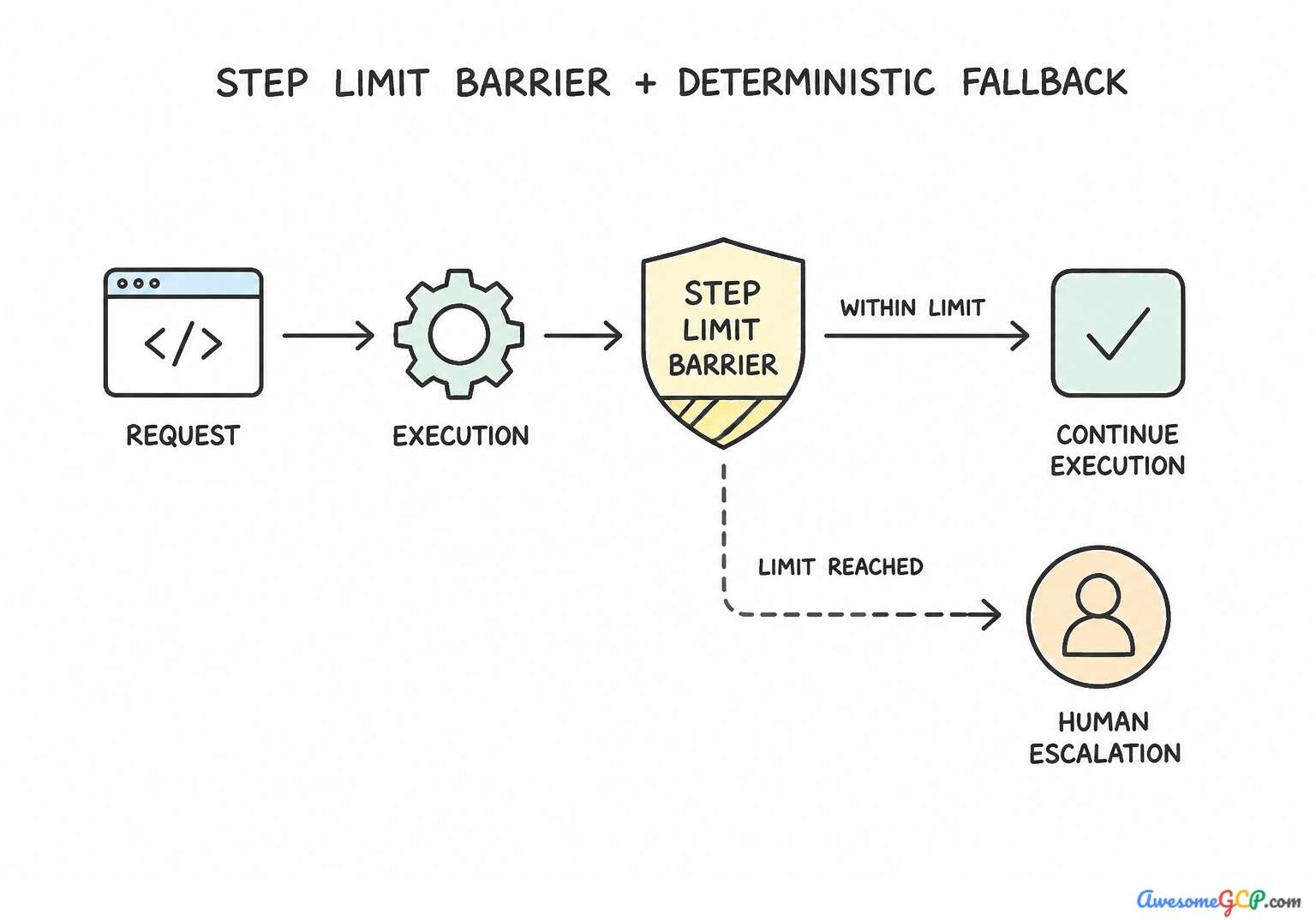
traceparent) headers across every agent and MCP call into Cloud Trace, and includelogging.googleapis.com/tracein Cloud Logging structured JSON entries to jump directly from a slow waterfall span to the exact prompt/tool payload. - 2. Infinite Reasoning / Tool Retry Loops: When an agent repeatedly calls a failing tool with identical bad parameters, enforce a deterministic maximum step/retry counter (
max_iterations), validate arguments against a strict schema before execution, and return structured corrective error hints or trigger a fallback. - 3. Downstream API / Data Drift: When an external API changes its payload structure or user query distributions shift, monitor tool error rate log-based metrics in Cloud Monitoring, decouple schemas via an MCP adapter layer, and feed drifted traces back into your Golden
evalset. - 4. Cascading Timeouts: Wrap slow or flaky external dependencies in a Circuit Breaker with strict per-tool timeouts and exponential backoff with jitter.
Takeaway 1: Mitigating Infinite Agent Reasoning Loops via Recursion Limits and Stop Conditions (vertex_ai:agent_builder · vertex_ai:reasoning_engine)
- Core Concept: Agent reasoning loops and deterministic breakout mechanisms
- Scenario Trigger & Requirement: A scenario where a GenAI agent repeatedly queries an API with modified parameters when empty results return, creating an infinite reasoning loop. The key task is to implement deterministic breakout mechanisms and safe human escalation.
- Winning Architecture & Implementation: Set a maximum execution step limit and define a deterministic fallback rule that triggers human escalation when the tool returns empty data. Configuring a maximum step limit (recursion limit) prevents the agent from calling tools indefinitely. When combined with a deterministic fallback rule for empty responses, the agent stops querying the billing API repeatedly and initiates a handoff to human support before exceeding timeout boundaries.
- Exam Traps to Reject: Disabling tools removes required live data access and causes hallucinations. Retrying indefinitely on empty responses wastes resources and increases user wait time without fixing the root cause.
Takeaway 2: Troubleshooting High Tool Invocation Latency Using Cloud Trace and Caching (cloud_trace · memorystore · cloud_run · vertex_ai)
- Core Concept: Tool invocation latency and downstream integration bottlenecks
- Scenario Trigger & Requirement: An AI agent where the core model inference is fast (< 800 ms), but the overall request exceeds 15 seconds due to multiple tool calls to an on-premises ERP system through Cloud Run. The requirements are twofold: identify/isolate the tool latency source and reduce repetitive read queries to the backend.
- Winning Architecture & Implementation: Instrument the agent workflow and Cloud Run service with Cloud Trace spans, and implement a Memorystore for Redis cache for read-only ERP queries. Implementing Cloud Trace allows you to capture distributed end-to-end latency across both the agent orchestration layer and downstream Cloud Run tool executions.
- Exam Traps to Reject: Model inference is already fast; changing the model or Cloud Run memory fails to address downstream ERP latency. GKE and Vertex AI Feature Store do not provide distributed tracing or API response caching for legacy ERP calls.
Takeaway 3: Handling Downstream Tool Failures with Circuit Breakers and Fallback Agents (vertex_ai:agent_builder · cloud_run · cloud_functions)
- Core Concept: System failures and resilient multi-agent fault isolation
- Scenario Trigger & Requirement: The core problem involves fault isolation in a multi-agent system. An external downstream dependency (third-party airline API) fails with HTTP 500/503 errors.
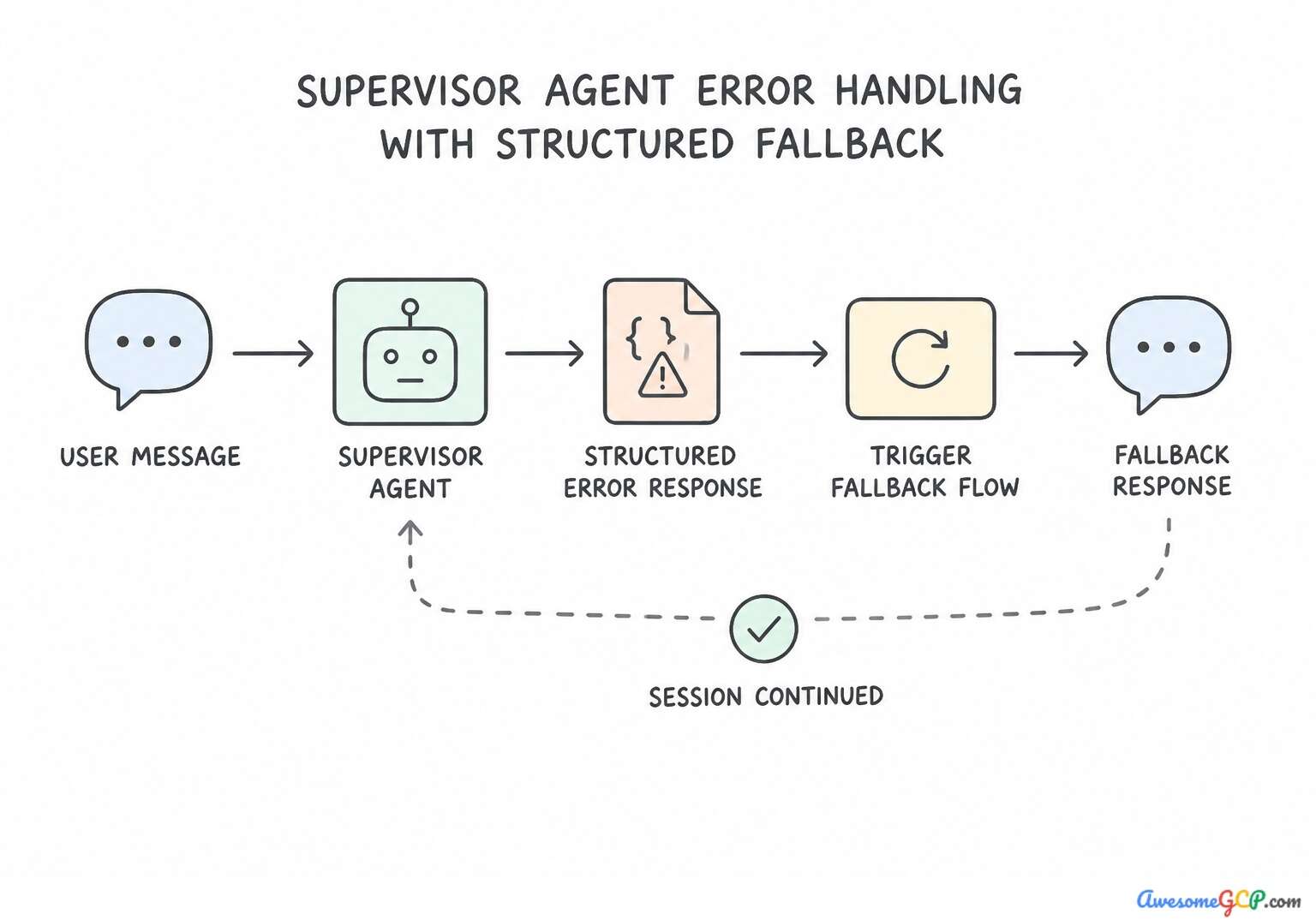
- Winning Architecture & Implementation: Capture API errors within the sub-agent tool to return structured error messages, and configure fallback handling in the supervisor agent. Catching exceptions within the tool interface and returning structured error payloads isolates system failures. This prevents sub-agent crashes from bubbling up to the supervisor agent.
- Exam Traps to Reject: External third-party APIs cannot be re-hosted in your Google Cloud environment. Continuous retries during partner outages increase latency and do not resolve unhandled system exceptions.
Takeaway 4: Detecting and Rectifying Knowledge Base Drift in Grounded Retrieval (vertex_ai:search · vertex_ai:agent_builder)
- Core Concept: Vector search retrieval drift and index staleness
- Scenario Trigger & Requirement: An AI agent that retrieves outdated instructions because the vector index has not ingested the newest files from Cloud Storage. The requirement is to restore grounded accuracy and maintain synchronization automatically.
- Winning Architecture & Implementation: Set up an automated recurring data sync schedule on the Vertex AI Search data store to periodically re-index the Cloud Storage bucket. When a grounded agent provides outdated information despite updated source files, the cause is index staleness. The index holds vector embeddings of older document versions.
- Exam Traps to Reject: Fine-tuning models for dynamic documentation updates is unnecessarily complex and does not address datastore index synchronization. Adjusting temperature and top-k retrieval parameters cannot fix missing or outdated index documents.
Consolidated Golden Rules (Consideration 4.2b):
- Agents require deterministic breakout controls such as maximum step limits to prevent unbounded reasoning loops.
- Empty tool responses must be handled with clear fallback heuristics or human handoff instead of continuous retries.
- Relying solely on model prompt instructions without system guardrails does not guarantee loop termination.
- Differentiate LLM inference latency from downstream tool execution latency by implementing distributed tracing with Cloud Trace.
- Mitigate repetitive, slow tool invocations for read-heavy operations by adding an in-memory cache such as Memorystore for Redis.
- Avoid modifying foundational model sizing when the bottleneck clearly resides in external tool orchestration.
Consideration 4.2c: Monitoring and optimizing agents for performance, reliability, and cost (e.g., identify logic errors, latency bottlenecks, and hallucinations)
When optimizing latency, throughput, and token cost in production:
- Eliminating
429 Resource Exhausted& Guaranteeing P99 Latency: Purchase Provisioned Throughput (reserved Generative Service Units) for predictable baseline traffic, and enable Pay-As-You-Go (PAYG) spillover for burst peaks. - Eliminating Serverless Cold Starts: If a Cloud Run agent or MCP server exhibits high latency on the first request after idle periods, configure
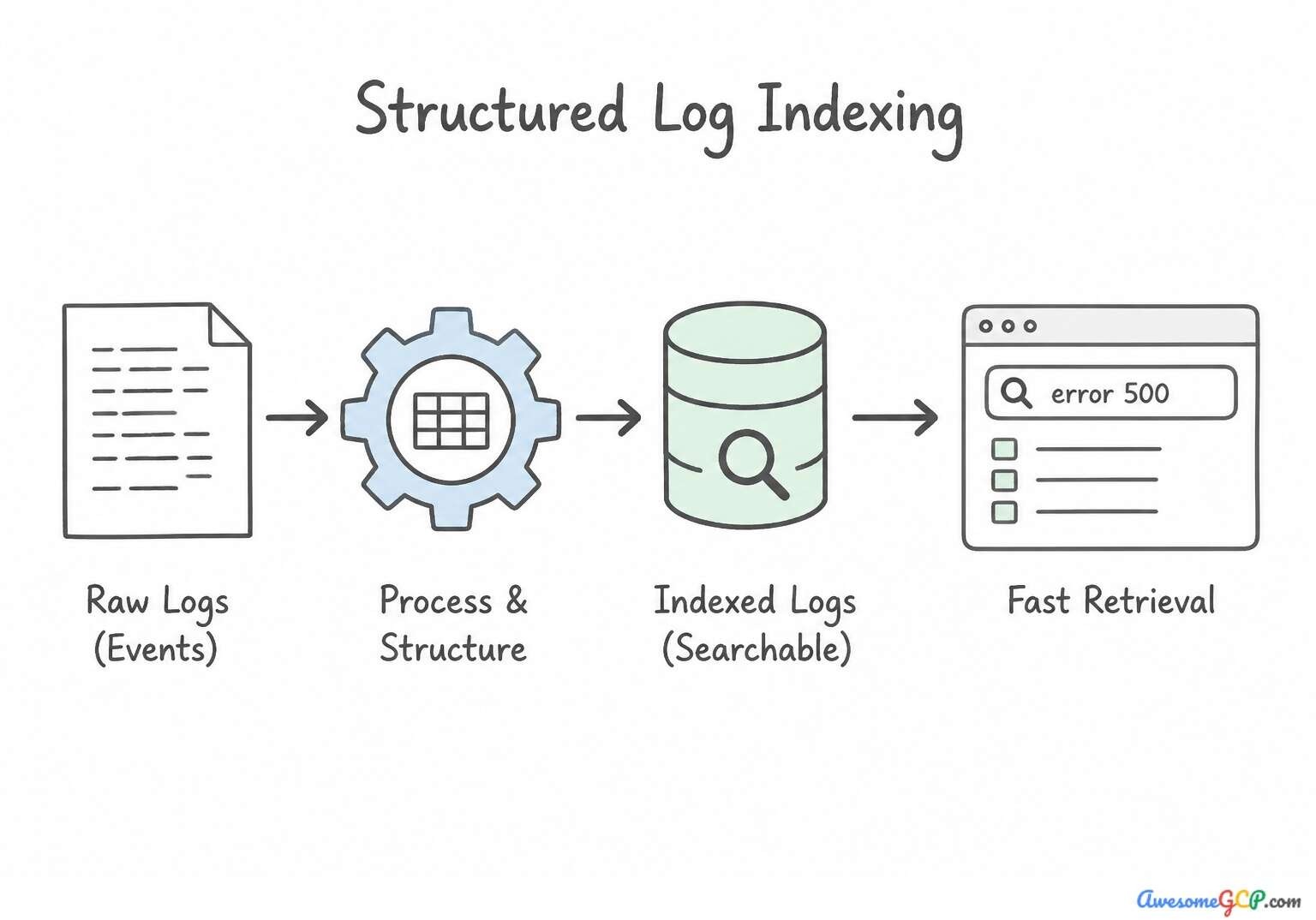
min-instances >= 1and CPU Startup Boost. - Semantic Caching with Memorystore for Redis: Embed incoming queries and check Memorystore for Redis (using vector similarity ≥ 0.95) to serve frequent, semantically equivalent questions in milliseconds without calling the LLM.
- Context Compaction & Model Tiering: Keep prompts lean via sliding-window summarization (storing large blobs as Cloud Storage URIs), and route simple classification/extraction hops to
Gemini Flash/Flash-Litewhile reservingGemini Profor complex reasoning.
Takeaway 1: End-to-End Distributed Tracing for Agentic Latency Bottlenecks (cloud_trace · cloud_run · vertex_ai:search)
- Core Concept: Tracing multi-agent execution steps with OpenTelemetry and Cloud Trace to identify latency hotspots across retrieval, tool execution, and inference.
- Scenario Trigger & Requirement: An AI agent workflow hosted on Cloud Run that interacts with multiple dependencies (Vertex AI Search and an external SAP API). Total response latency increased from 2 seconds to 9 seconds. The objective is to identify which specific internal workflow step (retrieval, tool execution, or model inference) causes the delay.
- Winning Architecture & Implementation: Instrument the agent application with OpenTelemetry to export trace spans for retrieval, tool execution, and model inference into Cloud Trace. Instrumenting the agent application with OpenTelemetry allows you to generate individual distributed trace spans for each sub-step of the agent workflow, such as Vertex AI Search retrieval, external SAP API tool execution, and large language model (LLM) generation.
- Exam Traps to Reject: Increasing compute resources will not identify latency bottlenecks or accelerate external third-party API response times. Container-level request logs only measure overall request duration, not individual internal agent steps.
Takeaway 2: Automated Production Hallucination and Groundedness Monitoring (vertex_ai:genai_evaluation · vertex_ai:endpoints · bigquery · cloud_monitoring)
- Core Concept: Continuous evaluation of live agent interactions using Vertex AI Gen AI Evaluation and BigQuery-driven metric dashboards.
- Scenario Trigger & Requirement: A generative AI agent in a high-stakes domain (healthcare) requiring continuous evaluation for hallucinations and groundedness in reference guidelines. The key need is an automated, scalable pipeline that logs production interactions, measures groundedness against source documents, and raises alerts when scores drop.
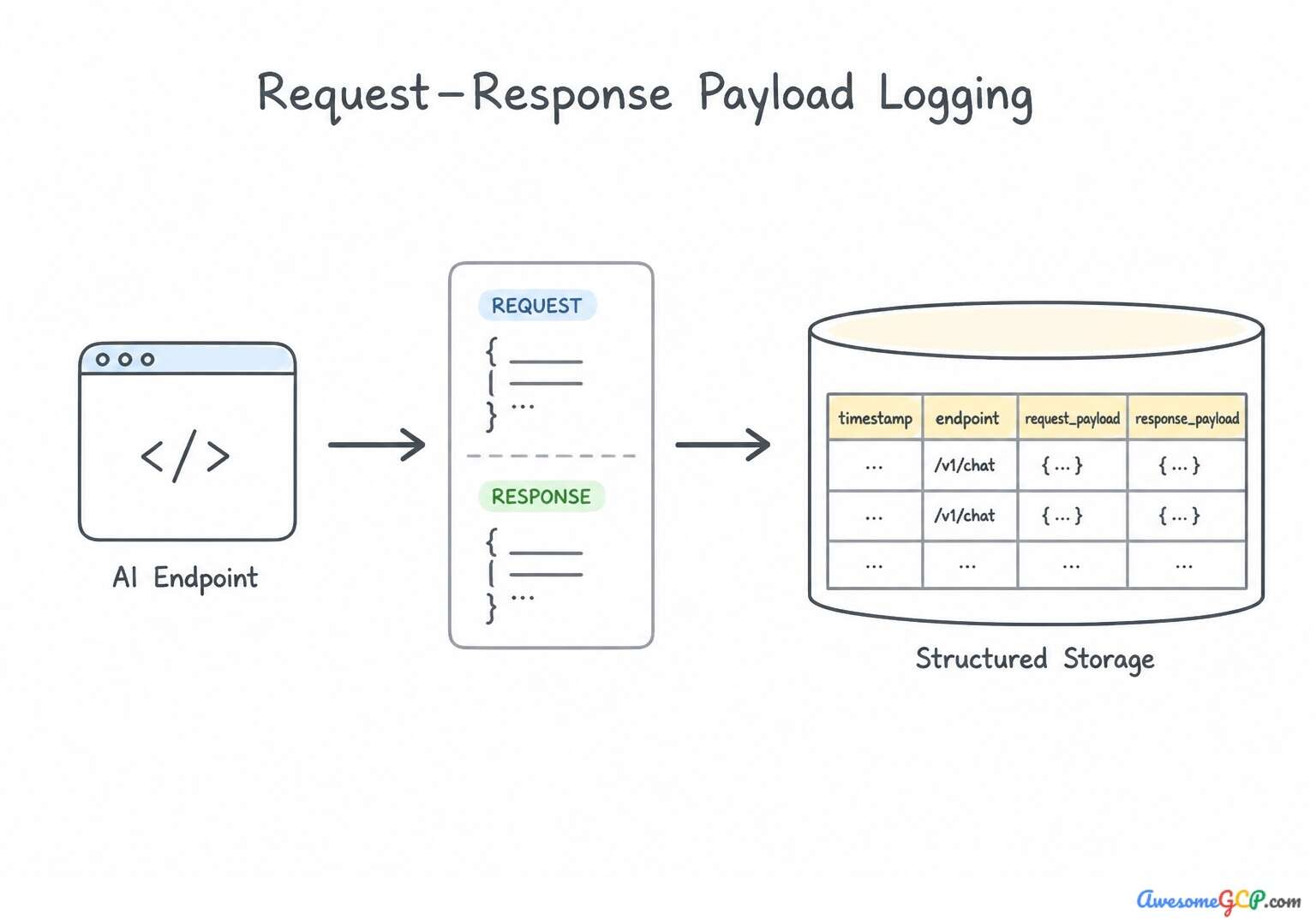
- Winning Architecture & Implementation: Enable request-response payload logging to BigQuery on the endpoint, schedule recurring Vertex AI Gen AI Evaluation jobs to compute groundedness metrics, and configure Cloud Monitoring alerting policies on the evaluation metric results. Exporting live inference payloads from Vertex AI endpoints into BigQuery enables continuous evaluation of production interactions.
- Exam Traps to Reject: Standard model monitoring evaluates tabular feature drift rather than generative text groundedness and hallucinations. Regex pattern matching is incapable of evaluating semantic factual grounding and hallucination.
Takeaway 3: Cost and Latency Optimization via Semantic Caching (vertex_ai · memorystore:redis · vertex_ai:embeddings)
- Core Concept: Implementing semantic caching on Vertex AI to reduce repetitive LLM calls and associated token costs.
- Scenario Trigger & Requirement: Two key bottlenecks: rising token consumption costs on Vertex AI and increasing latency caused by repetitive, semantically equivalent policy questions. The solution must intercept recurring questions before invoking foundation models.
- Winning Architecture & Implementation: Implement a semantic cache with Memorystore for Redis and Vector Search to store query embeddings and return cached responses for semantically similar questions. Implementing a semantic cache with vector search allows the architecture to recognize questions that share the same meaning even when phrased differently (for example, "How do I return an item?" versus "What is your return policy?").
- Exam Traps to Reject: Fine-tuning updates model weights rather than caching responses, failing to eliminate inference execution. Exact-match key-value caching fails to capture slight phrasing variations, resulting in low cache hit rates.
Takeaway 4: Detecting Tool Call Loops and Logic Failures in Agent Trajectories (cloud_monitoring · cloud_logging · kubernetes_engine)
- Core Concept: Monitoring agent trajectory depth, cyclic tool execution, and infinite loops via log-based metrics.
- Scenario Trigger & Requirement: An AI agent running on GKE that gets trapped in an infinite execution loop, calling the same tool repeatedly. Waiting for an HTTP 504 timeout or context limit error is reactive, costly, and causes poor user experience.
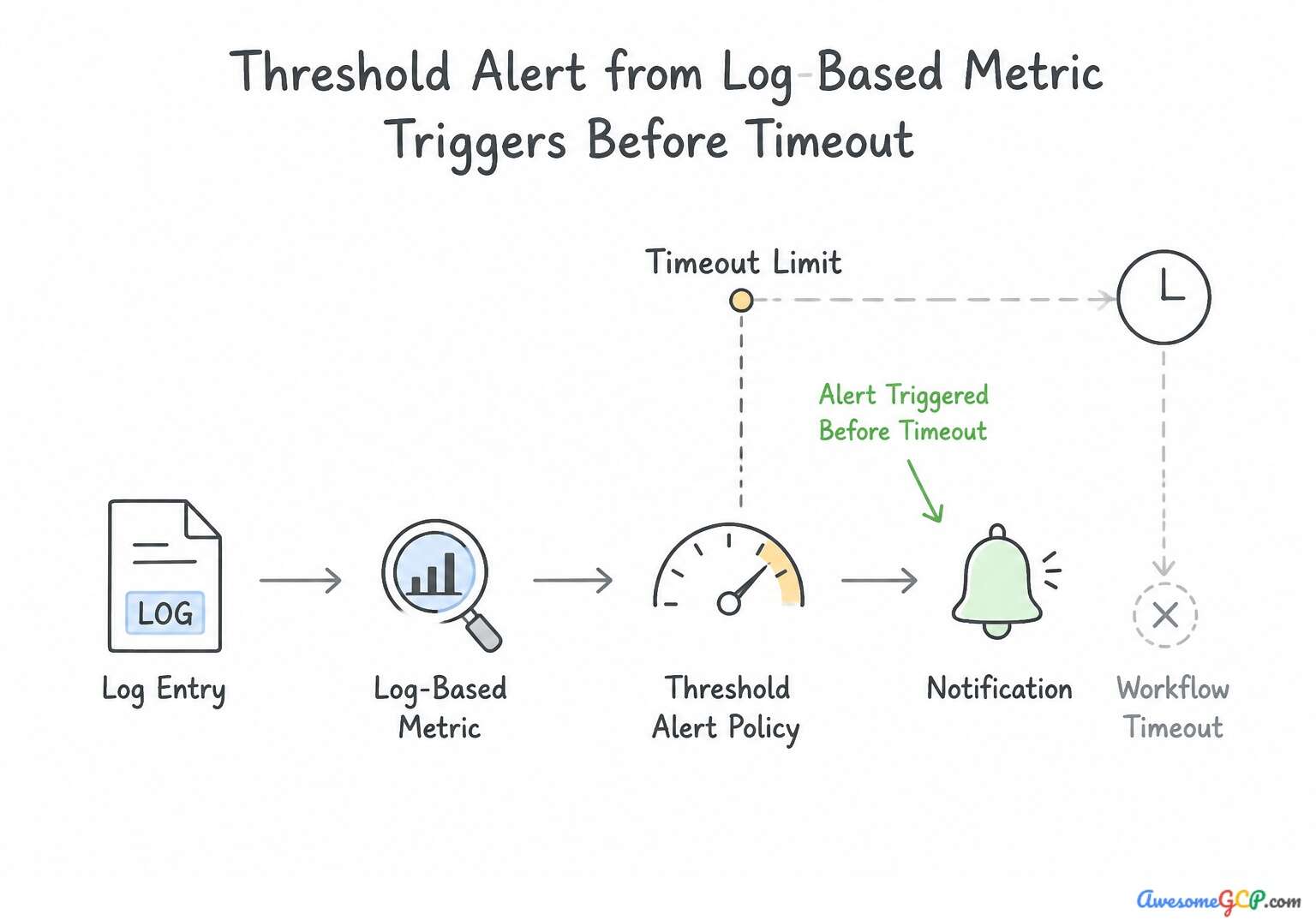
- Winning Architecture & Implementation: Emit structured logs containing execution step counts and tool call signatures from the agent. Create a Cloud Monitoring log-based metric and alert policy that triggers when step counts or repetitive tool signatures exceed a predefined threshold. Emitting structured logs with step counts and tool invocation signatures allows you to observe trajectory depth and repetitive tool invocation patterns in real time.
- Exam Traps to Reject: Uptime checks and HTTP 504 alerts only trigger after requests have already timed out and failed. Expanding context and compute limits exacerbates costs without detecting or resolving infinite loops.
Consolidated Golden Rules (Consideration 4.2c):
- Use OpenTelemetry spans and Cloud Trace to diagnose latency across individual steps in an AI agent workflow.
- Cloud Run request logs only capture total HTTP request duration, not internal agent step timings.
- Diagnose bottlenecks before scaling resources, as compute scaling does not fix slow downstream external APIs.
- Use BigQuery request-response payload logging on Vertex AI endpoints to capture production interactions for offline evaluation.
- Use Vertex AI Gen AI Evaluation (Groundedness and Faithfulness metrics) to detect hallucinations systematically.
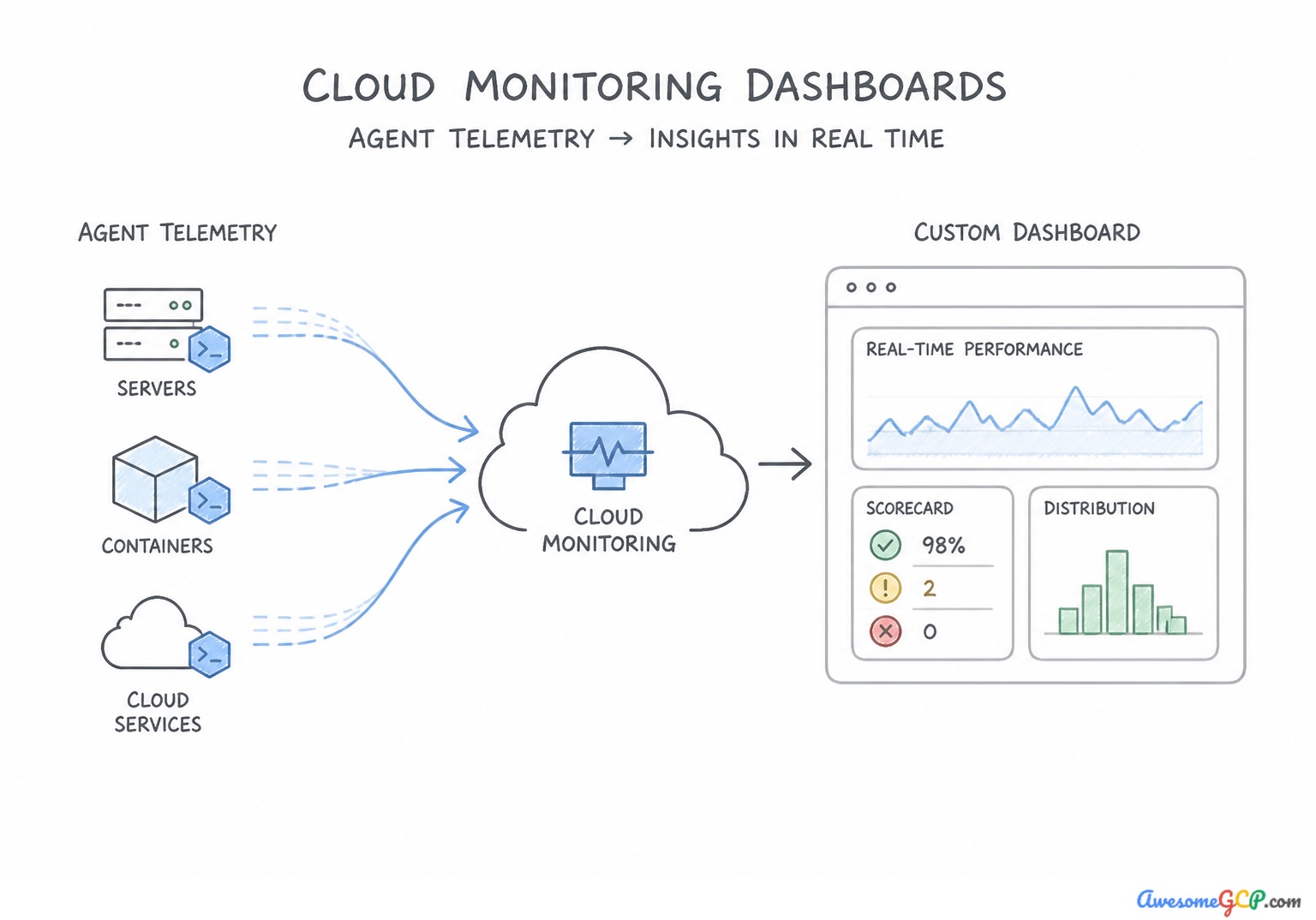
- Connect evaluated metric results to Cloud Monitoring alerting policies for proactive incident management.
Multi-Constraint Production Architecture Scenarios (Subsection 4.2)
Production Scenario & Hard Constraints | Winning Google Cloud Architecture | Why Look-Alike Alternatives Fail |
|---|---|---|
Standard pattern for handling transient external tool failures in an agent application: An AI agent integrating with an external database tool that periodically throws transient HTTP 503 Service Unavailable errors. The core problem is building an agent architecture that maintains session continuity, handles transient failures, and returns a helpful response without hallucinating data or crashing the host runtime. | Implement tool error handling and retry callbacks in ADK that return structured error context to the agent. Implement retry callbacks and deliver structured error responses so the agent can inform the user gracefully without crashing. | Hardcoded inventory values become outdated immediately and defeat the purpose of an operational database. Fabricating data introduces hallucinations and produces incorrect information. |
Architectural pattern in agent development to enforce tool latency constraints: A common production resilience requirement: invoking an external critical integration (a payment gateway) with a strict latency budget (five seconds). | Configure tool execution timeouts and fallback handler logic in the ADK tool configuration. Setting a tool timeout threshold and defining fallback logic enables automated failover to the secondary payment provider when the primary API exceeds five seconds. | Running concurrent payment calls can double-charge users and creates severe data consistency issues. Waiting indefinitely violates the five-second deadline requirement and causes agent sessions to freeze or time out uncontrollably. |
Runtime guardrails and budgetary protections to prevent runaway execution in automated agents: A failure mode common in autonomous AI agent systems: infinite tool-calling loops. The learner must identify governance, architectural, and runtime controls that cap resource consumption, stop endless reasoning cycles, and maintain fiscal predictability. | Configure maximum step limits, execution recursion caps, and budget quota alerts in the agent runtime. Setting recursion caps, maximum step limits, and budget alerts bounds execution and prevents catastrophic cost spikes. | Disabling alerts removes visibility into system anomalies and allows uncontrolled billing expenditure to continue. Increasing billing quotas removes financial safeguards and exacerbates uncontrolled cost accumulation. |
Distributed tracing with Cloud Trace and OpenTelemetry as the standardized observability: A production agent system suffering from non-deterministic latency spikes. The primary requirement is inspecting the exact sequence of events across multiple disparate components: foundation model reasoning cycles, downstream tool invocations, and database queries. | Implement distributed tracing with Cloud Trace and OpenTelemetry across the agent runtime and tools. Distributed tracing with Cloud Trace and OpenTelemetry breaks down execution timing across model calls, tools, and databases into spans to isolate latency bottlenecks. | Print statements lack trace context, span correlation, and timing visualization required to inspect distributed execution sequences. Adjusting virtual machine (VM) disk capacity does not provide observability into internal execution sequences and does not resolve unknown latency bottlenecks. |
Managed compute service in Google Cloud that offers automatic horizontal scaling: The key requirements in the question are: unpredictable enterprise traffic spikes, scale automatically from zero to hundreds of concurrent requests, and minimal operational overhead. | Deploy the ADK agent container on Cloud Run with automatic horizontal scaling and concurrency controls. Cloud Run automatically scales containerized applications from zero to hundreds of instances with zero server management overhead. | A single virtual machine (VM) cannot handle unpredictable spikes and does not scale to zero. Local workstations lack the scalability, redundancy, and security required for enterprise production traffic. |
Recommended deployment strategy and Google Cloud capabilities for splitting live: The scenario requires introducing a new prompt version for an agent while constraining the initial blast radius to exactly ten percent of live production traffic. The key operational requirement is executing a controlled canary deployment to observe real-world performance metrics prior to full release. | Configure traffic splitting in Cloud Run or Vertex AI Agent Service for canary deployment. Traffic splitting natively routes a specified percentage of live traffic to a canary revision for safe performance evaluation. | Replacing the full deployment immediately routes 100% of traffic, risking widespread failure instead of testing a canary. Manual user redirection degrades user experience and fails to achieve automated, representative traffic testing. |
Proper architectural and operational remedy for HTTP 429 Rate Limit Exceeded errors: The scenario specifies two crucial elements: frequent 429 Rate Limit Exceeded errors and higher demand during marketing campaigns. An HTTP 429 status code indicates that the workload exceeded quotas allocated for the Google Cloud project in that region. | Request a Vertex AI quota increase for tokens per minute and implement exponential backoff retry logic. HTTP 429 indicates quota exhaustion; requesting a quota increase accommodates sustained volume while exponential backoff gracefully handles temporary request spikes. | Vertex AI requires authentication, and rate limits enforce project-level quotas rather than individual user limits. Managed Vertex AI Gemini APIs run on Google Cloud infrastructure where quotas enforce limits centrally. |
Standard Google Cloud architecture for capturing application telemetry and rendering: The scenario requires monitoring specific operational parameters of an agentic workflow: token usage per user, tool error rates, and end-to-end response latency. Crucially, the requirement dictates displaying these metrics on a real-time dashboard. | Emit structured telemetry metrics to Cloud Monitoring and build a custom Cloud Monitoring dashboard. Cloud Monitoring captures custom multidimensional metrics and renders near real-time dashboards for latency, errors, and token usage. | Container file systems are ephemeral and do not provide centralized aggregation or real-time dashboarding. Exposing operational metadata to users degrades user experience, wastes tokens, and fails to deliver an operations dashboard. |
Standard architecture pattern that minimizes perceived wait times for users: User dissatisfaction concerning latency: 'waiting several seconds for full agent responses feels sluggish in the web interface'. The explicit design requirement is to 'improve the perceived responsiveness of the application'. Key concepts include perceived latency, Time to First Token (TTFT), and stream-based delivery mechanisms. | Enable token streaming in Vertex AI and stream response chunks to the frontend UI as they are generated. Token streaming lowers Time to First Token by sending chunks as they generate, greatly improving perceived responsiveness. | Disabling tools breaks agent functionality and returning empty text fails user requirements. Increasing the context window increases memory requirements and latency, which does not improve user perceived responsiveness. |
Standard sequence of phases required to develop, deploy, secure, and manage autonomous: Requires the standard sequence of operational and engineering stages in an AgentOps lifecycle. Autonomous agents interact dynamically with external systems through reasoning loops and tool execution. Identifying the standard phases guarantees safe and predictable deployment in enterprise environments. | Design, Build, Evaluate, Test, Secure, Deploy, Observe, and Improve. Option A defines the complete end-to-end lifecycle for building, testing, securing, operating, and continuously enhancing autonomous AI agents. | Post-retirement evaluation fails to ensure the agent behaves correctly during production service. Deploying directly to production without evaluation risks unpredictable behavior and hallucinations. |
Fastest and most reliable operational mechanism to restore stability by reverting: A scenario where a newly released generative AI agent exhibits hallucinations directly in the production environment, requiring immediate restoration of service stability. Key considerations include: * Unexpected spike in hallucinations: Indicates a functional regression introduced in the most recent version. | Perform an immediate rollback to the previous stable revision using Cloud Run revision traffic management. Rerouting traffic immediately back to the known stable Cloud Run revision eliminates user exposure to the hallucinating agent version without delay. | Refactoring code directly in production takes excessive time and exposes users to continued failures. Recreating the project creates complete service unavailability and destroys existing infrastructure unnecessarily. |
Best practices for AgentOps and configuration management by treating prompts and agent: Requires the standard engineering approach to achieve version control and lifecycle management for GenAI agent components (prompt templates, tool schemas, agent orchestration graphs) in tandem with application code. | Store prompt templates, tool schemas, and agent definitions as code in a Git repository with CI/CD automation. Storing agent definitions and prompts as code in a Git repository with CI/CD enables version control, automated testing, and parity with application code. | Draft emails do not provide version tracking, testing automation, or centralized source control. Directly modifying a production database lacks change auditing, version history, and automated deployment safety. |
Architectural patterns required to safeguard backend database connection pools against: A scenario where an AI agent platform must handle intense shopping traffic during Black Friday. Large language model agents frequently invoke external tools to query or mutate state in enterprise relational databases. | Implement connection pooling, rate limiters, and queue-based tool execution in the agent backend. Implementing pooling, rate limiters, and asynchronous queues protects database backends from connection saturation during traffic spikes. | Hardware resource boundaries prevent infinite connections, and removing limits leads directly to database crashes under heavy loads. Opening a dedicated connection for each tool call causes connection starvation and substantial connection setup latency. |
Proper operational practice to reclaim session memory in agent runtime containers after: An agent runtime environment where container memory steadily climbs across extended execution periods. The prompt pinpoints that session state objects linger in memory following conversation completion. | Configure session expiration timeouts and explicit memory cleanup hooks in the ADK session manager. Configuring explicit session timeouts and lifecycle cleanup hooks ensures memory allocations release properly when conversations finish. | Rebooting the virtual machine (VM) disrupts ongoing sessions and fails to fix the root cause of the memory leak. Increasing container memory merely delays out-of-memory crashes while raising infrastructure costs. |
Proper Google Cloud observability configuration to trigger automated notifications: A requirement for automated, real-time alerting based on a specific numerical threshold: an agent tool failure rate exceeding five percent evaluated over a rolling ten-minute window. Effective site reliability and AgentOps practices require programmatic metric monitoring rather than manual or user-driven discovery. | Create a Cloud Monitoring alerting policy based on tool execution error metrics with notification channels. Cloud Monitoring alerting policies allow you to define metric-based thresholds and send automated notifications through configured channels. | Customer support reporting is reactive and does not meet the requirement for automated real-time alerting. Manual weekly log inspection does not provide automated or real-time detection of tool failures. |
Recommended Google Cloud generative AI feature to optimize invocation latency and reduce: The question contains three critical elements: frequent calls to static knowledge base articles, a requirement to minimize model invocation latency, and a requirement to reduce token costs. | Enable Vertex AI Context Caching for the static knowledge base prefix. Vertex AI Context Caching stores large static prompt prefixes, which minimizes latency and decreases token processing costs. | Hourly fine-tuning is cost-prohibitive, technically impractical, and not suitable for static reference data lookup. Re-sending full text repeatedly consumes maximum input tokens and increases latency. |
Standard AgentOps practice for detecting prompt injection regressions and security: An AgentOps scenario where prompts undergo continuous integration. Prompts dictate model behavior, and minor text alterations can inadvertently weaken guardrails or expose the agent to direct or indirect prompt injection. | Include automated adversarial red-teaming and prompt injection evalsets in the CI/CD test suite. Automating adversarial evaluation datasets within CI/CD pipelines ensures prompt modifications do not introduce security vulnerabilities or prompt injection regressions. | Manual inspection cannot predict non-deterministic model responses to adversarial prompt injection techniques. Direct deployment without automated verification exposes production systems to unmitigated security vulnerabilities. |
Standard Google Cloud telemetry practices for inspecting and correlating step-by-step: A common production observability challenge in AgentOps: diagnosing an anomalous or incorrect output generated by an autonomous agent workflow. | Query Cloud Trace and Cloud Logging using the unique session ID and trace ID of the transaction. Filtering Cloud Logging and Cloud Trace with unique session and trace IDs reveals all intermediate inputs, tool calls, and model outputs for a specific execution. | Training foundation models from scratch is irrelevant to debugging runtime prompt formatting or tool calls. End users cannot inspect internal agent states, retrieval chunks, or raw model outputs. |
Standard runtime governance controls needed to prevent runaway loops and token: An autonomous research agent that performs iterative searches and tool executions. The core risk identified is budget overruns caused by runaway execution loops or excessive recursive calls. | Configure maximum step limits, execution recursion caps, and token budget thresholds in the agent runtime. Configuring step limits, recursion caps, and token thresholds stops runaway loops at runtime, directly preventing budget overruns. | Monthly invoices are retrospective and cannot prevent real-time budget overruns or runaway execution loops. Increasing quotas removes API throttling protections and amplifies financial overruns caused by runaway loops. |
Vertex AI feature designed to reduce token processing costs and response latency: Two specific pain points: high token costs and increased request latency arising from a static, massive schema (twenty megabytes) returned on every interaction by a Model Context Protocol (MCP) server. | Enable Vertex AI Context Caching for the static schema context returned by the MCP server. Vertex AI Context Caching stores repetitive, large inputs to reduce token consumption and lower request latency. | Re-transmitting the large payload on every interaction continues to incur excessive token costs and latency. Truncating schema definitions strips vital field specifications and leads to incorrect tool calling. |
Head-to-Head Architectural Trade-Off Clinic (Subsection 4.2)
Operational Scenario | Optimal Google Cloud Architecture | Common Exam Trap (Reject!) |
|---|---|---|
Deploy a stateful multi-turn ADK agent with minimal DevOps overhead and built-in session/memory management | Agent Runtime (formerly Agent Engine) | Self-managing a Kubernetes cluster on Compute Engine VMs or storing sessions in local container files. |
Deploy a stateless MCP server that receives 200 requests/day during business hours and zero overnight, minimizing cost | Cloud Run (scales to zero when idle) | Dedicated 24/7 GKE node pool or Compute Engine VM group. |
Execute untrusted Python scripts dynamically generated by an LLM with strong kernel isolation | GKE Sandbox ( gVisor) or managed Vertex AI Code Execution Sandbox | Running exec() / subprocess.run() directly inside the main agent container with the agent's IAM Service Account. |
Identify which sub-agent or MCP tool is causing a 14-second P99 latency spike across 5 microservices | Cloud Trace with OpenTelemetry & W3C traceparent header propagation | Grepping unstructured text logs across 5 separate Cloud Run services or checking average CPU utilization. |
Prevent 429 Quota Exceeded errors and guarantee P99 latency for a mission-critical banking agent with steady baseline load | Provisioned Throughput for baseline load + Pay-As-You-Go ( PAYG) spillover for bursts | Relying solely on PAYG with 30-second time.sleep() retries inside the user request thread. |
Cut LLM token spend by 40% for a retail FAQ agent where 35% of queries are variations of the top 100 questions | Semantic Caching using Memorystore for Redis (Vector Search over query embeddings) | Exact string-key Redis caching (misses paraphrased queries) or storing cache entries in BigQuery. |
Rapid Pattern-Trigger Cheat Sheet (Subsection 4.2)
If the Exam Scenario Mentions... | Choose This Architecture / Configuration | Reject This Common Distractor Trap |
|---|---|---|
"Multi-agent trace in Cloud Trace shows 4 separate unconnected traces instead of 1 unified waterfall" | Propagate the W3C traceparent context header across all HTTP, A2A, and MCP calls | Synchronizing system clocks via NTP or putting all agents in a single monolith container |
"Jump directly from a slow span in Cloud Trace to the exact prompt/tool logs for that step" | Write Structured JSON logs to Cloud Logging including logging.googleapis.com/trace and spanId | Writing plain-text print() logs to stdout |
"Cloud Run agent has fast 400ms responses under load, but the first request after 20 minutes of inactivity takes 9 seconds" | Set min-instances ≥ 1 (and enable CPU Startup Boost) on Cloud Run | Increasing maximum instances ( max-instances) or switching from HTTP/2 to HTTP/1.1 |
"Production agent hits 429 Resource Exhausted during predictable morning peaks" | Reserve Provisioned Throughput with PAYG spillover | Switching to a larger foundation model or adding synchronous sleep loops |
"Third-party shipping API goes down; agent hangs for 60s retrying and exhausts connection pools" | Implement a Circuit Breaker pattern with strict per-tool timeouts and graceful fallback | Increasing the global Cloud Run request timeout to 60 minutes |
Curated Official Google Cloud Documentation (Subsection 4.2)
- Cloud Run Overview — Explains how Cloud Run enables serverless execution of containerized applications and microservices with automatic scaling.
- Choosing a Google Cloud Compute Option — A comparative guide highlighting differences between Compute Engine, Google Kubernetes Engine, and Cloud Run.
- Vertex AI Agent Builder overview — Provides architectural details on building, deploying, and managing enterprise agents with Vertex AI Agent Builder and its runtime components.
- Vertex AI Model Monitoring overview — Describes how to monitor machine learning models and generative AI endpoints for feature drift, prediction drift, and data distribution shifts over time.
- Evaluate generative AI models and agents in Vertex AI — Explains how to run continuous and scheduled evaluations on agent workflows to detect quality degradation, hallucination, and drift.
- Develop custom agents in Vertex AI — Explains how to define custom reasoning logic, tool calling patterns, and execution limits for autonomous agents.
- Cloud Trace Overview — Cloud Trace is a distributed tracing system that collects latency data from your applications and displays it in the Google Cloud console, helping you understand how requests propagate through your service architecture.
- Cloud Logging overview — Provides an overview of Cloud Logging architecture, log ingestion, and indexing capabilities within Google Cloud.
- View logs with the Logs Explorer — Explains how to query, filter, and inspect structured operational logs for debugging running services and agent runtimes.
- Vertex AI Grounding Overview — Explains how grounding connects model responses to verifiable data sources to reduce hallucinations and ensure factual accuracy.
- Evaluate Generative AI Models in Vertex AI — Details evaluation metrics including groundedness and factual consistency for detecting model hallucinations.
- Google Kubernetes Engine (GKE) Overview — Provides an overview of GKE capabilities, cluster architecture, and supported workload types.
Book TOC · Previous · Chapter 6 of 8 · Next
AwesomeGCP.com Learning
The approach taken is a question-led learning approach: you explore realistic project scenarios where you need to make decisions or take actions to achieve business goals within specific constraints. Instead of passive learning, you are challenged to think and work through the options to master the Professional Agentic Architect (PAA) certification!