Book TOC · Previous · Chapter 1 of 7 · Next
Chapter 1: Digital Transformation Strategy, Cloud Economics (CapEx vs. OpEx) & Service Models
Chapter Focus: Cloud & Agentic AI definitions, CapEx to OpEx shift, TCO, Public/Private/Hybrid/Multicloud deployments, IaaS/PaaS/SaaS, and the Shared Responsibility Model.
Subsection 1.1: Explain why and how the cloud is revolutionizing businesses
The Big Picture
Many legacy enterprises treat "moving to the cloud" as an IT real-estate transaction: they copy aging virtual machines from a corporate data center onto rented cloud servers, change nothing about their manual approval workflows, keep their data locked in departmental silos, and wonder why innovation is still slow. On the Cloud Digital Leader architectures, this is the classic distinction between mere infrastructure migration and true digital transformation.
In Subsection 1.1, you must think like a Chief Digital Officer advising a board of directors:
- Master the New Vocabulary of Transformation (1.1a): Understand not just
cloudandinfrastructure, but how Agentic AI (autonomous systems that reason, plan multi-step workflows, and execute actions via tools/APIs without constant human prompting), open source, and open standards fundamentally alter enterprise agility and eliminate vendor lock-in. - Connect Technical Cloud Capabilities to Executive Business Outcomes (1.1b): Translate technical traits—
scalability,elasticity,agility,speed,global reach,high availability, andenhanced security—into strategic value: shifting engineering focus from undifferentiated hardware maintenance ("keeping the lights on") to core business differentiation. - Diagnose Transformation Drivers, Hurdles, and the Risk of Inaction (1.1c): Recognize why organizations are compelled to transform (rising customer expectations, supply-chain volatility, competitive velocity), the organizational hurdles that stall transformation (cultural resistance, skills gaps, legacy technical debt), and the existential risk of not adopting cloud (inability to run modern AI, escalating maintenance costs, and loss of market share).
- Articulate Google Cloud's Top Differentiators (1.1d): Know why enterprises choose Google Cloud specifically: world-leading AI (from Transformer research to Gemini and Enterprise Agents), the AI Hypercomputer (co-designed TPUs/GPUs, software, and flexible consumption), an AI-ready data platform (BigQuery + unified unstructured/structured data), deep commitment to openness and interoperability (Kubernetes, open standards, multicloud), planet-scale private global network, and secure-by-design infrastructure powered by clean energy.
Consideration 1.1a: Define the terms: cloud, agentic AI, infrastructure, digital transformation, open source, open standard
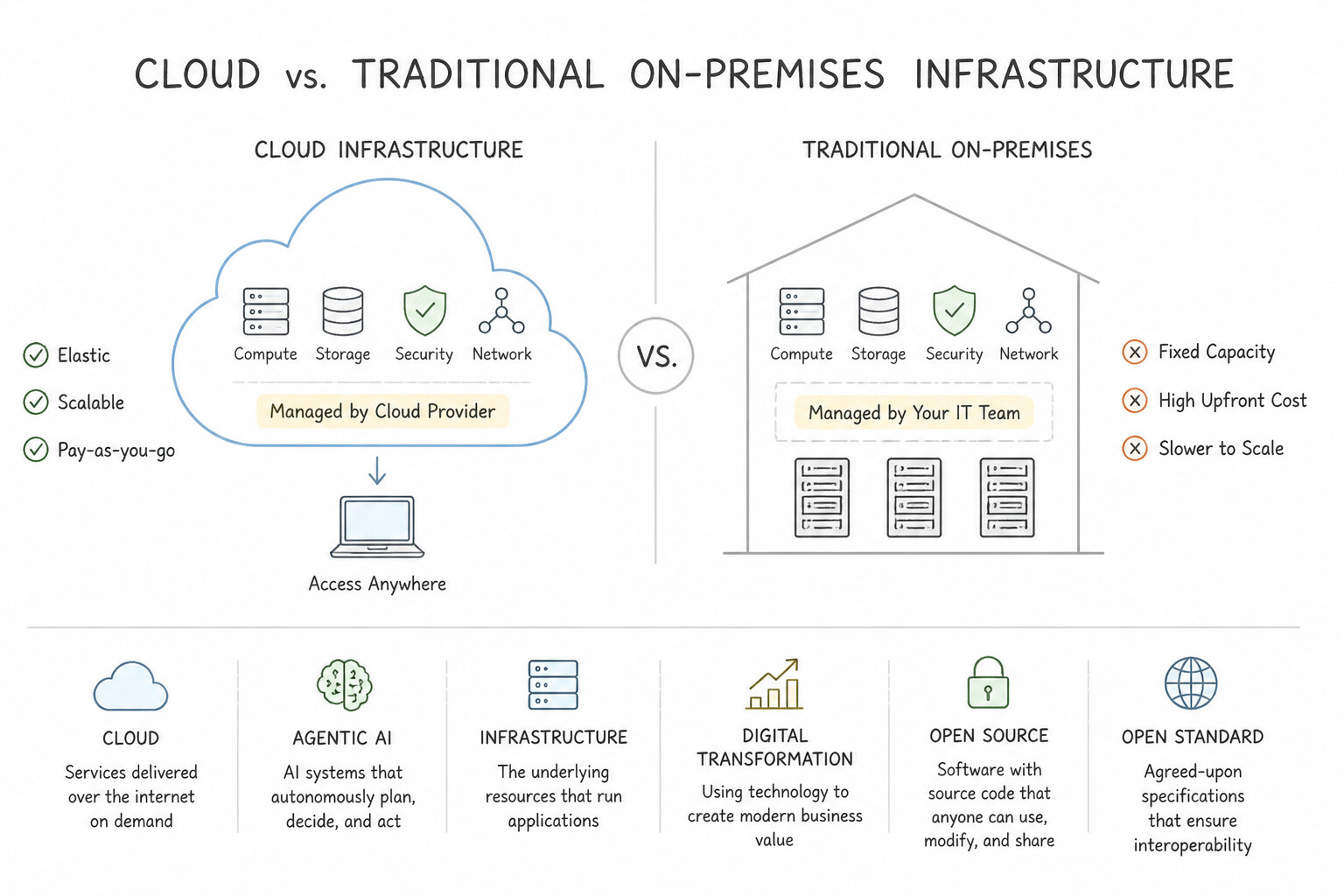
- Cloud vs. Traditional On-Premises Infrastructure:
Infrastructurerefers to the foundational physical and virtual hardware (servers, storage, networking) that runs software.Cloud computingdelivers this infrastructure, platform tooling, and software on-demand over the internet with pay-as-you-go pricing, removing the need to procure and maintain physical data centers. - Digital Transformation vs. Simple Migration:
Digital transformationis the strategic integration of cloud, data, and AI technologies into all areas of a business to fundamentally change how the organization operates and delivers value to customers—not merely moving legacy servers to a new hosting location. - Agentic AI vs. Traditional Predictive / Generative AI: While predictive ML forecasts numbers/labels and standard generative AI drafts content when prompted, Agentic AI combines foundation model reasoning with goal-oriented autonomy, multi-step planning, memory, and direct tool/API execution to complete complex business workflows end-to-end without step-by-step human intervention.
- Open Source vs. Open Standard: Open source refers to actual software implementations whose source code is publicly available to inspect, modify, and run anywhere (e.g., Linux, Kubernetes, Apache Spark, TensorFlow). An open standard is a publicly agreed-upon technical specification or protocol (e.g., HTTP, SQL, OpenAPI, W3C Trace Context) that allows independent systems and cloud vendors to interoperate seamlessly.
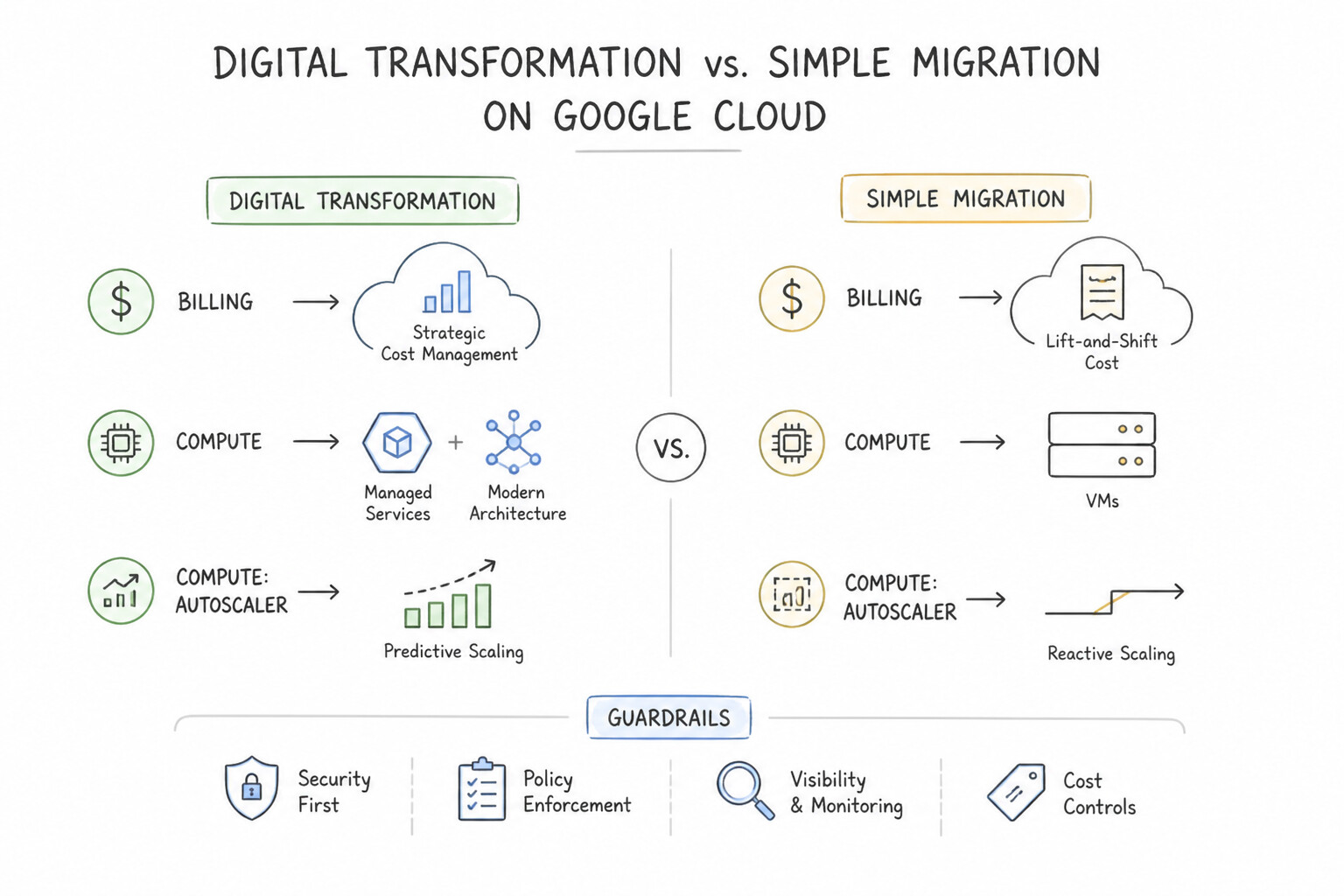
Key Implementation Patterns
- Retail Flash Sale Scalability: Use Use Google Cloud to shift from capital expenditure to operating expenditure. Cloud computing uses an Operating Expenditure (OpEx) model, allowing you to pay only for what you use without upfront hardware costs. (Avoid alternative: Purchasing servers is a Capital Expenditure (CapEx) requiring upfront money, which the startup lacks.)
- Capital Expenditure Reduction: Use Migrate your application to Google Cloud to leverage autoscaling capabilities that adjust capacity based on demand. Cloud autoscaling provides elasticity, allowing you to pay only for the resources you need when you need them. (Avoid alternative: Buying physical servers for peak load results in expensive, wasted capacity during normal traffic periods.)
- Rapid Product Experimentation: Use Provision virtual machines (VMs) in Google Cloud using on-demand self-service. Cloud computing allows for immediate self-service provisioning of resources, reducing wait times from weeks to minutes. (Avoid alternative: Expediting physical hardware still involves significant delays compared to cloud provisioning.)
Key Takeaways (1.1a)
- CapEx (Capital Expenditure) involves large upfront investments in physical infrastructure.
- OpEx (Operating Expenditure) involves ongoing, pay-as-you-go costs for services used.
- Cloud computing shifts IT spending from CapEx to OpEx, lowering the barrier to entry for startups.
- The OpEx model allows businesses to scale costs up or down based on actual usage.
Consideration 1.1b: Explain the benefits of cloud technology to a business' digital transformation (e.g., scalability, cost-effectiveness, agility, speed, flexibility, enhanced security, global reach and high availability, data-driven insights, strategic value and focus)
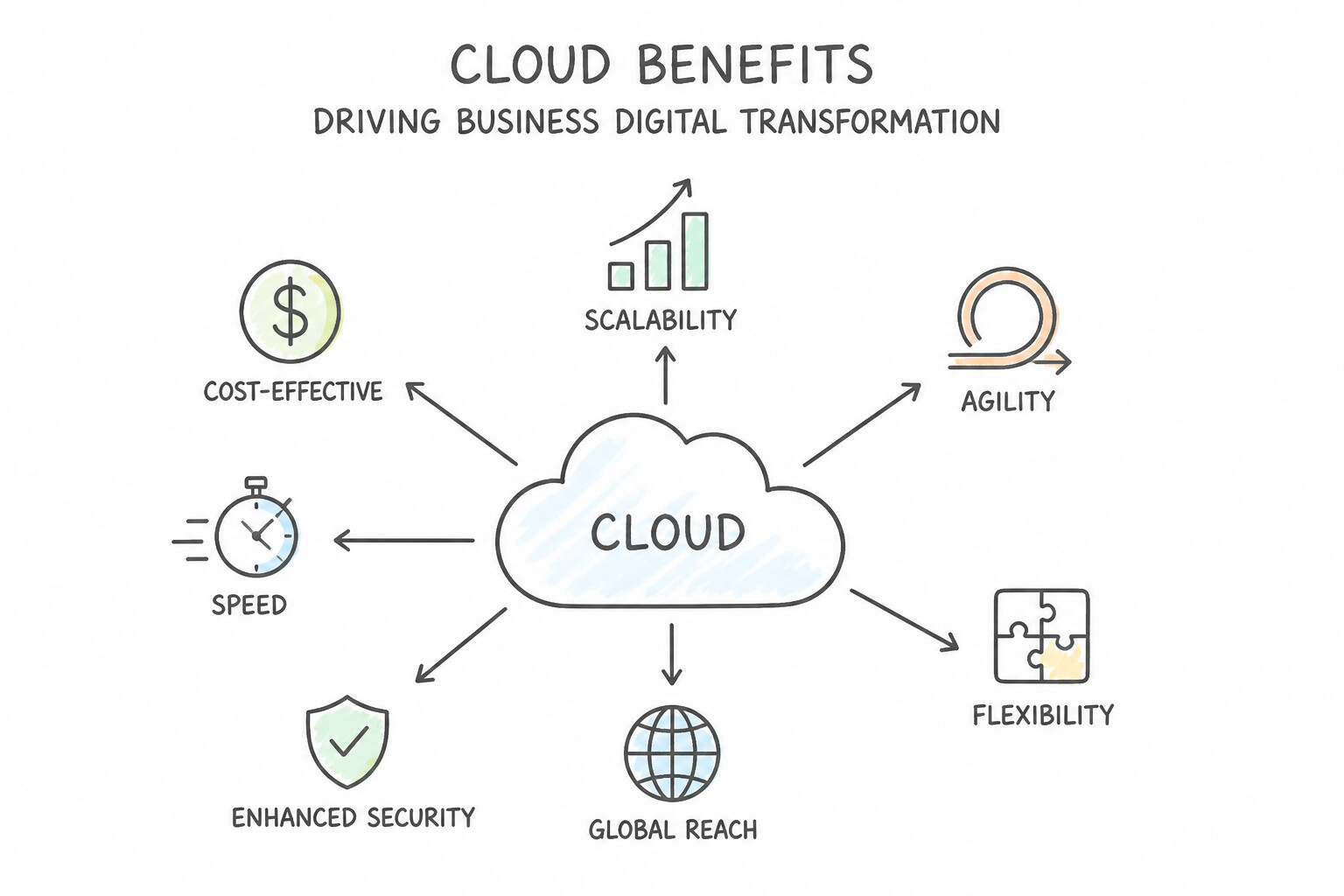
- Scalability vs. Elasticity: Scalability is the ability of a system to handle a growing total workload by adding capacity (vertical scale-up or horizontal scale-out). Elasticity is the automated, dynamic expansion and contraction of resources in real time to match spiky demand (e.g., scaling from 10 to 500 instances for a 4-hour flash sale and immediately back down to 10 so you never pay for idle servers).
- Agility, Speed, and Flexibility: Cloud reduces infrastructure provisioning from 6-month hardware procurement cycles to seconds, enabling rapid experimentation, fast fail-and-iterate cycles, and immediate time-to-market.
- Global Reach & High Availability: Instead of building overseas data centers, a startup can deploy applications across Google Cloud's global regions and zones in minutes, keeping applications online (
high availability) even if hardware or an entire zone fails. - Strategic Value & Focus: By offloading undifferentiated heavy lifting (hardware repairs, hypervisor patching, cooling, physical security) to Google Cloud, internal engineering teams refocus their talent on revenue-generating products and customer experience.
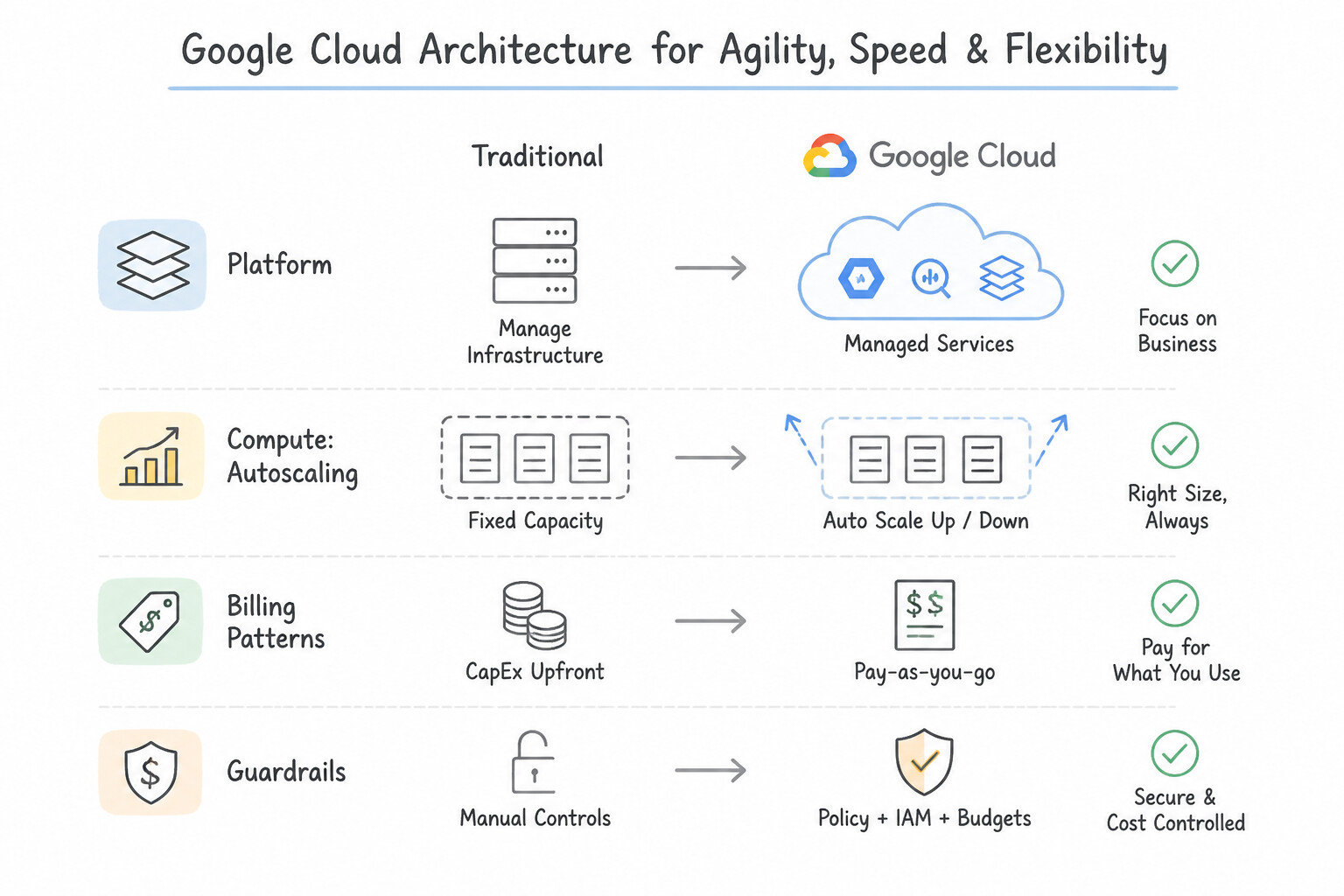
Key Implementation Patterns
- Customer Expectation and Agility as Transformation Drivers: Use Scalability. Scalability allows resources to automatically increase during high demand and decrease during low demand, optimizing costs. (Avoid alternative: Agility relates to the speed of innovation and development, not the automatic adjustment of infrastructure capacity.)
- Hybrid Cloud for Regulatory Compliance: Use Recommend utilizing cloud services to trade Capital Expenditure (CapEx) for Operational Expenditure (OpEx). Cloud computing shifts costs from upfront Capital Expenditure (CapEx) to variable Operational Expenditure (OpEx), removing the need to buy physical hardware.
- Capital Expenditure vs. Operational Expenditure Flexibility: Use Provision resources on Google Cloud to shift from capital expenditure to operational expenditure. Cloud computing enables a shift from upfront CapEx to variable OpEx, allowing you to pay only for what you use.
Key Takeaways (1.1b)
- Scalability allows systems to handle increased loads by adding resources.
- Elasticity is the automated aspect of scalability that adjusts resources up and down to match demand.
- On-premises infrastructure usually requires provisioning for peak capacity, which leads to wasted costs during off-peak times.
- Cloud computing enables a pay-as-you-go model, enhancing cost-effectiveness.
Consideration 1.1c: Describe the primary drivers that compel organizations to pursue digital transformation and the significant challenges they face (i.e., factors that motivate organizations to transform, common hurdles that can affect transformation, implications and risks of not adopting cloud)
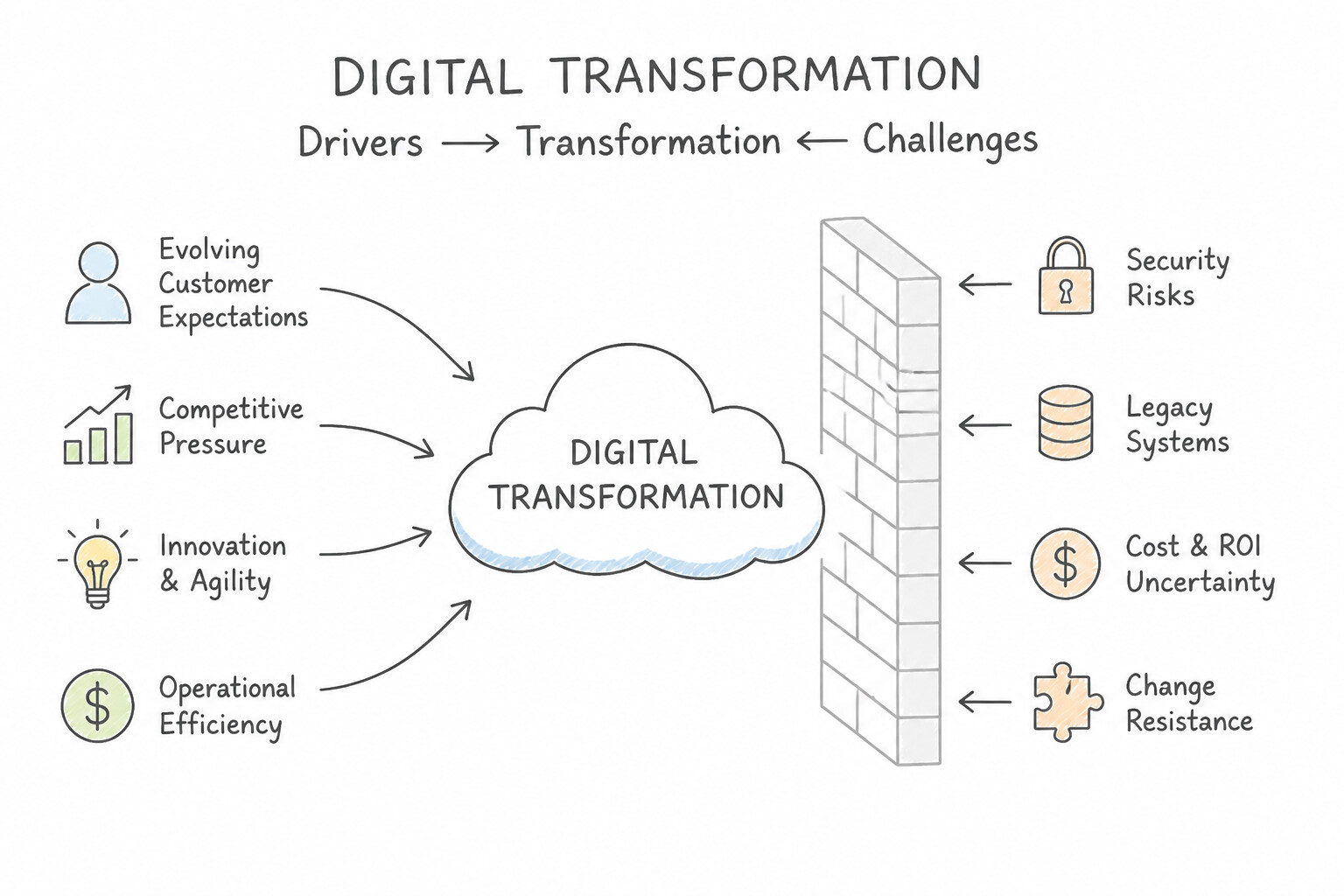
- Primary Drivers for Digital Transformation: Rising customer expectations for personalized real-time digital experiences, competitive pressure from cloud-native disruptors, supply chain agility, and the need to unlock siloed enterprise data for AI.
- Common Transformation Hurdles: Legacy technical debt (tightly coupled monolithic mainframes), organizational silos, cultural resistance to change ("we've always done it this way"), and cloud/AI skills gaps. Successful leaders address these through executive sponsorship, psychological safety, and upskilling across people, process, and technology.
- Risks & Implications of Not Adopting Cloud: Organizations that cling to static on-premises hardware face escalating maintenance costs (spending 80% of IT budget on legacy upkeep), severe security exposure from end-of-life (EOL) systems, inability to adopt modern generative/agentic AI, and gradual loss of market relevance.
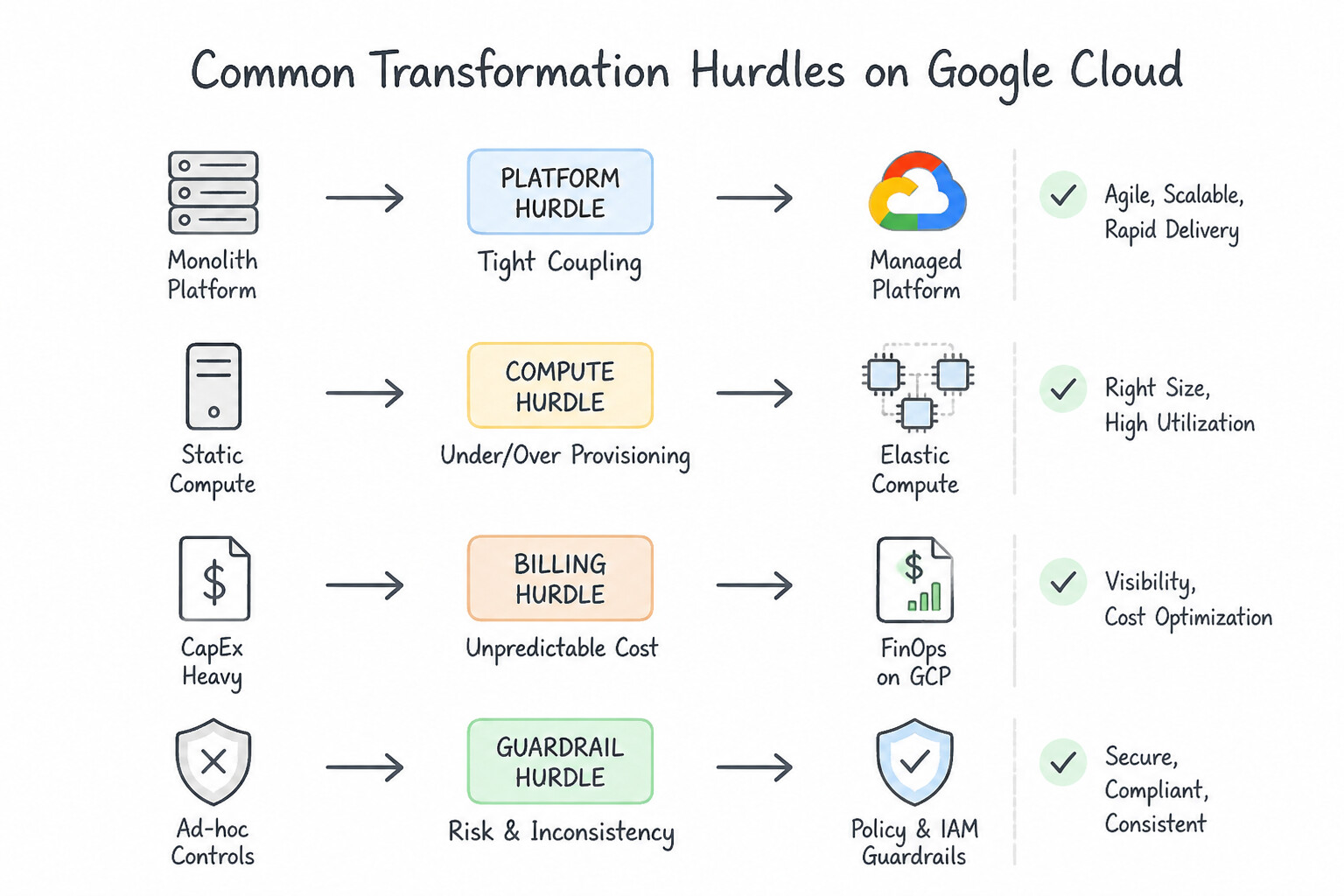
Key Implementation Patterns
- Competitive Disadvantage via Time-to-Market: Use Competitive disadvantage resulting from slow time-to-market. Long procurement cycles delay feature releases, allowing competitors to capture market share first. (Avoid alternative: The scenario focuses on deployment speed, not security vulnerabilities.)
- CapEx vs. OpEx Transformation: Use Adopt the Operating Expenditure (OpEx) model using cloud services. OpEx allows you to pay-as-you-go without upfront investment, ideal for startups with limited capital. (Avoid alternative: CapEx requires significant upfront payment for hardware, which the startup cannot afford.)
- Security Risks of Legacy Infrastructure: Use Increased security exposure due to manual operational toil. The reliance on manual patching (toil) led to a missed update and subsequent breach, highlighting the security risk of legacy operations. (Avoid alternative: CapEx relates to financial cost models, not the operational security failure described in the scenario.)
Key Takeaways (1.1c)
- Agility is a core benefit of the cloud, allowing businesses to provision resources in minutes rather than months.
- Time-to-market is the speed at which a company can deliver a product or feature to customers.
- Staying on-premises can create a competitive disadvantage if competitors innovate faster using cloud resources.
- Cloud technology shifts focus from infrastructure management (racking servers) to innovation (building apps).
Consideration 1.1d: Recognize some of Google Cloud's top differentiators (e.g., world-leading AI, deep commitment to openness and interoperability, AI Hypercomputer, AI-ready data platform, security, global network)
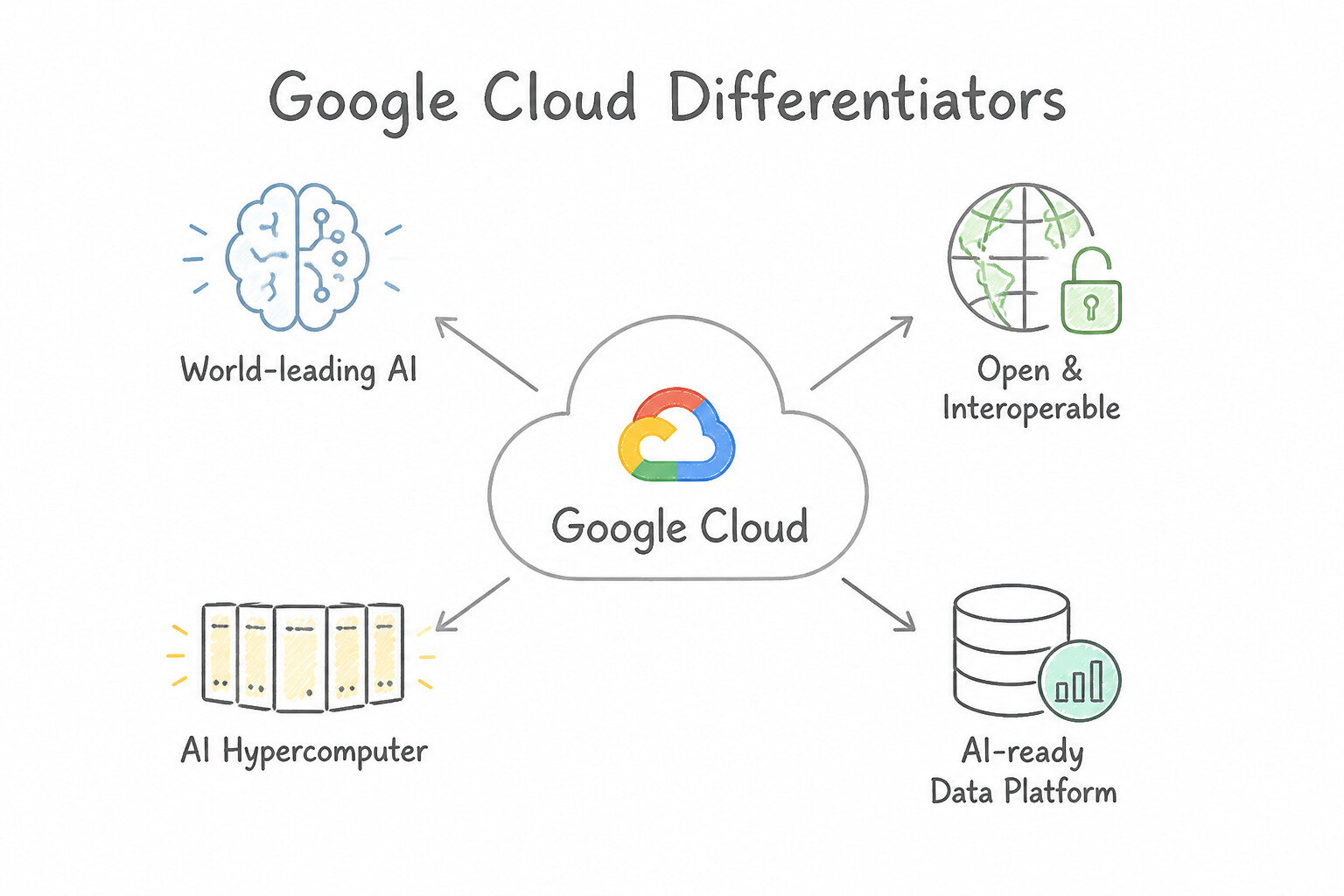
- World-Leading AI & AI-Ready Data Platform: Google invented the
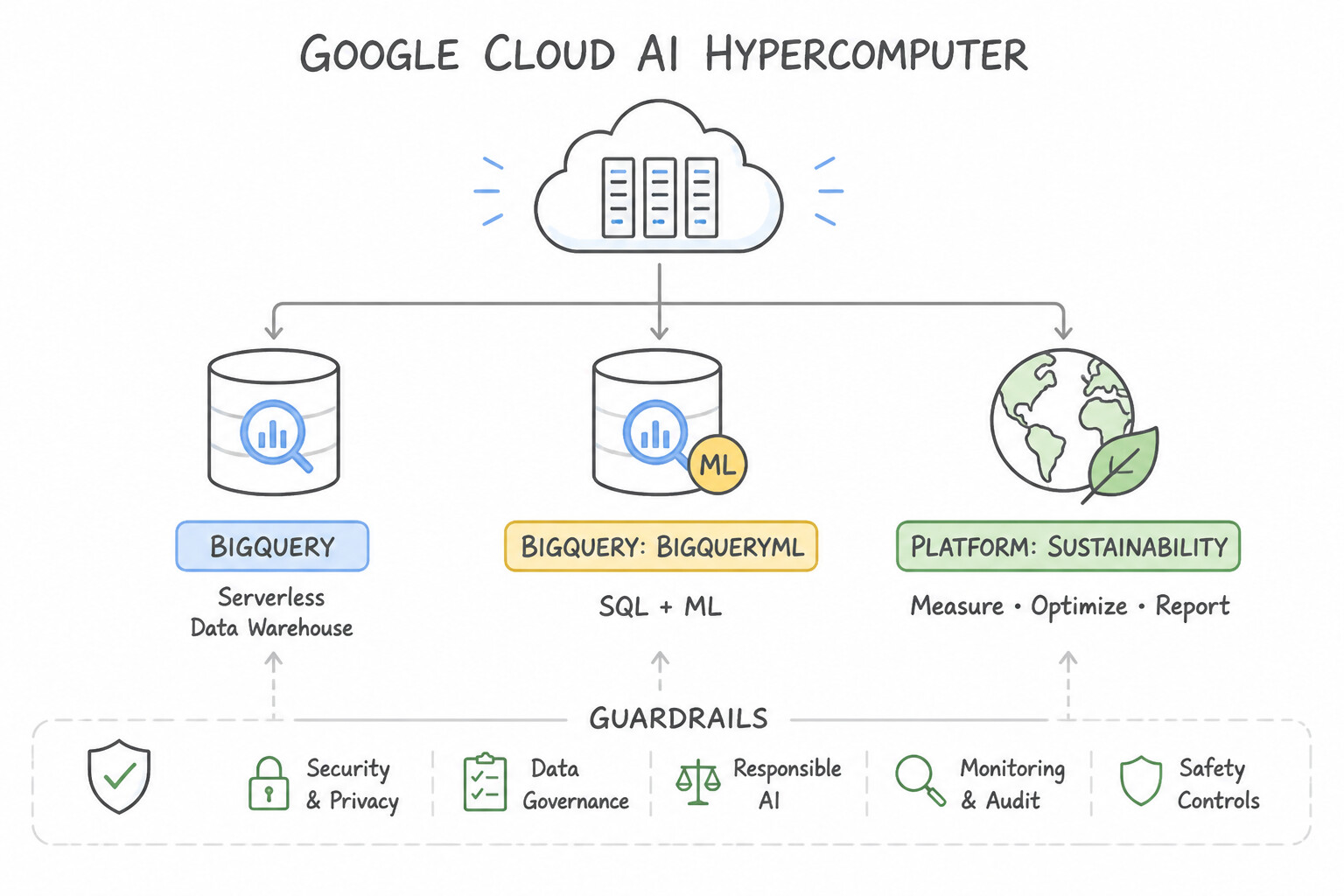
Transformerarchitecture and offers Gemini foundation models, Gemini Enterprise Agent Platform, and an AI-ready data platform (anchored by BigQuery) that connects structured and unstructured enterprise data directly to AI models without complex data movement. - The AI Hypercomputer: A purpose-built supercomputing system integrating performance-optimized hardware (Cloud TPUs and GPUs), open software frameworks (
PyTorch,JAX,Kubernetes), and flexible consumption models (Dynamic Workload Scheduler, Spot VMs, CUDs). - Deep Commitment to Openness & Interoperability: Google Cloud leads open-source ecosystems (
Kubernetes,Istio,Knative,Apache Beam) and multicloud tooling (GKE Enterprise, BigQuery Omni, AlloyDB Omni, Looker), giving enterprises freedom of choice without vendor lock-in. - Security by Design, Global Network, and Sustainability: Custom Titan security chips, default encryption at rest and in transit, the world's largest private subsea fiber-optic network, and 100% renewable energy matching with Carbon Footprint reporting tools.
Key Implementation Patterns
- Data-Driven Decision Making: Use Ingest the data into BigQuery and use BigQuery ML to build predictive models. BigQuery ML allows you to build machine learning models using standard SQL, enabling predictive analytics without a dedicated data science team. (Avoid alternative: Cloud Storage is for storage, not analysis or machine learning, and does not provide the predictive capabilities required.)
- 24/7 Carbon-Free Energy Goal: Use Operate on carbon-free energy 24 hours a day, 7 days a week. Google's specific goal for 2030 is to operate on carbon-free energy 24/7 in all data centers. (Avoid alternative: Google achieved 100% renewable energy matching in 2017, so this is not the 2030 target.)
- Carbon Footprint Dashboard Reporting: Use Use the Carbon Footprint dashboard in the Google Cloud console to view and export the emissions data. Carbon Footprint is the dedicated tool for visualizing and exporting Google Cloud emission data. (Avoid alternative: Manual calculation is unnecessary and complex because a built-in tool already exists.)
Key Takeaways (1.1d)
- Intelligence as a Benefit: Cloud transformation allows organizations to unlock value from data using managed services.
- BigQuery ML: Enables SQL users to build machine learning models without extensive data science knowledge.
- Managed vs. Manual: Prefer fully managed services (like BigQuery) over manual infrastructure (like VMs) when expertise is limited.
- Google has been carbon neutral since 2007.
Quick Decision Cheat Sheet (Subsection 1.1)
If the Scenario Requires... | Choose This Architecture / Concept | Avoid This Common Mistake |
|---|---|---|
"Autonomously plans multi-step workflows, reasons over state, and executes APIs without human prompts" | Agentic AI | Standard Generative AI chatbot or rule-based RPA scripts |
"Reimagining business processes and customer value using cloud, data, and AI" | Digital Transformation | Lift-and-shift server relocation ("IT infrastructure refresh") |
"Publicly available source code that can be inspected, modified, and run on any cloud" | Open Source (e.g., Kubernetes, TensorFlow, Apache Beam) | Proprietary vendor-locked SDKs |
"Agreed-upon technical specification enabling different platforms to exchange data seamlessly" | Open Standard | Proprietary file formats |
"Automatically expanding capacity during traffic spikes and shrinking to zero/baseline afterward" | Elasticity (paired with Cost-Effectiveness) | Over-provisioning static physical hardware for peak load |
"Co-designed hardware (TPUs/GPUs), open ML software stack, and flexible consumption models" | Google Cloud AI Hypercomputer | On-premises GPU clusters with fixed CapEx depreciation |
"Track and reduce the gross carbon emissions of cloud workloads by selecting low-carbon regions" | Google Cloud Carbon Footprint & Sustainability differentiators | Manually estimating power usage from data center utility bills |
Further Reading (Subsection 1.1)
- Google Cloud Overview - CapEx vs OpEx — Provides a fundamental overview of cloud computing benefits, specifically focusing on the financial shift from upfront infrastructure costs to variable operational expenses.
- What is Agentic AI? — Agentic AI refers to artificial intelligence systems designed to pursue complex goals over time with minimal human supervision. Unlike traditional AI that responds to specific prompts, agentic AI can plan, reason, and execute actions autonomously.
- Generative AI glossary — Defines AI agents as goal-oriented applications using reasoning, tools, and actions.
- What is digital transformation? | Google Cloud — Digital transformation is the integration of digital technology into all areas of a business, fundamentally changing how you operate and deliver value to customers.
- Overview of the Cloud Healthcare API — Overview of standards-conformant APIs for FHIR and DICOMweb healthcare data exchange.
- What is multicloud? — Explains portability across clouds and avoiding vendor lock-in with open technologies.
Subsection 1.2: Describe fundamental cloud concepts
The Big Picture
When organizations design their cloud foundation, two strategic miscalculations frequently derail their Total Cost of Ownership (TCO) and operational velocity:
- The Service Model Mismatch (1.2d): A small startup with three web developers chooses Infrastructure as a Service (IaaS) virtual machines instead of Platform as a Service (PaaS). Within months, they spend 60% of their engineering hours patching Linux kernels, configuring OS firewalls, and manually tuning auto-scalers instead of shipping product features. Conversely, an enterprise with a legacy banking application requiring custom kernel drivers tries to force it into a rigid PaaS runtime and hits a wall.
- The Geographic & Network Topology Blind Spot (
1.2a,1.2b,1.2c): A team deploys a mission-critical database in a single Zone thinking "the cloud never goes down," only to suffer an outage during a zonal maintenance event because they confused a Zone (a single fault domain within a data center cluster) with a Region (multiple independent zones connected by high-speed fiber) or Edge Locations (caching content close to end users to minimize latency).
Consideration 1.2a: Identify the corresponding business use case and benefits of various cloud architectures (e.g., private cloud, hybrid cloud, multicloud)
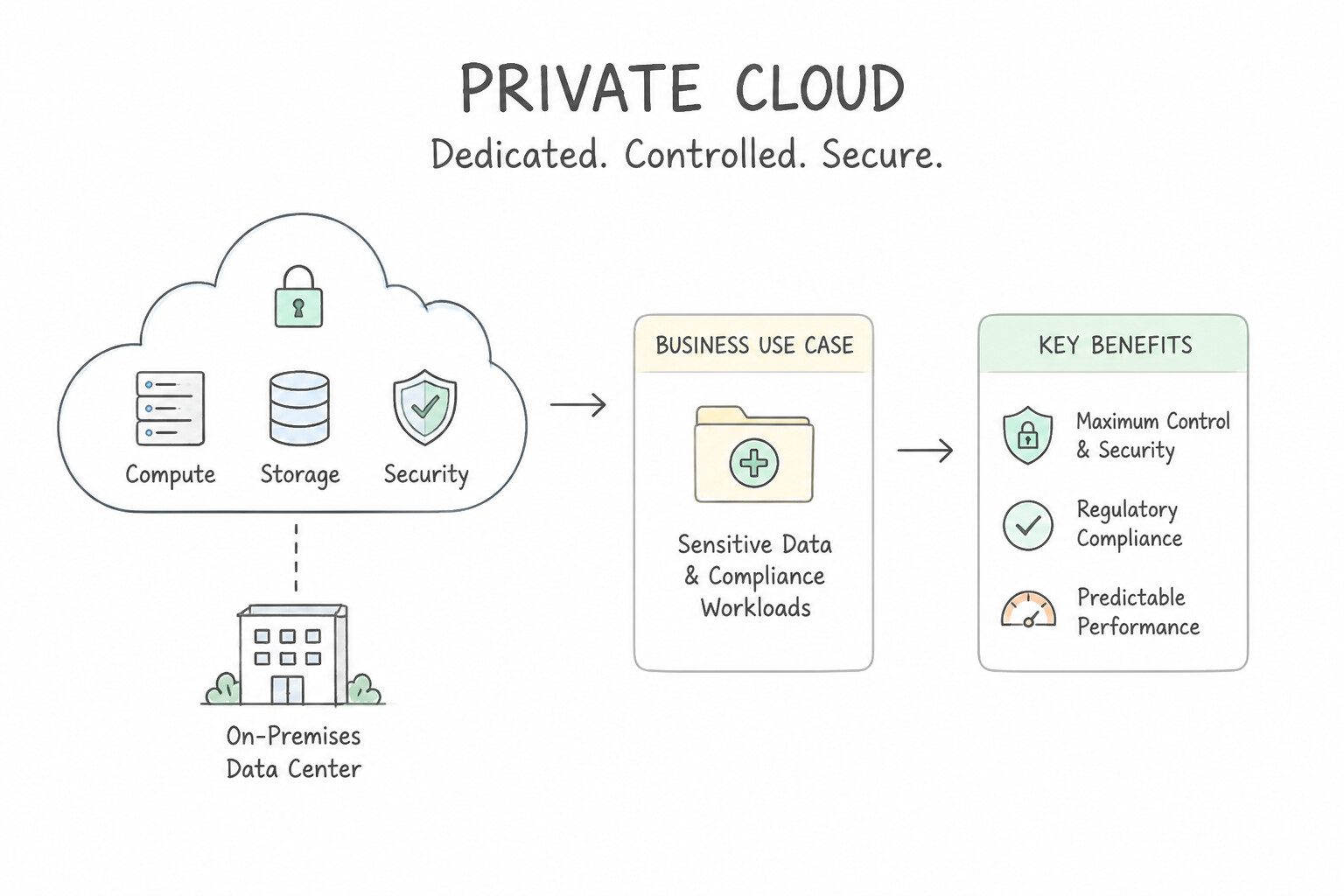
- Private Cloud: Infrastructure dedicated exclusively to a single organization (typically on-premises). Chosen only when strict physical data residency or specialized hardware laws forbid public cloud tenancy; carries high CapEx and limited elasticity.
- Public Cloud: Compute, storage, and AI services delivered over the internet by a cloud provider (Google Cloud) on shared, multi-tenant infrastructure with elastic OpEx pricing.
- Hybrid Cloud: Bridges an organization's private/on-premises infrastructure with Google Cloud (using Cloud VPN, Cloud Interconnect, and GKE Enterprise). Ideal for gradual step-by-step migration, cloud bursting (handling seasonal traffic spikes in Google Cloud while baseline runs on-prem), or keeping ultra-low-latency factory/hospital workloads local while running analytics in the cloud.
- Multicloud: Intentionally running workloads across two or more public cloud providers (e.g., Google Cloud + AWS or Azure). Chosen to leverage best-of-breed capabilities (such as Google Cloud's BigQuery and Vertex AI alongside existing AWS/Azure workloads), satisfy multi-vendor resilience mandates, and avoid single-vendor lock-in.
Key Implementation Patterns
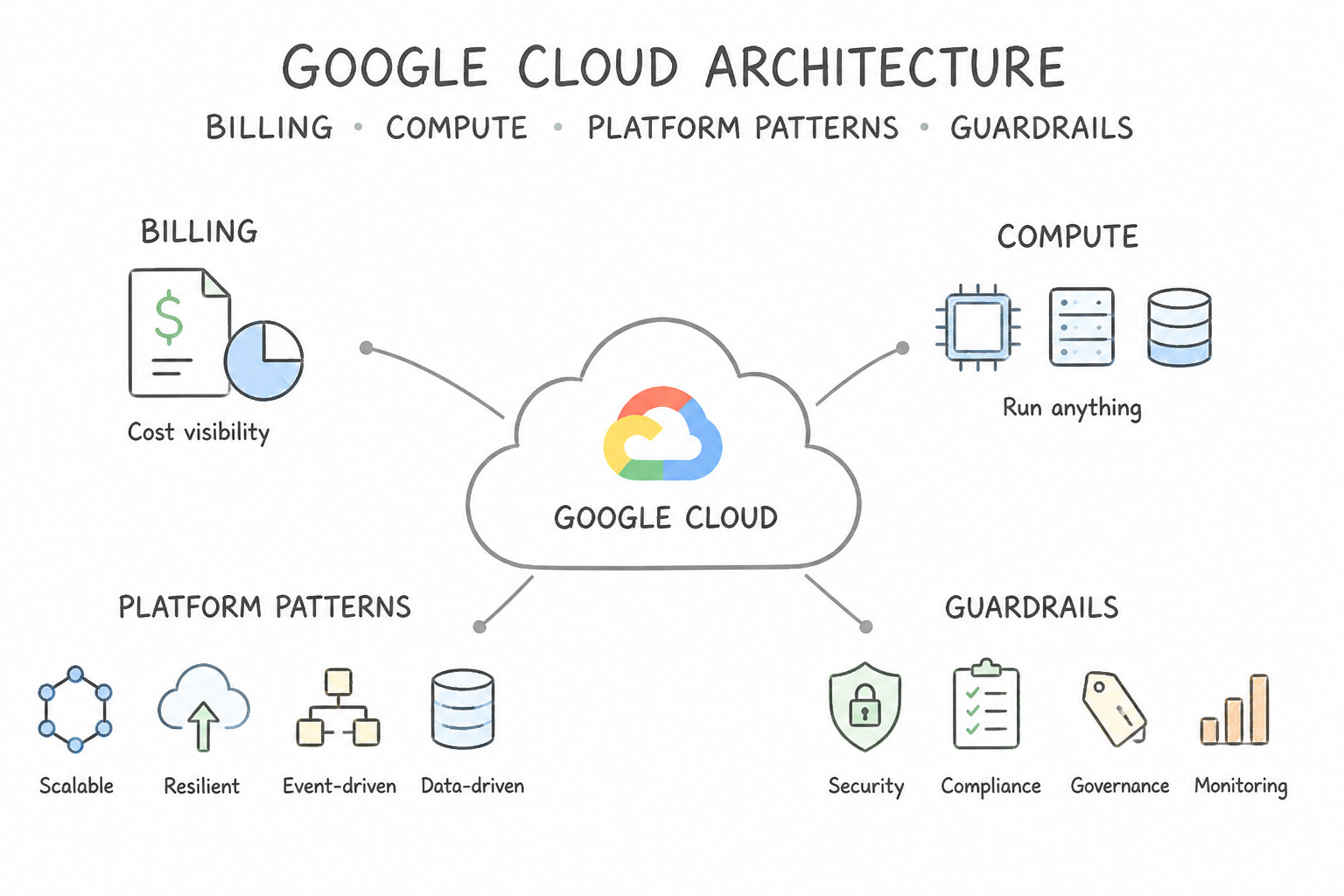
- Openness and Avoiding Vendor Lock-In: Use Adopt a public cloud strategy to leverage an operational expenditure (OpEx) model. Public cloud uses an OpEx model (pay-as-you-go), eliminating the need for upfront hardware costs. (Avoid alternative: On-premises requires buying hardware upfront (CapEx), which violates the constraint of limited funds.)
- High Availability with Multi-Zone Deployment: Use Implement a hybrid cloud architecture. Hybrid cloud combines on-premises security for compliance with public cloud resources for advanced capabilities like AI. (Avoid alternative: Moving everything to the public cloud violates the strict data residency regulations requiring data to stay on-premises.)
- AI Hypercomputer Architecture: Use Implement a hybrid cloud model to connect your on-premises infrastructure with Google Cloud. Hybrid cloud connects on-premises infrastructure with public cloud services, meeting both compliance and analytics needs. (Avoid alternative: A full public cloud model moves all data off-premises, which violates the stated legal requirements.)
Key Takeaways (1.2a)
- CapEx (Capital Expenditure): Upfront spending on physical assets (hardware, buildings). Common in on-premises models.
- OpEx (Operational Expenditure): Day-to-day spending on services. Common in public cloud models (pay-as-you-go).
- Startups often prefer Public Cloud to avoid heavy upfront investments and gain financial flexibility.
- Hybrid Cloud is the standard solution for balancing compliance (data residency) with innovation (cloud services).
Consideration 1.2b: Define fundamental networking concepts and describe how Google Cloud's global network infrastructure supports digital transformation (e.g., IP address, domain name service (DNS), basic IP addresses, latency, bandwidth)
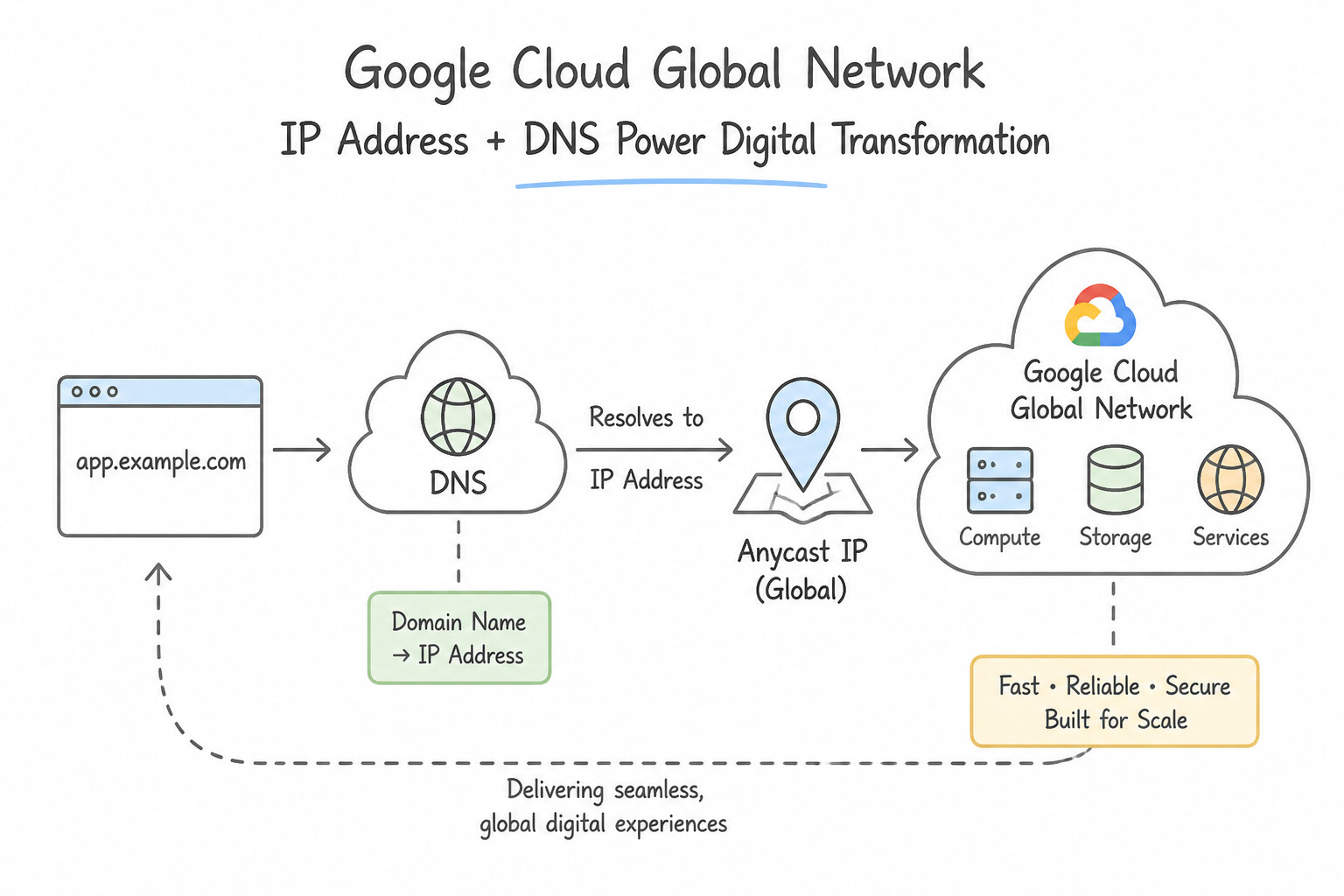
- IP Address (Internal vs. External): A unique numerical identifier assigned to every network interface so devices can locate and communicate with each other (private/internal IPs within a VPC; public/external IPs across the internet).
- Domain Name System (DNS / Cloud DNS): The "phonebook of the internet" that translates human-friendly domain names (
www.example.com) into machine-routable numerical IP addresses (34.102.136.180). - Latency vs. Bandwidth: Latency is the time delay (measured in milliseconds,
ms) for a packet to travel from source to destination. Bandwidth is the maximum data transfer capacity (measured inGbpsorMbps) of a network pipe over a given time. High bandwidth does not automatically fix high latency if the server is on the wrong continent! - How Google's Global Fiber Network Supports Transformation: Unlike providers that bounce customer traffic across the congested public internet ("hot-potato routing"), Google Cloud carries traffic across its own private, software-defined subsea and terrestrial fiber-optic backbone—delivering lower latency, higher throughput, and stronger security worldwide.
Key Implementation Patterns
- Data Residency and Compliance: Use Deploy the database resources in a Google Cloud region located geographically within the European Union. Selecting a specific region ensures data is stored physically within that geographic area, satisfying residency laws. (Avoid alternative: Multi-Region replication involving the US moves data outside the EU, violating the compliance requirement.)
- High Availability Design: Use Deploy the application resources across multiple zones within the same region. Zones are isolated failure domains within a region; spreading resources across zones protects against facility-level failures. (Avoid alternative: Multi-region architectures protect against regional disasters, which is overkill for a single facility failure scenario.)
- Replacing Internal Communication Systems: Use The IT staff will stop managing server hardware and software updates, focusing instead on user management and configuration. Google Workspace is SaaS, meaning Google handles all infrastructure and patching while staff manages configuration.
Key Takeaways (1.2b)
- Regions define location: Selecting a Google Cloud Region determines the physical location where your data is stored.
- Compliance drives architecture: Legal requirements like data residency often dictate infrastructure choices (e.g., prohibiting Multi-Region replication if it crosses borders).
- Encryption is not location: Encrypting data does not satisfy laws requiring data to physically reside in a specific geography.
- Zones represent isolated failure domains within a Region (e.g., separate data centers).
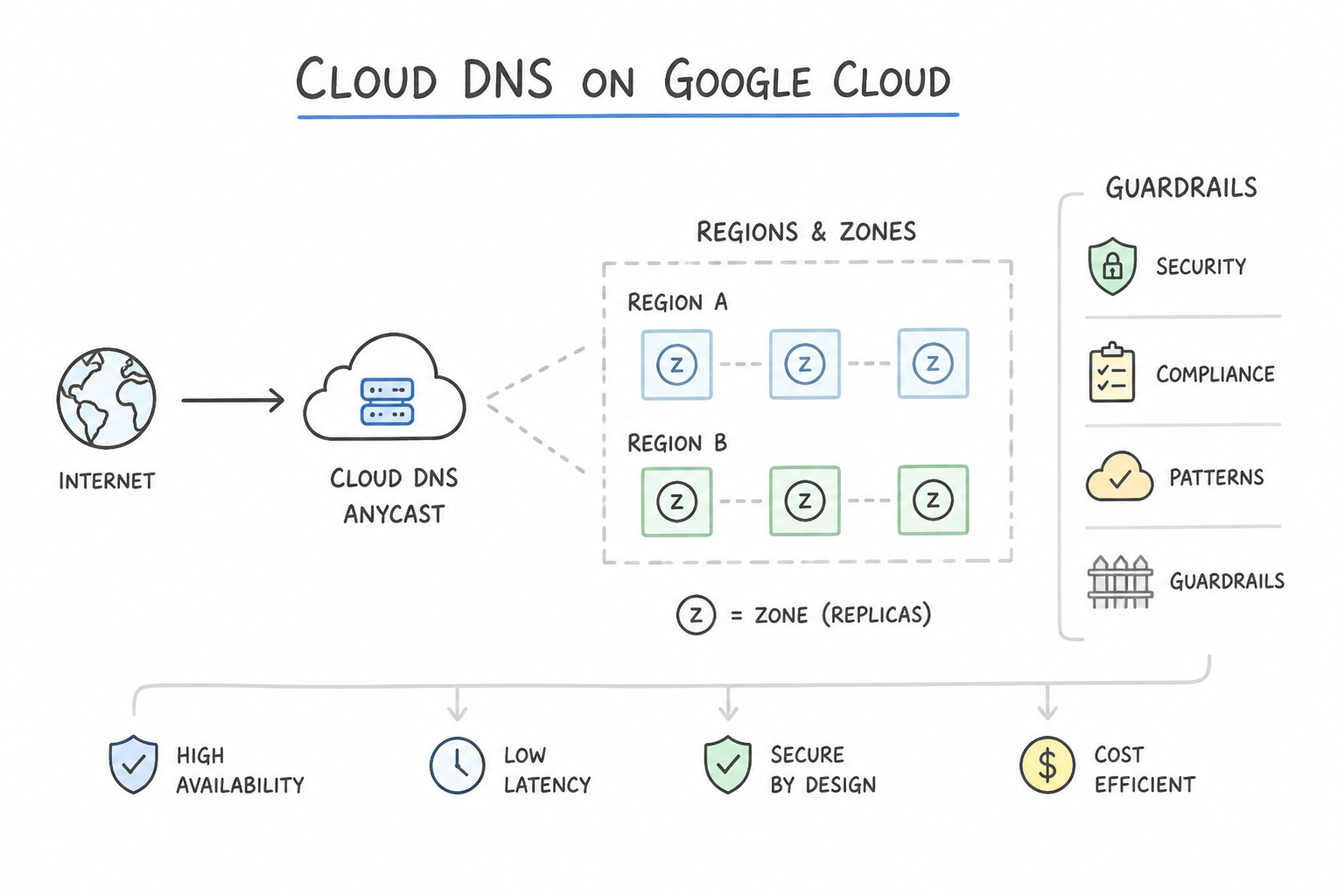
Consideration 1.2c: Describe the components of Google Cloud's network and explain how they work together (e.g., regions, zones, edge locations)
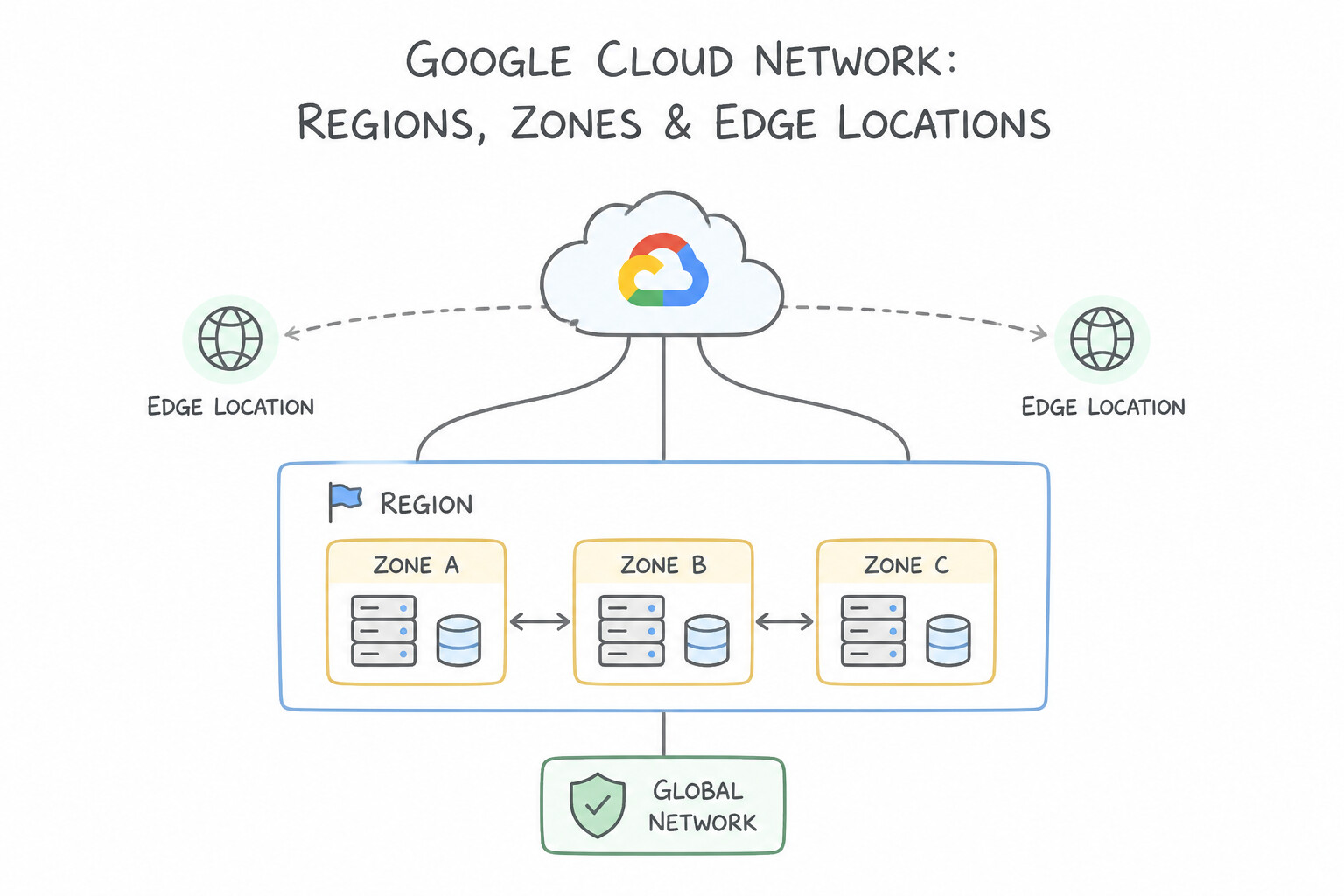
- Zones (Fault Domains): A Zone (e.g.,
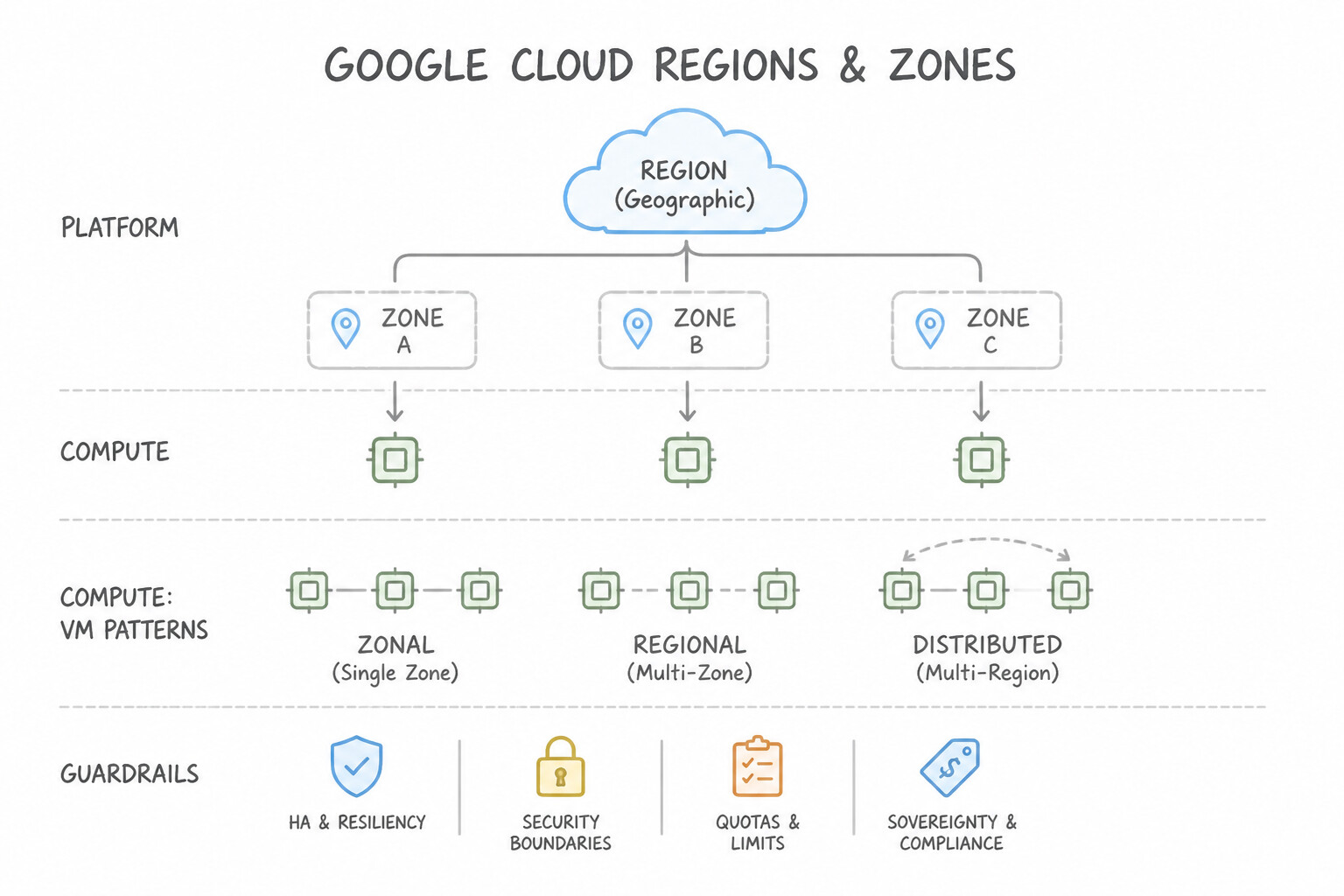
europe-west1-b) is an isolated deployment area within a region that has independent power, cooling, and networking. If a single zone experiences a power or hardware failure, other zones in the same region remain unaffected. - Regions (Geographic Collections of Zones): A Region (e.g.,
europe-west1in Belgium) is an independent geographic location composed of three or more zones connected by ultra-low-latency fiber. Deploying an application across multiple zones within a region protects against zonal outages; deploying across multiple regions protects against large-scale regional disasters and satisfies country-level data residency laws. - Edge Locations (Points of Presence / Cloud CDN): Distributed network entry points located in major cities worldwide. Edge locations cache static content (images, video streams, web assets) close to end users so requests are served in milliseconds without traversing back to the origin region.
Key Implementation Patterns
- OS Customization vs Management Overhead: Use Deploy the application resources across multiple zones within the 'us-central1' region. Zones are isolated locations within a region that provide fault tolerance against single data center failures. (Avoid alternative: A single zone represents a single point of failure for physical infrastructure issues, regardless of subnet configuration.)
- Developer Speed with Managed Runtimes: Use Deploy the game servers in a Google Cloud region located in Japan. Moving resources physically closer to users reduces network latency. (Avoid alternative: Bandwidth determines capacity, not the speed of travel across a distance.)
- Data Residency and Legal Compliance: Use Adopt a multicloud strategy by utilizing services from two or more public cloud providers. Multicloud involves using multiple public cloud providers, which prevents reliance on a single vendor and reduces lock-in risks. (Avoid alternative: Private cloud uses only internal infrastructure and does not leverage public cloud services or address the goal of using multiple external providers.)
Key Takeaways (1.2c)
- Regions are large geographic areas composed of multiple Zones.
- Zones are isolated failure domains within a Region (independent power/cooling).
- To survive a single data center failure, deploy resources across multiple Zones.
- To survive a total regional disaster (like a flood), deploy resources across multiple Regions.
Consideration 1.2d: Describe the benefits and tradeoffs of different cloud service models: Infrastructure as a Service (IaaS), Platform as a Service (PaaS), and Software as a Service (SaaS)
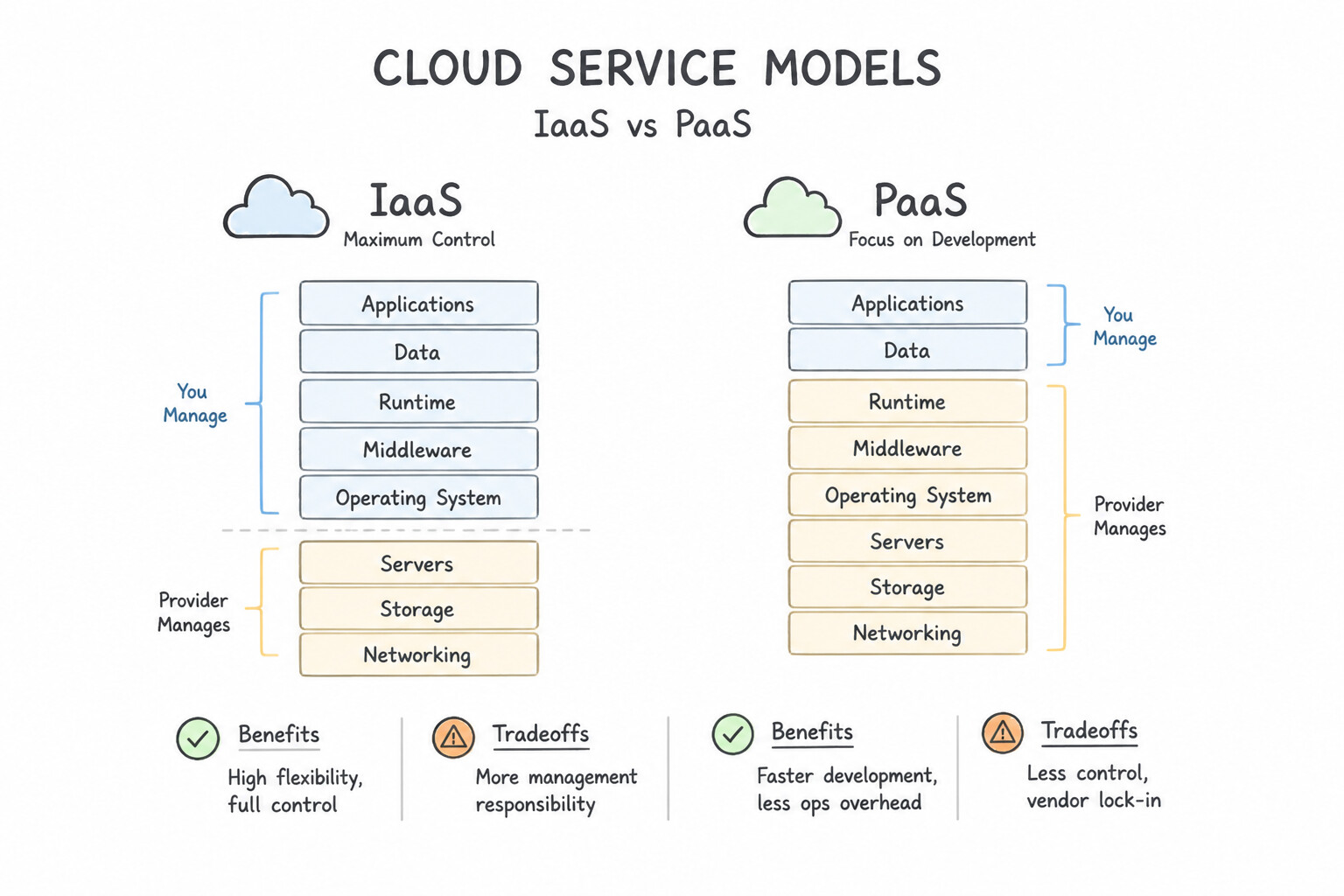
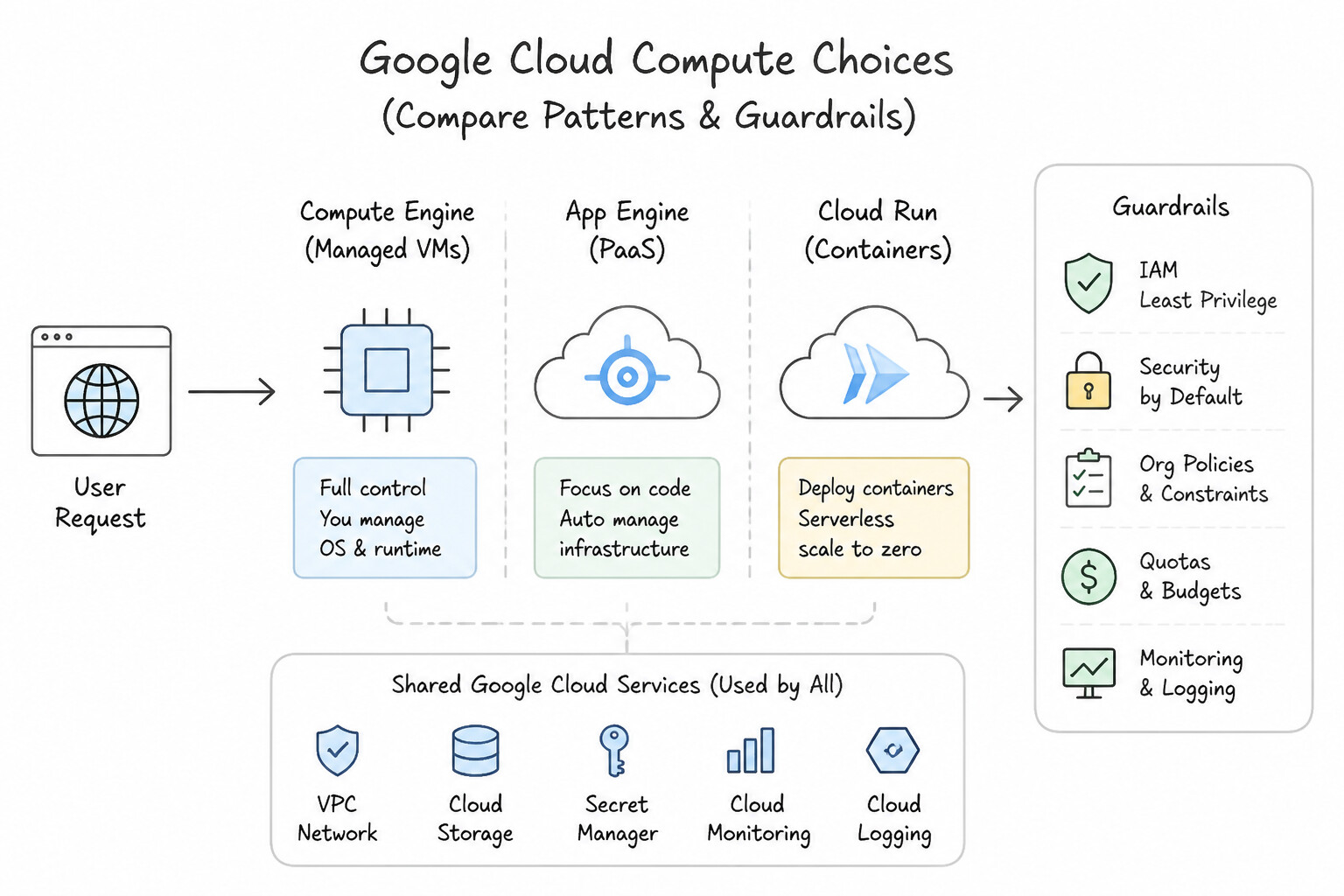
- Infrastructure as a Service (IaaS — e.g., Compute Engine): Google manages physical data centers, servers, storage disks, and virtualization. The customer manages the Operating System (OS patches), middleware, runtime, application code, and data. Best for lift-and-shift (
rehost) migrations and workloads requiring custom OS/kernel configurations. - Platform as a Service (PaaS — e.g., App Engine, Cloud Run): Google manages the hardware, virtualization, OS, and runtime scaling. The customer focuses strictly on writing application code and managing data/access. Best for accelerating developer velocity and minimizing operational overhead.
- Software as a Service (SaaS — e.g., Google Workspace, Gmail, Docs): Google manages the entire technology stack end-to-end (hardware, OS, runtime, and application software). The customer is still responsible for configuring user access (IAM) and securing how their data is shared. Best for standardized business productivity tools with minimal IT staffing.
Key Implementation Patterns
- Legacy Application Migration: Use Infrastructure as a Service (IaaS). IaaS provides raw compute resources (virtual machines) where you manage the operating system and software stack, making it ideal for legacy apps requiring custom configurations. (Avoid alternative: PaaS abstracts the operating system management, preventing the installation of specific OS versions or custom kernel configurations required by the scenario.)
- Legacy Application Migration (Lift and Shift): Use Select Infrastructure as a Service (IaaS) and deploy the application on a virtual machine (VM). IaaS provides full control over the operating system, allowing custom kernel configurations and specific OS versions required by legacy applications.
- Legacy Application Migration requiring OS Control: Use Select Infrastructure as a Service (IaaS). IaaS provides full control over the operating system, allowing custom configurations and manual patching. (Avoid alternative: PaaS abstracts the operating system, preventing the installation of custom OS versions or kernel modifications.)
Key Takeaways (1.2d)
- IaaS provides the most control, allowing you to manage the Operating System, kernel, and installed software.
- PaaS abstracts the OS, making it suitable for modern code but difficult for legacy apps with specific OS dependencies.
- SaaS is for consuming finished software, not building or migrating custom apps.
- Legacy migrations requiring 'lift and shift' of specific environments usually map to IaaS.
Quick Decision Cheat Sheet (Subsection 1.2)
If the Scenario Requires... | Choose This Architecture / Concept | Avoid This Common Mistake |
|---|---|---|
"Keep sensitive legacy systems in a company-owned data center while using Google Cloud for elastic bursts" | Hybrid Cloud | Multicloud or Pure Public Cloud |
"Run workloads across Google Cloud and AWS/Azure simultaneously to use best-of-breed services and avoid lock-in" | Multicloud | Hybrid Cloud (which requires a private/on-prem component) |
"Translate human-readable domain names ( example.com) into numerical IP addresses" | DNS (Cloud DNS) | Cloud CDN or Cloud Load Balancing |
"Reduce the time delay ( ms) for global users downloading static web assets and video streams" | Edge Locations / Cloud CDN (minimizes Latency) | Adding more RAM to the origin VM |
"Protect an application against a hardware or power failure inside a single data center facility" | Deploy across multiple Zones within a Region | Deploying multiple VMs inside the exact same Zone |
"Maximum control over the Operating System (OS), custom kernel modules, and lift-and-shift VMs" | IaaS ( Compute Engine) | PaaS ( App Engine) or SaaS (Google Workspace) |
"Developers want to focus 100% on writing application code while Google manages OS patching and scaling" | PaaS ( App Engine / Cloud Run) | IaaS ( Compute Engine) |
"Turnkey email, calendar, and document collaboration with zero application development" | SaaS ( Google Workspace) — customer still manages user access & data sharing | Building a custom collaboration portal on GKE |
Further Reading (Subsection 1.2)
- Google Cloud Pricing Philosophy — Overview of Google Cloud's pay-as-you-go pricing model which supports OpEx strategies.
- CapEx vs OpEx in Cloud Computing — General overview explaining why businesses move to the cloud to reduce upfront infrastructure costs.
- Google Cloud Connectivity — Overview of Google Cloud's hybrid capabilities, explaining how they enable consistency across on-premises and cloud environments.
- What is Hybrid Cloud? — A fundamental definition page that explains the benefits and use cases of hybrid cloud architectures, specifically mentioning compliance and legacy application modernization.
- Google Cloud Geography and Regions — This page explains the concept of Regions and Zones and lists the available locations globally.
- Data Residency and Sovereignty — Overview of how Google Cloud helps organizations meet data residency requirements through region selection and policy controls.
Book TOC · Previous · Chapter 1 of 7 · Next
AwesomeGCP.com Learning
The approach taken is a question-led learning approach: you explore realistic project scenarios where you need to make decisions or take actions to achieve business goals within specific constraints. Instead of passive learning, you are challenged to think and work through the options to master the Cloud Digital Leader (CDL) certification!